Saint Rose of Viterbo

A childhood marked by early, intense devotion
Rose was born around 1233 in Viterbo, a city in central Italy that, in the 13th century, sat at the heart of repeated political and military conflicts between the papacy and the Holy Roman Empire. Her family was of modest means, and from a young age, according to the accounts gathered for her later canonization, Rose displayed an unusually intense personal piety — extended periods of prayer, a strong devotion to the recently deceased Saint Francis of Assisi (who had died in 1226, only a handful of years before Rose's birth), and a reported vision at around age eight or nine that deepened her sense of religious purpose.
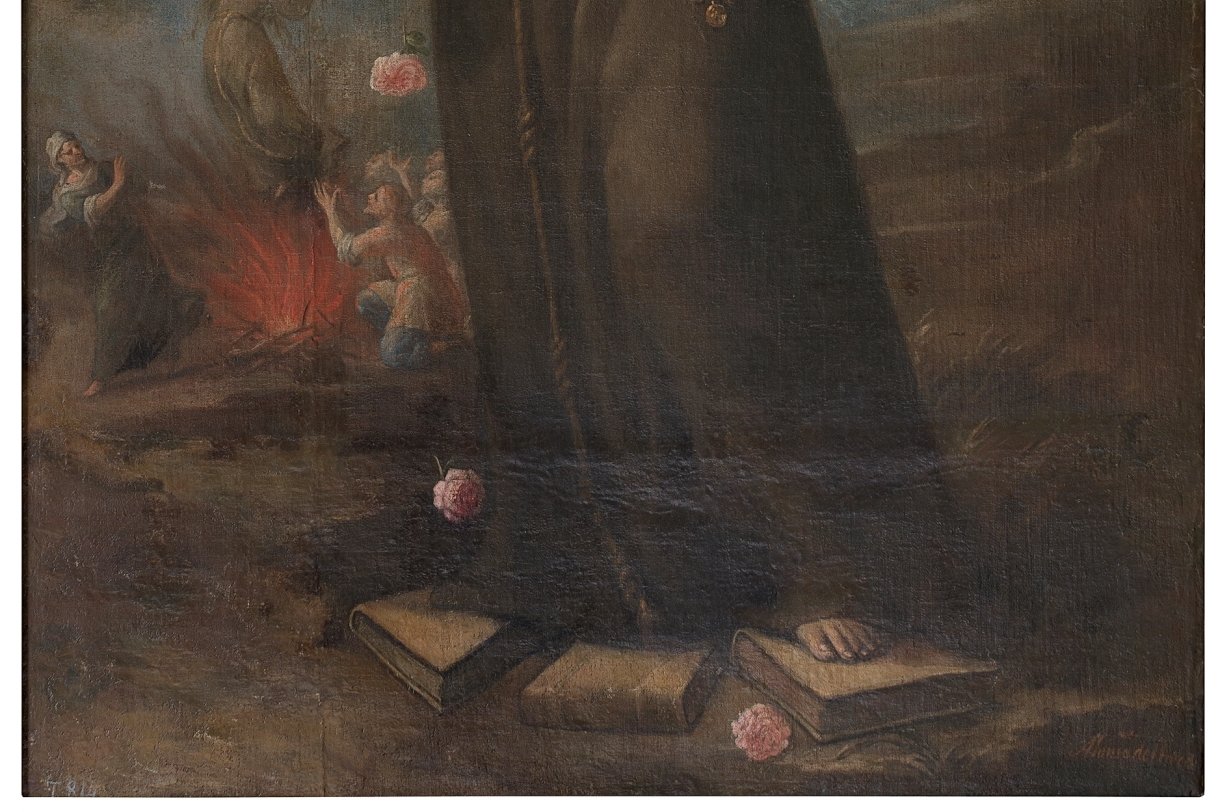
Alonso del Arco, Santa Rosa de Viterbo, late 17th century, Museo del Prado — public domain.
She became a Franciscan tertiary, meaning she formally committed to a rule of life shaped by Franciscan spirituality — simplicity, penance, prayer, and active charity — while remaining a laywoman living at home with her family rather than entering a convent, a path available to devout men and women who wanted to live a religious life without taking the formal vows of a nun or friar. This lay Franciscan path, known as the Third Order, had grown rapidly in Italy in the decades since Francis's death, and Rose became one of its more notable early adherents.
A city caught between empire and papacy
Rose's short life unfolded against the backdrop of one of the most severe conflicts of the medieval papal-imperial struggle. Emperor Frederick II, ruler of the Holy Roman Empire and a figure of enormous political and intellectual ambition, had been locked for years in a bitter contest with successive popes over authority in Italy, and Pope Gregory IX had formally excommunicated him in 1239. Viterbo itself became a contested city during this period, at various points controlled by pro-papal and pro-imperial factions, and by the time Rose reached her early teens, the city had fallen under the control of a faction loyal to the excommunicated emperor.
A twelve-year-old preacher
Around 1245 or 1246, when she was roughly twelve years old, Rose began preaching publicly in the streets of Viterbo, urging the city's residents to reject Frederick II's authority and return their loyalty to the papacy — an extraordinarily bold act for anyone in that political climate, let alone a child with no formal standing or authority to speak on such matters. Her preaching reportedly drew real public attention and stirred anti-imperial sentiment within the city, enough that Viterbo's pro-imperial civic authorities considered her a genuine political threat rather than dismissing her as a harmless curiosity.
The authorities' response was to banish Rose and her family from Viterbo entirely, forcing them into exile in the nearby town of Soriano nel Cimino. Rose continued her preaching and devotional activity even in exile, and tradition holds she also attempted, unsuccessfully, to preach in the city of Vetralla during this period, provoking hostility there as well. She and her family remained in exile until Frederick II's death in December 1250 shifted the political balance in Viterbo back toward the papacy, finally allowing them to return home.
Rejection from religious life, and death at eighteen
Once back in Viterbo, Rose reportedly sought formal admission to a local convent of Poor Clares, the women's Franciscan order founded by Saint Clare of Assisi. She was turned away, most accounts suggest because the convent judged it could not take on responsibility for supporting her financially, given her family's continuing poverty — a mundane, practical reason rather than any judgment against her character or vocation, though it meant Rose would live out her entire short life as a laywoman rather than as a professed nun, despite her clear desire for that path.
Rose died in Viterbo in 1251, at eighteen years old, not long after her return from exile. The cause of her death isn't clearly documented in the surviving sources, consistent with the generally sparse historical record typical of a laywoman of modest means in 13th-century Italy, however remarkable her public actions as a young teenager had been.
Canonization
Devotion to Rose grew steadily in Viterbo in the centuries following her death, and she was formally canonized by Pope Callixtus III in 1457 — more than two centuries after her death, reflecting the often lengthy timelines of medieval canonization processes. Her body is preserved and venerated today in the Monastery of Santa Rosa in Viterbo, and the city continues to hold an annual procession in her honor, the Transport of the Macchina di Santa Rosa, recognized by UNESCO as part of the Intangible Cultural Heritage of Humanity.
Feast day
Saint Rose of Viterbo's feast is celebrated on September 4.
Related reading
Rose's short life as a lay Franciscan tertiary caught up in the political struggles of her era sits alongside other young medieval saints known for unusually early, intense religious conviction — readers may also want to read about Saint Clare of Assisi, founder of the Poor Clares order Rose sought and failed to join, or Saint Francis of Assisi, whose spirituality shaped the Third Order tradition Rose followed as a laywoman.
Trivia
Who was Saint Rose of Viterbo?
Why did Saint Rose of Viterbo preach against Emperor Frederick II?
Was Rose of Viterbo a nun?
What happened to Rose of Viterbo after she was banished from her city?
When is Saint Rose of Viterbo's feast day?
You May Also Like

Related Reading