The Angel and the Army of Sennacherib


A kingdom already falling apart
By the time this story reaches its turning point, Judah is in genuine crisis. Assyria, under King Sennacherib, has swept through the region with the kind of totality Scripture states plainly: "Sennacherib, king of Assyria, attacked all the fortified cities of Judah and captured them" (2 Kings 18:13, NABRE) — not some of them, all of them. King Hezekiah's first response is an attempt to buy his way out, stripping "the funds there were in the house of the Lord and in the treasuries of the king's house," even prying gold off the Temple's own doors to pay the tribute Sennacherib demands (2 Kings 18:15-16, NABRE). It doesn't work. The Assyrian army advances on Jerusalem anyway.
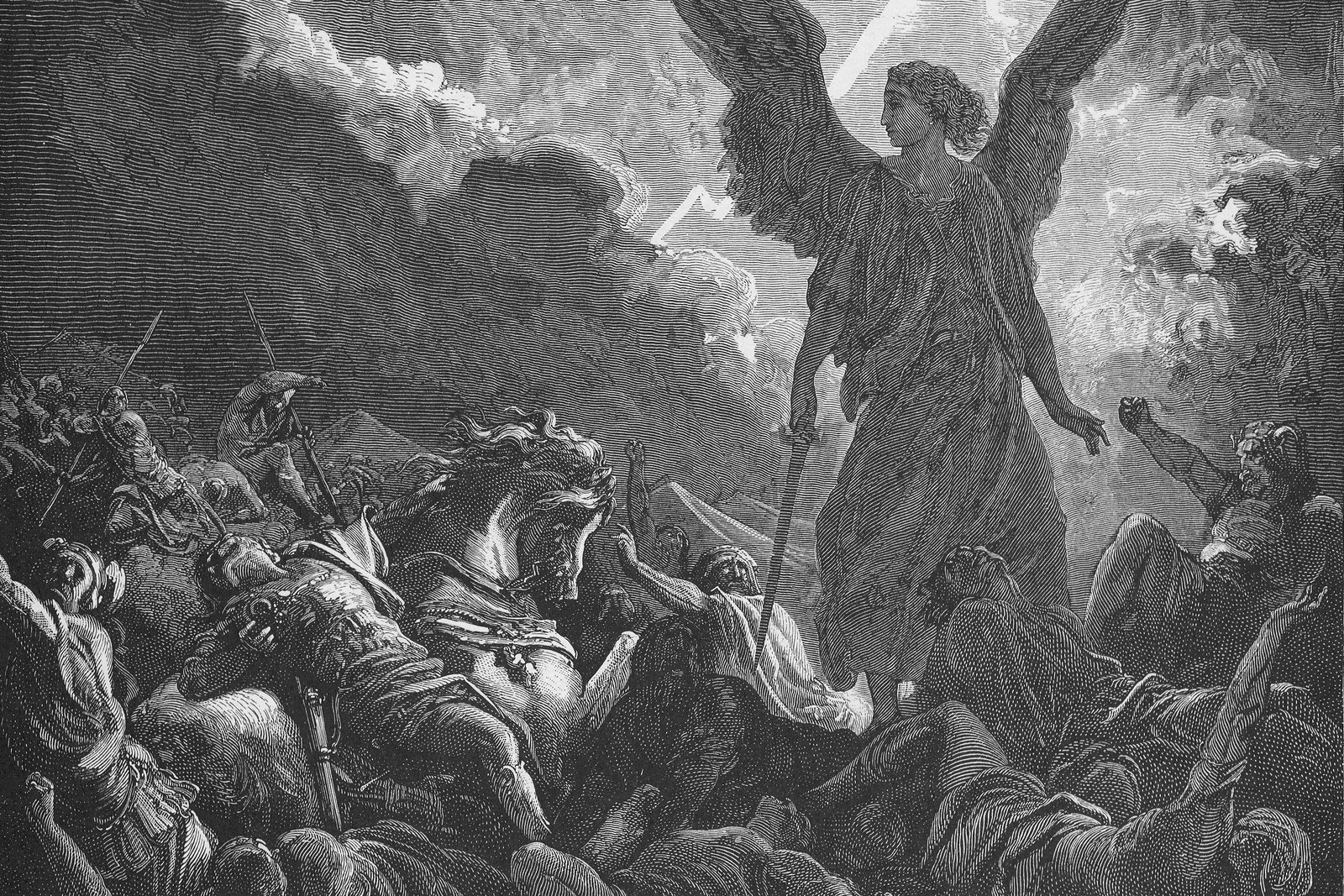
Gustave Doré, "Sennacherib's Army Is Destroyed," 1866, from La Grande Bible de Tours -- public domain.
What follows is a siege conducted as much through psychological pressure as military force. Sennacherib's field commander delivers a speech outside Jerusalem's walls, in the hearing of the people on the ramparts, deliberately mocking Hezekiah's trust in God and comparing the Lord to the gods of every other nation Assyria has already crushed — a calculated attempt to break the city's will before a single wall is breached.
A letter spread out before the Lord
Hezekiah's response to the final escalation — a written message repeating the same taunts — is unusual in its directness. "Hezekiah took the letter from the hand of the messengers and read it; then he went up to the house of the Lord, and spreading it out before the Lord" (2 Kings 19:14, NABRE), he prays. The prayer itself is worth noticing for what it asks: not simply personal or national survival, but vindication of God's own reputation. "Save us from this man's power, that all the kingdoms of the earth may know that you alone, Lord, are God" (2 Kings 19:19, NABRE). Hezekiah frames Jerusalem's crisis as, at its core, a test of whether the God Sennacherib had openly mocked was real.
The prophet Isaiah — appearing in this narrative just as he does in the book that bears his name, where the same events are recorded almost identically — brings back a direct response: "I have listened!" (2 Kings 19:20, NABRE), followed by a lengthy oracle promising that Sennacherib will not so much as shoot an arrow into the city, and that he will return home the way he came, by the same road.
One night, and the siege was over
What actually happens is recorded in a single, spare sentence, with almost none of the drama the buildup might lead a reader to expect: "That night the angel of the Lord went forth and struck down one hundred and eighty-five thousand men in the Assyrian camp. Early the next morning, there they were, dead, all those corpses!" (2 Kings 19:35, NABRE). Isaiah 37:36 preserves nearly the identical wording, underscoring how consistently this account was preserved across two different books of the Hebrew Bible.
Scripture offers no explanation of method — no description of how an angel accomplishes something on this scale, no visible appearance recorded, nothing beyond the stated fact and its immediate result. What follows is equally abrupt: "Sennacherib, the king of Assyria, broke camp, departed, returned home, and stayed in Nineveh" (2 Kings 19:36, NABRE). The siege that had swallowed every other fortified city in Judah simply ends, in one night, without Jerusalem's walls ever being breached.
A death the narrative had already foretold
Before the plague ever strikes the Assyrian camp, Isaiah delivers a second, more specific word about Sennacherib himself: "I am putting in him such a spirit that when he hears a report he will return to his land. I will make him fall by the sword in his land" (2 Kings 19:7, NABRE) — a prediction not just of retreat, but of a violent death, still to come, on Assyrian soil.
The narrative closes that thread deliberately. After the angel strikes the camp and Sennacherib withdraws to Nineveh, Scripture records: "while he was worshiping in the temple of his god Nisroch, his sons Adrammelech and Sharezer struck him down with the sword and fled into the land of Ararat" (2 Kings 19:37, NABRE) — killed, years later, by his own sons, inside the temple of the very god he served, and immediately after committing an act of worship. The king who had mocked the God of Jerusalem as no different from the gods of every nation he'd already conquered dies exactly the way Isaiah had said he would, at the hands of family, in the house of a god who did nothing to protect him.
A pattern that runs through the Old Testament
Scripture elsewhere describes angels acting in this same protective, decisive role on Israel's behalf — the Catechism of the Catholic Church, summarizing this recurring thread across salvation history, notes that angels have "led the People of God" and served "the accomplishment of the divine plan" from the earliest chapters of the Bible onward (CCC 332). The destruction of Sennacherib's army stands as one of the largest-scale examples of that pattern in the entire Old Testament — a single night's intervention that ended, without further battle, one of the gravest military threats Jerusalem ever faced.
Trivia
Who was Sennacherib and why was he attacking Judah?
What did Hezekiah do when Jerusalem itself was threatened?
What exactly happened to the Assyrian army?
Does Scripture explain how the angel struck down the army?
What ultimately happened to Sennacherib himself?
Related Reading