Jeremiah Thrown into the Cistern

A message no one in power wanted to hear
By the time this episode takes place, Jerusalem is under siege by the Babylonian army, and the prophet Jeremiah has been delivering a message the city's leadership finds intolerable: surrender to Babylon rather than continue a resistance Jeremiah insisted would end in the city's destruction regardless. It wasn't a popular position to hold inside a besieged capital, and it wasn't the first time Jeremiah's prophetic message had put him in direct conflict with those holding political and military power in the city.
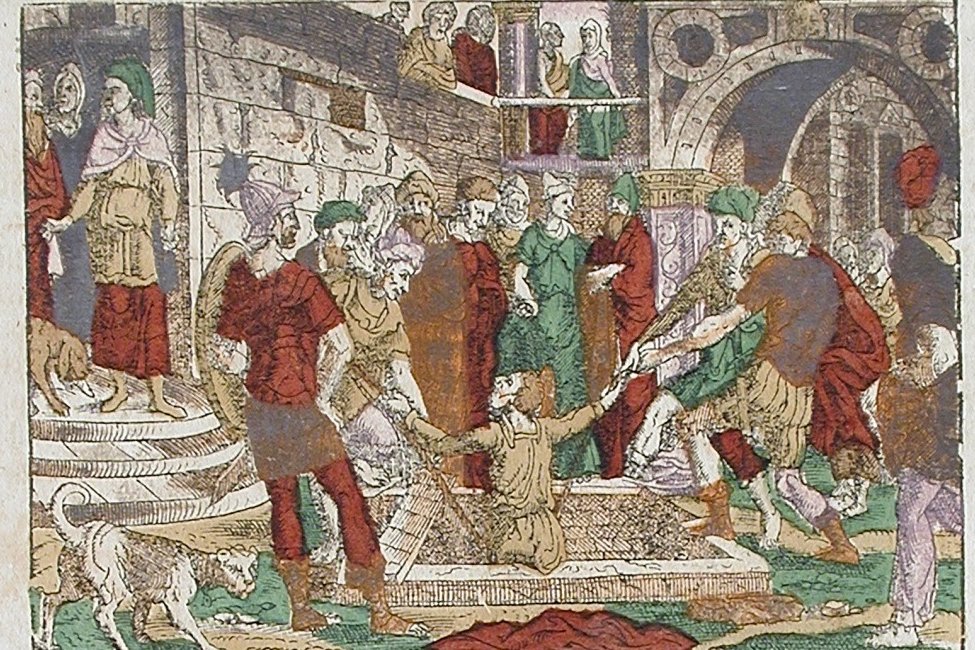
Jost Amman, illustration for the Feyerabend Bible, 16th century -- public domain.
An accusation of treason, dressed as concern for morale
The city's princes bring their complaint directly to King Zedekiah, and the accusation is framed in the language of wartime necessity rather than simple anger: "This man ought to be put to death. He is weakening the resolve of the soldiers left in this city and of all the people, by saying such things to them; he is not seeking the welfare of our people, but their ruin" (Jeremiah 38:4, NABRE). It's worth noting how the accusation inverts Jeremiah's own claimed motive — he believed he was warning the people toward the only path that could actually preserve their lives, while his accusers frame that same warning as active sabotage of the city's survival.
A king who admits he has no real power
Zedekiah's response is telling in what it reveals about his own position. Rather than defending Jeremiah or overruling the princes, he simply hands the decision over to them: "'He is in your hands,' for the king could do nothing with them" (Jeremiah 38:5, NABRE). It's a striking admission from a reigning king — not a ruling on the merits of the accusation, but a confession that he lacks the authority, or the will, to protect Jeremiah from officials who technically served under him.
Lowered into mud, not water
What the princes do with that permission is deliberately drawn out rather than swift. "They took Jeremiah and threw him into the cistern of Prince Malchiah, in the court of the guard, letting him down by rope. There was no water in the cistern, only mud, and Jeremiah sank down into the mud" (Jeremiah 38:6, NABRE). The detail that there was no water is significant — this wasn't intended as a quick drowning, but a slower, more exposed death: no water to drink, no solid ground to stand on, left to sink gradually while the siege continued above him. It's one of the more starkly physical episodes of persecution recorded against any of the Old Testament's major prophets.
Rescue from an unexpected source
The man who intervenes isn't one of Jeremiah's own countrymen from among the city's leadership — it's Ebed-melech, identified in the text as an Ethiopian serving in the royal household, a foreign-born court official with far less obvious stake in Judah's internal political disputes than the princes who had condemned Jeremiah. He appeals to Zedekiah directly, and this time the king acts decisively: "Take three men with you, and get Jeremiah the prophet out of the cistern before he dies" (Jeremiah 38:10, NABRE). Ebed-melech's rescue is carried out with notable care — he specifically lowers "old, tattered rags" for Jeremiah to place under his arms before the ropes are used to pull him up, protecting him from injury during the extraction itself (Jeremiah 38:11-12, NABRE), a small but telling detail of practical compassion amid an otherwise brutal episode.
A promise given back to Ebed-melech
Ebed-melech's act of mercy doesn't go unanswered in the larger narrative. Later, as Jerusalem's fall to Babylon finally arrives, God sends Jeremiah a direct word meant specifically for the man who had saved him: "Go, tell this to Ebed-melech the Ethiopian: Thus says the Lord of hosts, the God of Israel: See, I am now carrying out my words against this city, for evil and not for good; this will happen in your presence on that day" (Jeremiah 39:16, NABRE). Rather than leaving Ebed-melech to share in the city's coming destruction, God promises him protection specifically: "on that day I will deliver you... you shall not be handed over to the men you dread... Your life will be your spoils of war because you trusted in me" (Jeremiah 39:17-18, NABRE). It's a rare moment in the book where a single named individual, rather than the nation as a whole, receives a personal word of rescue — directly tied to the specific courage he showed pulling Jeremiah from the mud.
A prophet repeatedly left for dead
The cistern wasn't an isolated brush with death for Jeremiah. Across the book that bears his name, he's beaten, placed in stocks, plotted against by his own hometown, and accused of treason more than once during the siege — the cistern episode is simply the most physically dramatic entry in a long pattern of resistance to his message. Jewish and Christian readers alike have long noted how closely Jeremiah's suffering for an unwelcome message anticipates later biblical figures persecuted for speaking truths those in power didn't want spoken, giving this single episode a weight that extends well beyond the siege of Jerusalem itself — a prophet who kept speaking what he believed God required of him, regardless of what it repeatedly cost him personally.
Rescued, but still not free
Jeremiah's rescue from the cistern isn't presented as a full resolution. "Jeremiah remained in the court of the guard" (Jeremiah 38:13, NABRE) — pulled from the mud and spared death, but still held in custody, still caught between his prophetic conviction and a city leadership unwilling either to fully silence him or to actually heed what he was telling them. The episode captures something the whole book of Jeremiah returns to repeatedly: a prophet whose message was consistently rejected by the very people it was meant to warn, saved this time not by vindication or belief, but by one court official's willingness to act on simple, human concern for a man left to die in the mud.
Trivia
Why did Jerusalem's princes want Jeremiah killed?
How did King Zedekiah respond to the princes' demand?
What exactly happened to Jeremiah in the cistern?
Who rescued Jeremiah, and how?
Was Jeremiah set free after being rescued from the cistern?
Related Reading