Servant of God Nicholas Black Elk

A boy who had visions before he had a war to fight
Black Elk was born an Oglala Lakota, somewhere between 1858 and 1866 by most accounts (the Diocese of Rapid City's own cause materials give the range; his later Catholic baptismal record lists December 6, 1863), on the northern Great Plains during the final, violent decades of U.S.–Lakota conflict. From boyhood he was marked out as unusual — he experienced vivid visions that, as he later told interviewers, began with a severe illness around age nine, and those visions quickly earned him respect among the Lakota's medicine men and spiritual leaders, well before he reached adulthood. He was a cousin of the war leader Crazy Horse, and still a teenager when he took part in the Battle of the Little Bighorn in Montana in June 1876, the fight in which Lt. Col. George Armstrong Custer and his unit were killed. By his own later account, he scalped a soldier's body on that battlefield — a detail he didn't hide in later life, and one that makes clear how far his path eventually traveled.
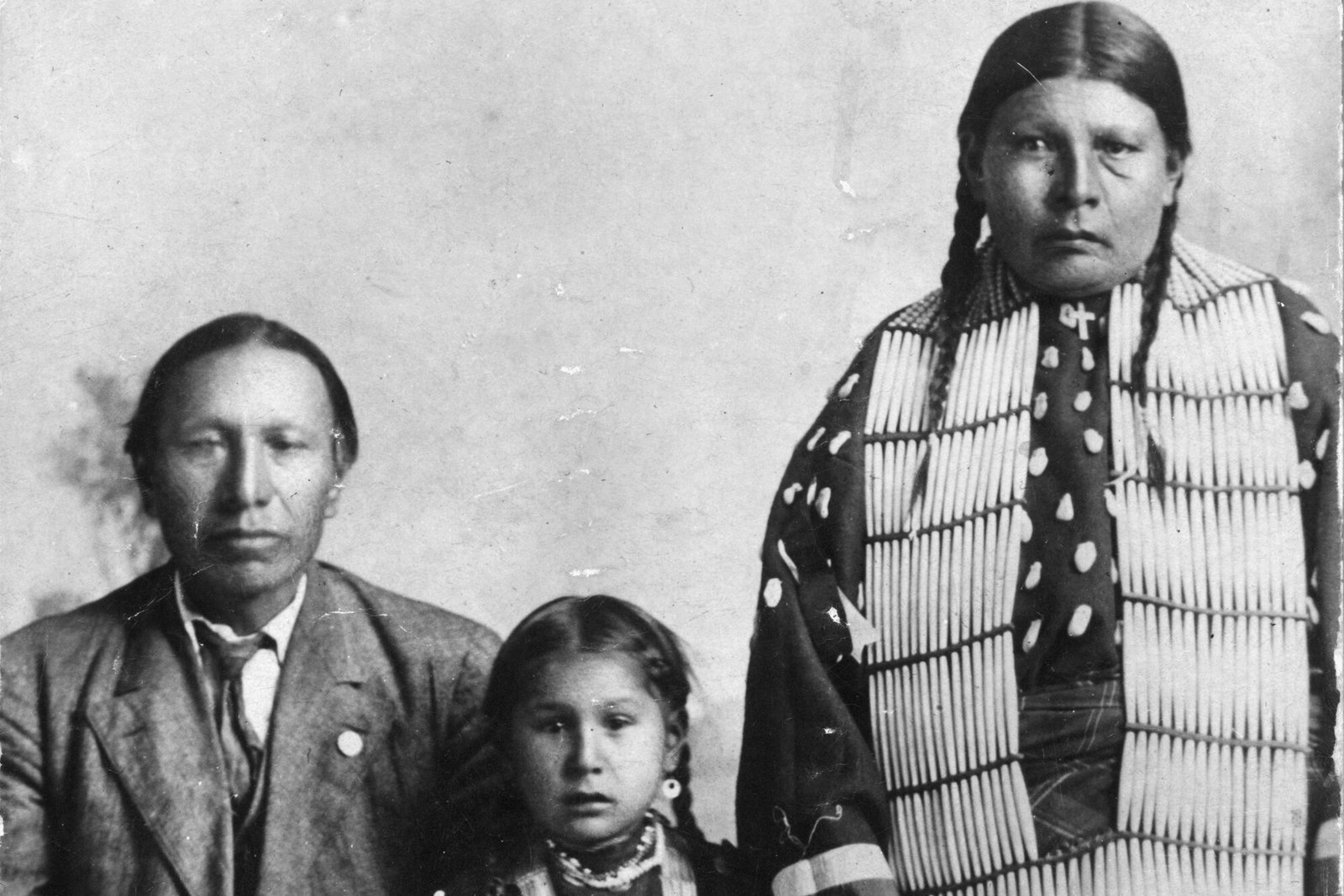
Photograph captioned "Nick Black Elk and Family, Catholic Catechist," c. 1910, Denver Public Library Special Collections — public domain.
The years that followed brought catastrophic loss for the Lakota and other Plains nations: the mass killing of the bison herds, forced confinement to reservations, and a federal policy aimed at breaking up tribal land and culture. In the late 1880s, a new religious movement called the Ghost Dance swept through Native communities on the Plains, built around the hope that the old world — the bison, the free life, the dead — might be restored through ceremonial dance. Black Elk took part in it, and it was during a Ghost Dance that he experienced a vision of a man "with wounds in the palms of his hands" standing before a flowering tree, calling all people — not just the Lakota — to himself. Decades later, his daughter Lucy would describe that figure to biographers as the resurrected Christ, though that reading of an earlier vision is itself part of the interpretive debate historians still have about how continuous his spiritual life really was.
Wounded Knee, and the slow end of armed resistance
The U.S. Army, fearing the Ghost Dance would fuel further resistance, moved to suppress it. On December 29, 1890, soldiers attempting to disarm a band of Lakota at Wounded Knee Creek on the Pine Ridge Reservation in South Dakota opened fire, killing an estimated 300 or more Lakota men, women, and children. Black Elk, by then recognized as a healer and holy man, rode to the scene and helped tend to the wounded in the massacre's aftermath. It was one of the last major episodes of the Plains Indian Wars, and it marked the effective end of organized Lakota armed resistance. Red Cloud, the respected Oglala leader, afterward urged Black Elk and others toward life on the reservation rather than further conflict — and it was Red Cloud who, trusting the Jesuit missionaries the Lakota called "black robes," invited them to establish a mission at Pine Ridge.
In between the violence, Black Elk had already glimpsed a different world: in 1887 he joined Buffalo Bill Cody's touring Wild West show, traveling to Europe and performing before Queen Victoria during her Golden Jubilee year. The trip exposed him to European cathedrals and to white Christians who, he came to feel, were not uniformly the enemy his people had faced on the Plains — an experience biographers point to as part of what widened his later religious outlook beyond a purely tribal one.
From holy man to Catholic catechist
Black Elk married Katie War Bonnet, herself a Catholic convert, in 1892, and their children were baptized Catholic; Katie died in 1903. The following year, in 1904, Black Elk himself was baptized, taking the name Nicholas — the feast day of St. Nicholas, December 6, became the birthdate he used from then on, by his own account because it marked the day he considered himself "born again." He later married Anna Brings White, also a Catholic, and remained married to her until her death.
What followed was not a brief gesture of conversion but a vocation that filled the rest of his life. For roughly the next fifty years, Black Elk served as a catechist at Pine Ridge — an official lay teaching role in the Catholic Church, responsible for instructing others in the faith, leading prayer, and in his case, by Fr. Michael Steltenkamp's account, carrying out duties that resembled those of a modern permanent deacon: preaching, teaching the Rosary and the basics of Catholic belief, and baptizing the dying when no priest was available. He is credited with helping bring thousands of Lakota into the Catholic Church over those decades, traveling on horseback and later by wagon between scattered reservation communities to do it.
A life scholars still argue about — honestly
Here the story resists a tidy ending, and it's worth saying so plainly rather than smoothing it over. Black Elk's own grandson-figure in later life, Fr. Steltenkamp (Black Elk's daughter Lucy called him "grandson" for his closeness to the family), has argued in his biographies that Black Elk's Catholic faith only deepened with time and became the defining commitment of his later decades — a model, in Steltenkamp's view, of a genuinely "universal," Christ-centered faith rather than a strategic accommodation to white authority. Other scholars read the record differently: some see Black Elk's conversion as at least partly a pragmatic response to the pressures reservation life placed on traditional religious practice, and some argue — based on his own words recorded late in life — that he never fully set aside Lakota ceremony and the Ghost Dance's hope for cultural renewal, even while serving as a Catholic catechist for half a century.
Much of this debate traces back to "Black Elk Speaks," the 1932 book built from his conversations with Nebraska poet John G. Neihardt. It's by far the most widely read account of his life, but it covers roughly only his first twenty-five years and was shaped substantially by Neihardt's own editorial choices — a point scholars including Indiana University's Raymond DeMallie have raised directly. The book essentially stops before Black Elk's decades as a catechist even begin, which is part of why so many readers know him only as a pre-Christian visionary and have never encountered the second half of his life at all.
The Catholic Church's own investigation into his cause is, notably, not trying to erase this complexity. Bishop Robert Gruss of Rapid City, in opening the cause in 2017, spoke of Black Elk as someone who "merged the Lakota and Catholic culture" throughout his life — language that treats the blending itself, not a clean break with his Lakota identity, as part of what the Church is examining rather than something to be explained away.
An open cause, not yet a settled verdict
At a Mass at Holy Rosary Church in Pine Ridge on October 21, 2017, Bishop Gruss formally opened Black Elk's canonization cause, giving him the title "Servant of God" — the first of four stages in the Church's process, well short of "Blessed" or "Saint." That first stage means diocesan investigators are gathering testimony about his life and reputation for holiness and reviewing his writings and recorded words; a positive outcome there would move his cause toward "Venerable," then, with an approved miracle, toward beatification and eventual canonization. None of those later steps has happened yet, and there is no fixed timeline for when, or whether, they will.
Whatever the outcome, Black Elk's story has already reshaped how many American Catholics think about the relationship between Native culture and the Catholic faith — not as a story of one replacing the other, but as an often difficult, still-debated question about how the two can be held together in a single life. His headstone, by the way, calls him "Chief," though diocesan archivists are careful to note he never held that formal title in a military or political sense; his family gave him the honorific out of respect for the humility and devotion people saw in him over those fifty years at Pine Ridge.
Trivia
Who was Nicholas Black Elk?
What does it mean that Black Elk is a 'Servant of God'?
When was Black Elk's cause for canonization opened?
Did Black Elk remain a traditional Lakota holy man after becoming Catholic?
Is Nicholas Black Elk the same person as the narrator of 'Black Elk Speaks'?
Is there a Saints Home product connected to Black Elk yet?
You May Also Like
Related Reading