Venerable Augustus Tolton

Born enslaved in Missouri
Augustus Tolton was born into slavery on April 1, 1854, near Brush Creek in Ralls County, Missouri, to Martha Jane Chisley and Peter Paul Tolton, both of whom were themselves enslaved and both of whom were Catholic. That detail matters: the Catholic faith wasn't something introduced to Tolton later in life by white missionaries looking for converts — it was his family's faith from the start, passed down the way any family passes down what it believes.
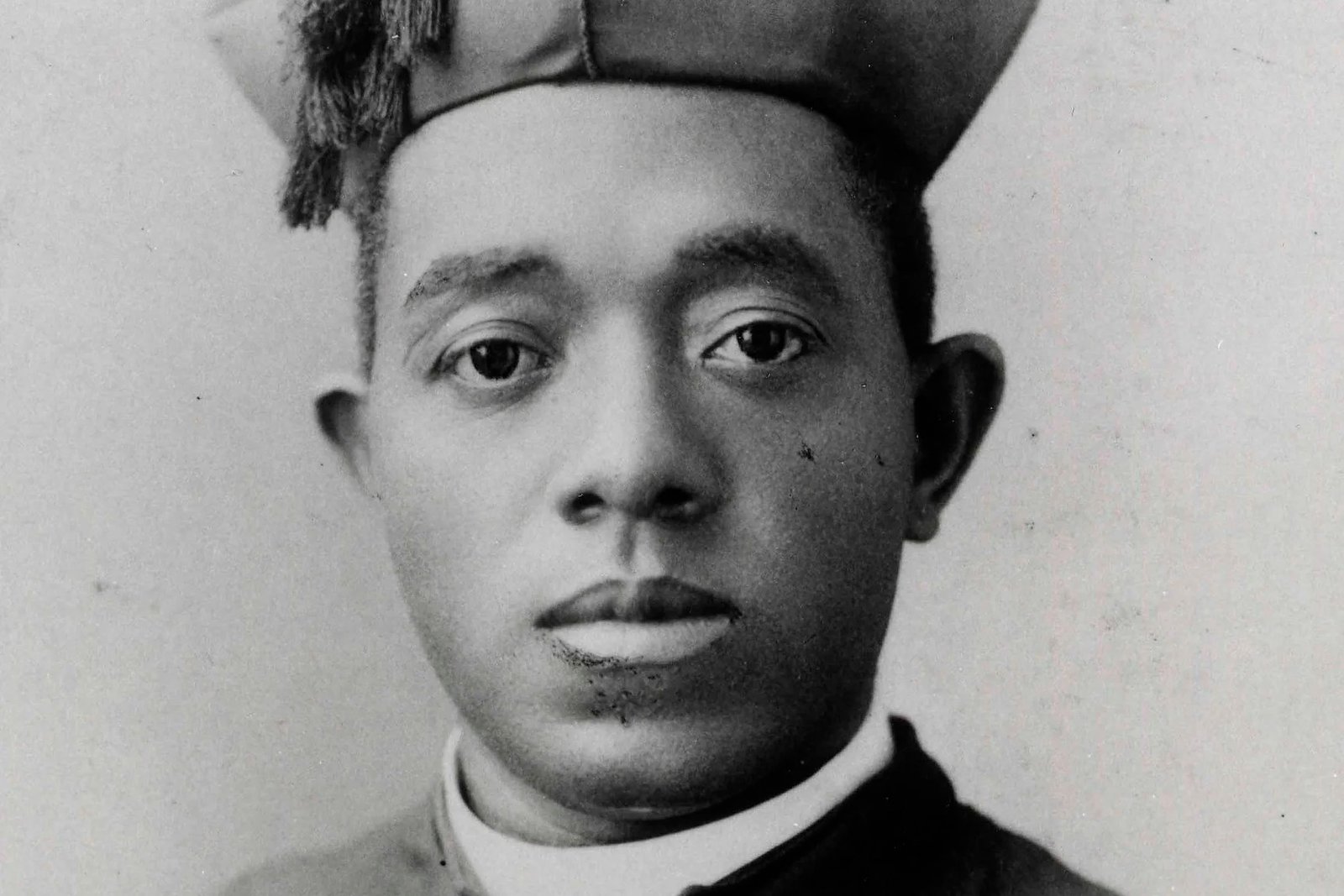
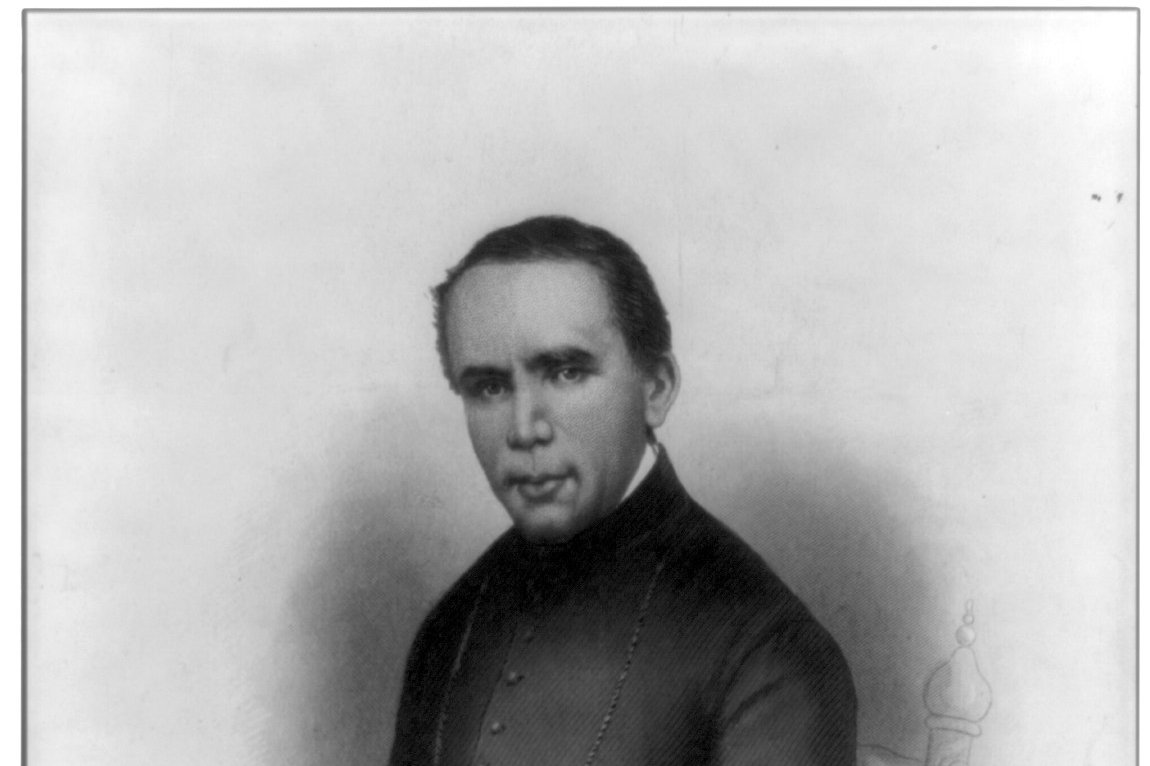
Unidentified photographer, circa 1890s — public domain (Wikimedia Commons).
When the Civil War broke out, Peter Paul Tolton escaped and joined the Union Army, where he died not long afterward. According to Catholic News Agency's account of the family's history, Martha Jane made her own escape in 1862, crossing the Mississippi River into Illinois with Augustus and his siblings rather than wait out the war in bondage. Family tradition holds that she told her young son, as they reached the far bank, "John, boy, you're free. Never forget the goodness of the Lord" — a line that's been repeated often enough in Tolton's story that it's worth naming honestly as a cherished family account rather than a documented, contemporaneously recorded quotation.
The family settled in Quincy, Illinois, a river town just across from Missouri, where Father Peter McGirr, pastor of St. Peter's parish, let young Augustus attend the parish school — an all-white school, at a time when that was itself a quietly remarkable decision for a priest to make. McGirr baptized him, prepared him for his first Communion, and over the years that followed became one of several local priests who recognized something in Tolton worth encouraging toward the priesthood itself.
Rejected by every seminary in America
This is the part of Tolton's story that tends to stop people short, because it runs against the assumption that a well-educated, devout young man with the backing of multiple priests and his own bishop would have had a straightforward path into seminary. He didn't. According to Wikipedia's account of his life, Tolton applied to every major Catholic seminary in the United States and was turned down by each one because of his race — and when a European mission society, the Mill Hill Missionaries in London, was approached as an alternative, they refused him too.
His bishop, Peter Joseph Baltes of the Diocese of Alton, didn't let the matter end there. Baltes arranged for Tolton's admission instead to the Pontifical Urban College in Rome — the Vatican's own seminary for training missionary priests, run by the Congregation for the Propagation of the Faith — where nationality and race weren't the barrier they'd proven to be at home. Tolton entered the college and was ordained a priest on April 24, 1886, at St. John Lateran Basilica, Rome's cathedral and the pope's own seat as Bishop of Rome. He offered his first Mass at St. Peter's Basilica.
Rome's plan for him, going in, had been to send him to serve as a missionary in Africa once ordained — a reasonable assumption for a Black seminarian trained at a school built to supply missionaries to the missions. Cardinal Giovanni Simeoni, the Vatican official who made the final call, changed course instead and sent him back to his own country. According to Catholic News Agency, Simeoni told the committee deciding Tolton's assignment: "America has been called the most enlightened nation in the world. We shall see whether it deserves that honor. If the United States has never before seen a Black priest, it must see one now." It's a pointed line, and a fair one — the country that had enslaved Tolton as an infant, and whose own seminaries had refused to train him as a grown man, was the one Rome sent him back to.
Quincy, then Chicago
Tolton returned to Illinois in July 1886 to a welcome that genuinely was warm in places — crowds and clergy met him, and his home parish in Quincy celebrated his first Mass there as a milestone for the whole Catholic community. But the warmth didn't eliminate the opposition. He served roughly three years at St. Joseph's parish in Quincy, assigned to the Diocese of Alton, and faced resistance from some corners even there: friction with the German-American priest who oversaw the parish's affairs, and suspicion from some of the city's Black Protestant ministers, who weren't necessarily eager to see a Catholic alternative drawing their own congregants. None of it was simple, and none of it fit a tidy story of unanimous welcome.
At his own request, Tolton was reassigned to the Archdiocese of Chicago, where his ministry took on a different shape. He became the driving force behind founding St. Monica's, a parish built specifically to serve Chicago's Black Catholic community on the city's South Side — what the Church calls a "national parish," a designation normally used for immigrant communities organized around shared language or ethnicity, applied here to Black Catholics for much the same reason. St. Monica's was completed in 1893 at 36th and Dearborn Streets, with financial support from Saint Katharine Drexel, the Philadelphia heiress who gave away nearly her entire fortune to fund Catholic ministry among Black and Native American communities and who would later be canonized herself. Tolton became known to his parishioners simply as "Good Father Gus" — a nickname that says something about the kind of presence he was in the neighborhood, beyond the historic weight of his ordination.
An unexpected death
Tolton's ministry in Chicago lasted only a few years. On July 9, 1897, during one of the severe heat waves that periodically struck the city before air conditioning existed, he collapsed from heat exhaustion while walking back from a train station after returning from a priests' retreat in Bourbonnais, Illinois. He died that evening. He was 43 years old, and the suddenness of it — a man in otherwise ordinary health, undone in a matter of hours by the heat — left the community he'd built at St. Monica's without warning.
A cause still moving forward
The Archdiocese of Chicago opened Tolton's cause for canonization in 2010, the formal first step that earns a candidate the title "Servant of God." Pope Francis declared him Venerable on June 12, 2019 — the second of four recognized steps toward sainthood, meaning the Church has formally recognized that he lived a life of heroic virtue. Beatification, the next step, still requires a miracle attributed to his intercession to be investigated and accepted by the Vatican; canonization requires a second miracle after that.
Why his cause matters goes beyond the list of firsts attached to his name. Tolton's story sits at an uncomfortable intersection that the Church doesn't get to look away from: a man enslaved by Catholics as a child, ordained because Rome would train him when his own country's dioceses wouldn't, and sent home to a ministry that still met resistance even after Rome had settled the question of whether he belonged in the priesthood at all. His path to the altar, however it eventually concludes, is also a record of exactly how slow and uneven that country's own reckoning with race was — inside the Church as much as outside it.
His feast is not yet fixed, since he hasn't yet been beatified, but devotion to him is active and growing, particularly in the Diocese of Springfield in Illinois (the successor to the old Diocese of Alton) and the Archdiocese of Chicago, the two dioceses where he actually served.
Trivia
Who was Venerable Augustus Tolton?
Why did Augustus Tolton have to study for the priesthood in Rome instead of the United States?
Was Augustus Tolton the first Black Catholic priest in the United States?
Where did Augustus Tolton serve as a priest?
How did Augustus Tolton die?
What is the status of Augustus Tolton's cause for sainthood?
You May Also Like
Related Reading