Fr. Vincent Capodanno, "The Grunt Padre"

From Staten Island to a mountain mission in Taiwan
Vincent Robert Capodanno Jr. was born on February 13, 1929, in the Elm Park section of Staten Island, New York, the youngest of ten children in an Italian-American family. He worked for a time as an insurance clerk and took night classes before, in 1949, entering the Maryknoll Missionary Seminary — the formation house of the Catholic Foreign Mission Society of America, better known as the Maryknoll order, which trains American priests specifically for missionary work overseas. Cardinal Francis Spellman ordained him a priest on June 14, 1958, after nearly a decade of study.
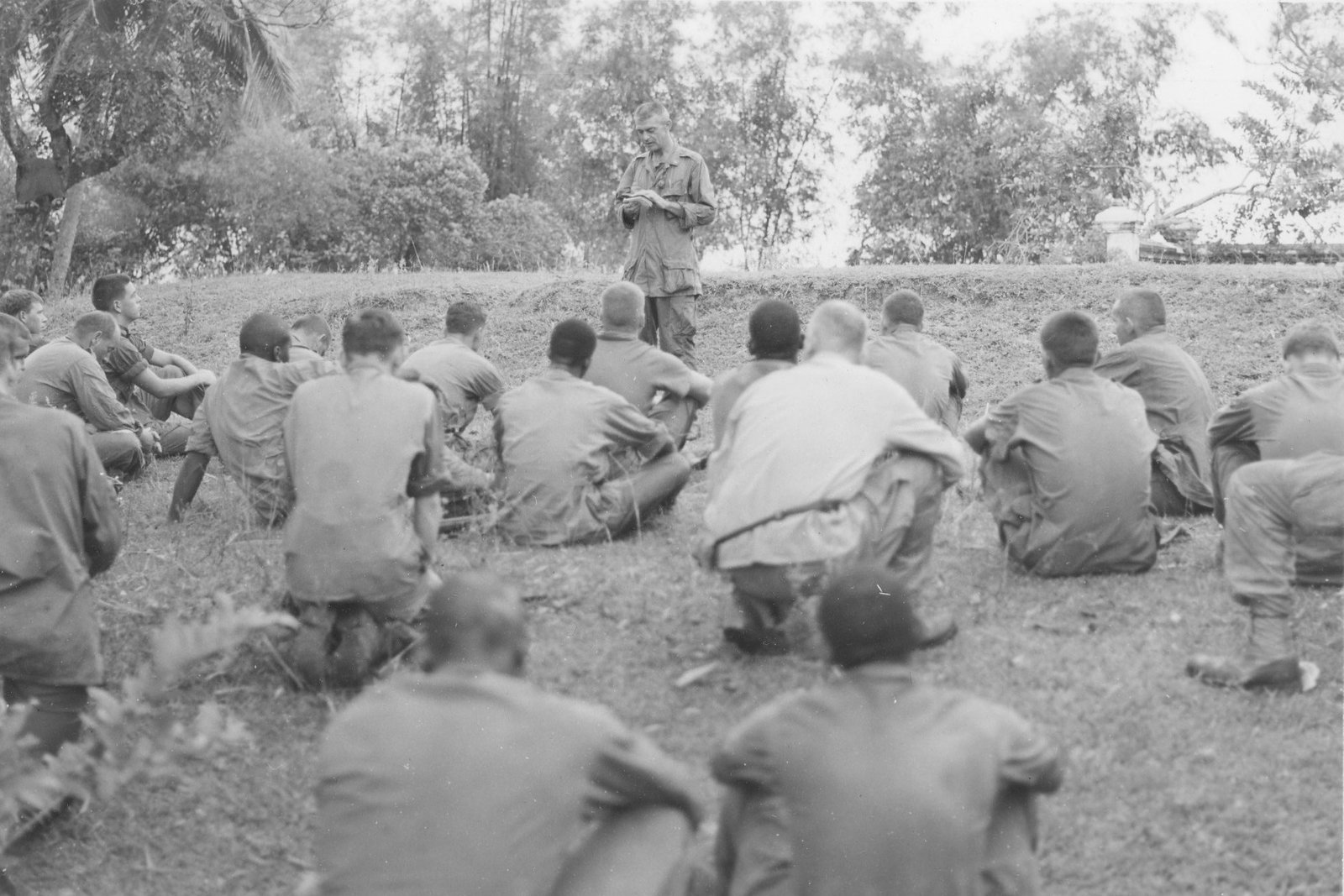
Vincent Capodanno Leads Field Prayer Services, September 11, 1966 — USMC Archives, Quantico. Licensed CC BY 2.0 via Wikimedia Commons.
His first mission assignment sent him in 1959 to a Hakka community in the mountains of Taiwan, where he spent six years working in a parish and a school before a stint in Hong Kong. It was a quiet, settled kind of missionary life. Then the Vietnam War began pulling in American ground troops in large numbers, and Capodanno volunteered to leave it behind — asking his superiors for permission to become a military chaplain so he could minister to the men being sent into combat.
Choosing the front line over the rear base
Capodanno received his commission as a Navy lieutenant in the Chaplain Corps on December 28, 1965, and specifically requested assignment to the Fleet Marine Force — the chaplains and corpsmen the Navy embeds directly with Marine infantry units, since the Marine Corps has no chaplains of its own. He arrived in Vietnam in April 1966 and was assigned first to the 1st Battalion, 7th Marines, later serving with other battalions of the 1st Marine Division.
What set him apart, by multiple firsthand accounts, was a simple refusal to stay where it was safer. Chaplains were not required to go out on patrol with combat units, and many didn't. Capodanno did — repeatedly, voluntarily, sharing the same mud, rations, and incoming fire as the riflemen around him rather than waiting at a command post for the wounded to be brought back to him. "Grunt" was the Marines' own weathered slang for the infantrymen who carried the heaviest and most dangerous share of the fighting; giving a Navy chaplain that nickname, and meaning it as praise, was the men's way of saying he'd earned a place among them. When his one-year tour ended in 1967, he asked for a six-month extension rather than go home.
September 4, 1967: Operation Swift
Early on the morning of Labor Day, September 4, 1967, a Marine company caught in the Que Son Valley of Quang Tin Province came under attack from a vastly larger North Vietnamese force — part of a sprawling, fast-moving battle that became known as Operation Swift. Word reached Capodanno that a platoon from M Company was taking heavy casualties and in danger of being overrun. According to the Medal of Honor citation later issued in his name, he left the relative safety of the command post and ran through open, fire-swept ground directly to the besieged platoon.
What followed, according to that same official citation, was hours of Capodanno moving across the battlefield under small-arms, automatic-weapons, and mortar fire, administering last rites to the dying and first aid to the wounded. A mortar round eventually tore into both of his arms and legs and severed part of his right hand. He refused all medical aid for himself, telling the corpsmen nearby to tend to the other wounded men instead, and kept moving among the Marines, encouraging them by voice and by the plain fact of his presence. Near the end, he spotted a Navy corpsman wounded and exposed directly in the line of an enemy machine gun roughly fifteen yards away. Capodanno went toward him anyway. He was killed by a burst of machine-gun fire only inches from reaching the man he was trying to save.
Fourteen Marines and two Navy corpsmen from his battalion died in that same engagement. Capodanno's body was recovered and returned home to be buried in his family's plot at St. Peter's Cemetery on Staten Island.
"No one has greater love than this"
The Gospel of John records Jesus telling his disciples, in words the Church has long applied to martyrs and to anyone who dies for another, "No one has greater love than this, to lay down one's life for one's friends" (John 15:13, New American Bible, Revised Edition). Capodanno was not a combatant — Navy chaplains serve unarmed, by long custom and by the Geneva Conventions' protections for medical and religious personnel — but he died doing exactly what that verse describes, moving toward danger rather than away from it on behalf of men who weren't even family, in the ordinary sense of the word.
On December 27, 1968, the Secretary of the Navy notified the Capodanno family that he would receive the Medal of Honor posthumously; the formal ceremony followed on January 7, 1969. The full citation praises his "conspicuous gallantry and intrepidity at the risk of his life above and beyond the call of duty," and closes with a line that has followed him ever since: "He gallantly gave his life in the cause of freedom." He became only the third U.S. military chaplain, and the second Navy chaplain, ever to receive the nation's highest award for valor.
A Servant of God, and an open cause
The Catholic Church opened the formal process toward Capodanno's possible canonization — the recognition of someone as a saint — on May 19, 2002, with supporting documentation submitted two years later to the Congregation for the Causes of Saints, the Vatican office that reviews such cases. On May 21, 2006, Archbishop Edwin F. O'Brien, then head of the Archdiocese for the Military Services, announced that Capodanno had officially received the title "Servant of God." That title marks only the earliest formal stage of a canonization cause — well before "Venerable," "Blessed," and finally "Saint," the ranks that still lie ahead if his cause advances. In 2019, a Florida bishop credited Capodanno's intercession with the healing of a woman suffering from multiple sclerosis, a development reportedly under continued investigation by those advancing his cause. As of this writing, Capodanno remains a Servant of God — his case still open, not yet resolved one way or the other — and nothing beyond that should be stated as settled.
Half a century on, his name is attached to a Navy frigate once blessed by Pope John Paul II, to chapels at several Marine Corps and Navy installations, and to a boulevard on his native Staten Island. For readers drawn to the saints connected to Vietnam-era military history, it's also worth reading about the broader history of Catholic chaplains and military ministry, or browsing the site's directory of saints and holy figures for other 20th-century causes still working their way through Rome. Capodanno's own story — missionary, then volunteer, then a man who chose to kneel beside the wounded rather than stand apart from them — is still being written by the Church that has not yet finished deciding what to call him.
Trivia
Who was Fr. Vincent Capodanno?
Why was he called 'the Grunt Padre'?
How did Vincent Capodanno die?
Did Vincent Capodanno receive the Medal of Honor?
Is Vincent Capodanno a canonized saint?
You May Also Like
Related Reading