The Angelus Prayer Explained

A prayer built around one moment
The Angelus takes its name from its opening Latin words, Angelus Domini nuntiavit Mariae — "The Angel of the Lord declared unto Mary" — and everything in the prayer circles back to that single scene: the angel Gabriel appearing to a young woman in Nazareth and asking her to become the mother of God. Rather than a long meditation, the Angelus compresses that entire encounter into three short verses, each drawn almost directly from the Gospel of Luke, and pairs each verse with a Hail Mary.
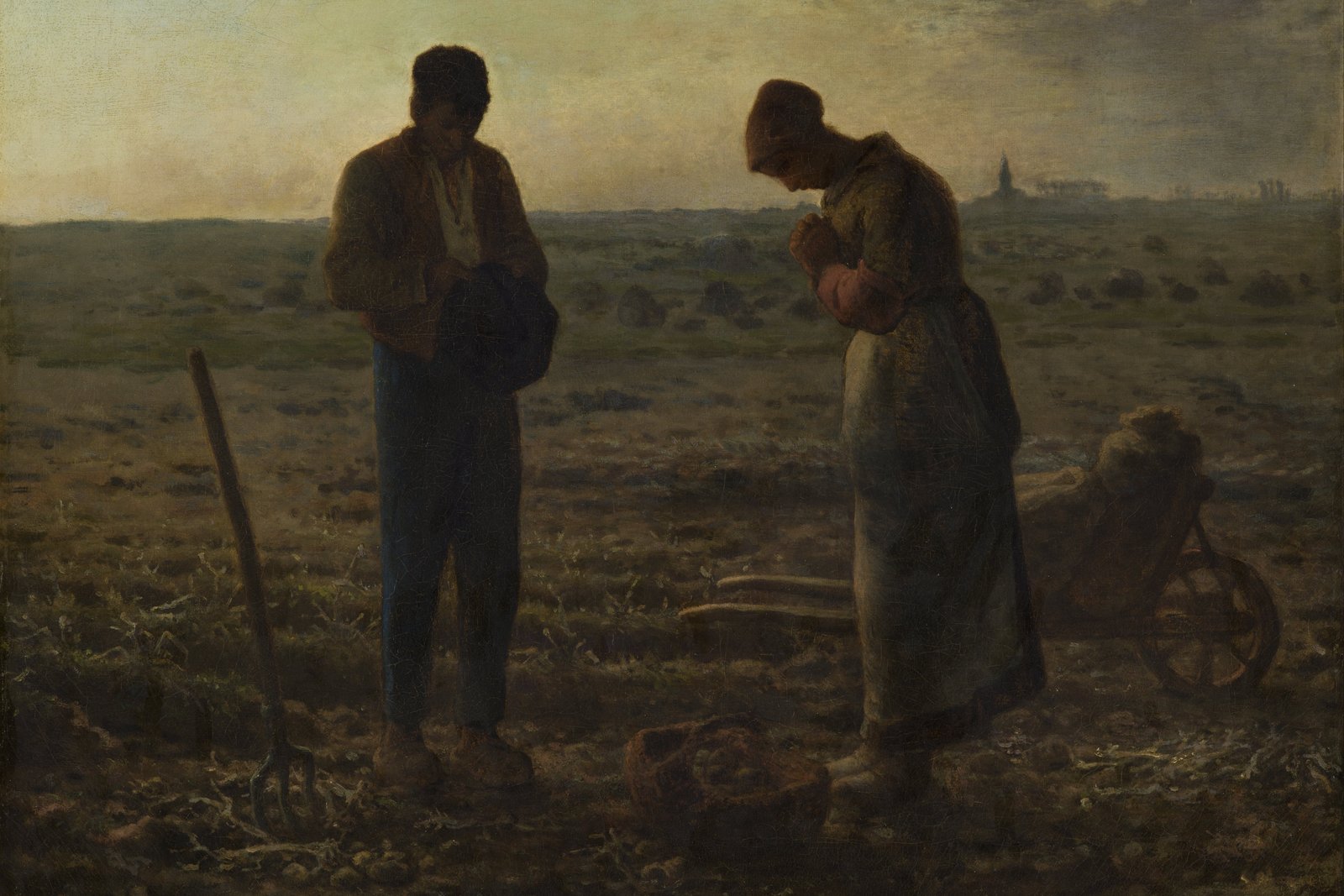
Jean-François Millet, The Angelus, 1857–59, Musée d'Orsay, Paris — public domain, Wikimedia Commons.
The first verse announces Gabriel's arrival and greeting to Mary, echoing Luke's account that the angel said to her, "Hail, favored one! The Lord is with you" (Luke 1:28). The second gives Mary's response of humble acceptance, echoing her words in Luke 1:38, where she answers, "Behold, I am the handmaid of the Lord. May it be done to me according to your word." The third verse states that the Word became flesh and dwelt among us, paraphrasing John 1:14, marking the moment of the Incarnation itself. A closing versicle and a short collect prayer bring the sequence to an end. The whole thing takes well under two minutes to pray, which is part of why it survived as a daily habit for so many centuries: it asks almost nothing of a person's schedule, only their attention.
The bell that stopped a village
What makes the Angelus distinctive among Catholic prayers isn't really its text but its timing and its signal. From at least the 14th century, parishes across Europe developed the custom of ringing a specific bell pattern — traditionally three strokes, three times, followed by nine — at the hours the Angelus was meant to be prayed, conventionally morning, noon, and evening. The bell didn't just remind people inside the church; it reached everyone within earshot, which in a farming village meant most of the population, wherever their work had taken them that day.
That's the scene Jean-François Millet painted in The Angelus (1857–59), now in the Musée d'Orsay: two peasants standing in a field at dusk, tools set down, heads bowed, responding to a bell tower barely visible on the horizon. Millet himself said he painted the scene from memory of his own grandmother, who would stop working whenever she heard the bell and insist the family pause with her. The painting became one of the most reproduced religious images of the 19th century, precisely because it captured something true about how deeply the custom had embedded itself into ordinary daily rhythm, not just churchgoing.
Three times a day, still
The traditional pattern of praying the Angelus at 6 a.m., noon, and 6 p.m. persists in many places today, though it's practiced with far less uniformity than in Millet's era. Convents, monasteries, and some parishes still ring bells and pause for the prayer at these hours. Individual Catholics who keep the custom often do so more flexibly, saying it whenever the moment allows rather than by the clock exactly.
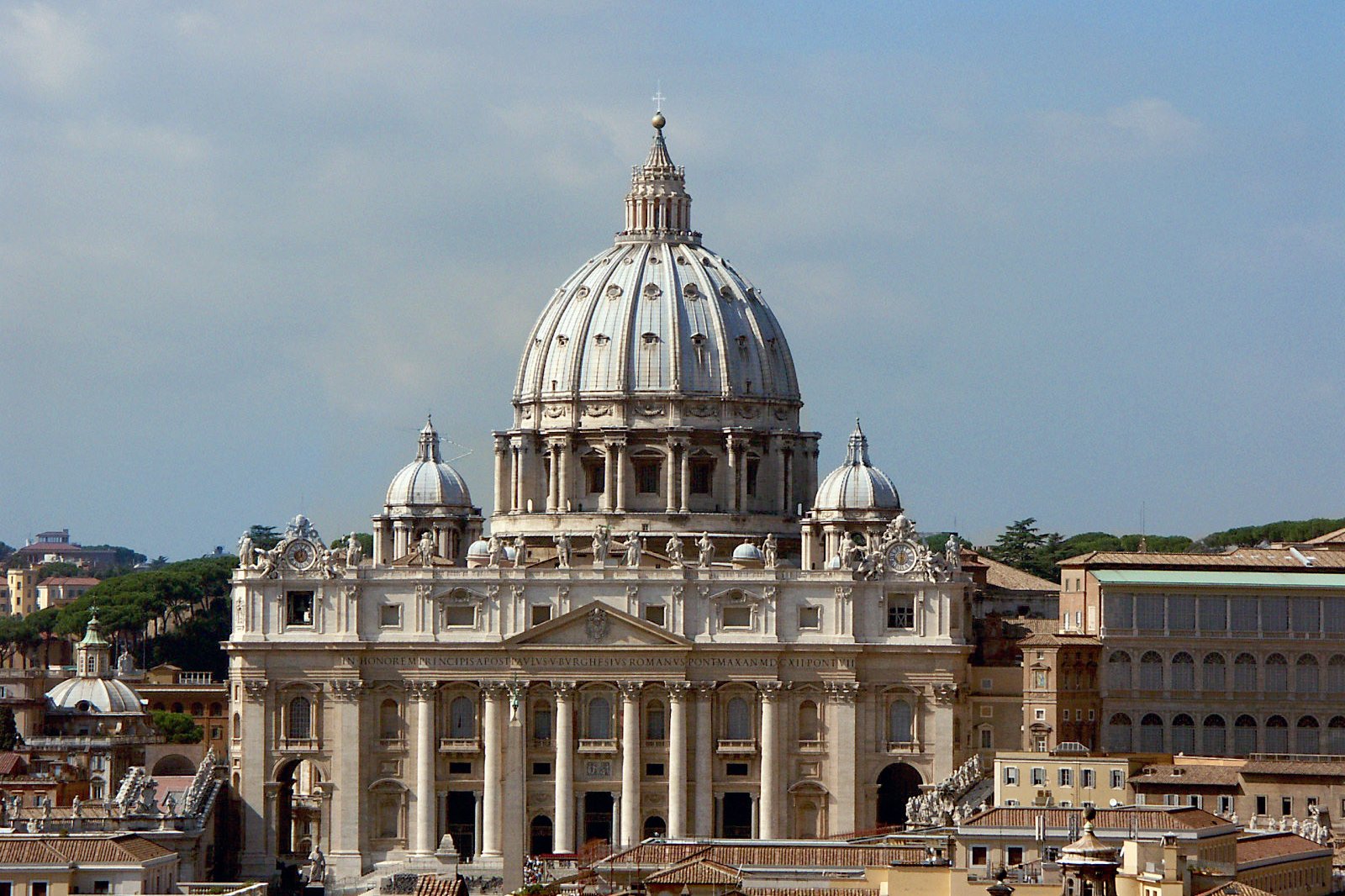
The most visible modern survival of the Angelus is its recitation by the Pope. Every Sunday at noon, weather and health permitting, the Pope appears at a window overlooking St. Peter's Square in Rome and leads the assembled crowd through the prayer, followed by a short reflection and a blessing. It's a practice that draws thousands of pilgrims and tourists on any given Sunday and remains one of the more widely recognized public prayer traditions connected to the papacy, alongside other papal customs like the papal conclave.
The Easter substitute: Regina Caeli
For roughly seven weeks each year, the Angelus steps aside for a different prayer. From Easter Sunday through Pentecost, tradition replaces the Angelus with the Regina Caeli ("Queen of Heaven"), a prayer built on the same basic structure — short verses interspersed with a different concluding prayer — but oriented toward the Resurrection rather than the Annunciation. The switch reflects a broader pattern in Catholic prayer life: devotions often shift in tone and focus to match the liturgical season, the same logic that governs why liturgical colors change through the year or why certain novenas cluster around particular feasts.
A small habit with a long memory
Part of what has kept the Angelus alive for nearly seven centuries is its sheer economy. It requires no book, no group, no particular posture beyond a pause — historically, even a pause mid-stride in a field was considered sufficient. That simplicity is exactly what Millet's painting communicates without a single word: two tired figures, interrupted mid-labor, doing nothing more dramatic than standing still for a moment to acknowledge something they believed had once happened to an ordinary young woman in Nazareth, and which changed everything after.
For a devotion so brief, the Angelus asks a surprisingly large thing of the people who keep it: not extended time, but interruption — a willingness to let the day's ordinary momentum break, however briefly, for something that isn't itself.
Trivia
What is the Angelus prayer?
Why is it called the Angelus?
Why do church bells ring for the Angelus?
When is the Angelus traditionally prayed?
Is the Angelus replaced by a different prayer during Easter?
Related Reading