The Sign of the Cross Explained — History and Meaning

A gesture that predates the words attached to it
Ask most Catholics what the Sign of the Cross means and the answer usually starts and stops at "it's how you begin a prayer." That's true, but it undersells a gesture the Church treats as carrying real theological weight every single time it's made — not a throat-clearing motion before the actual prayer starts, but a small act of prayer in its own right.
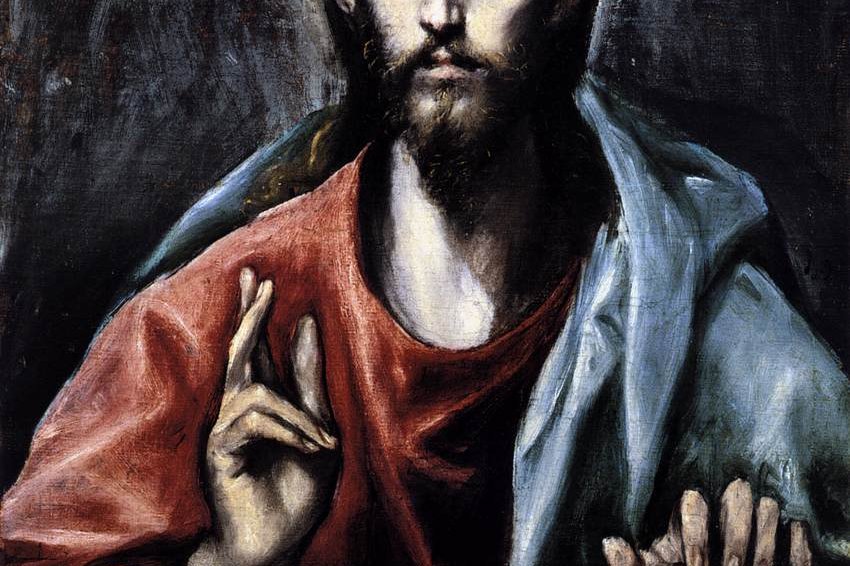
El Greco, Christ as Saviour (Salvator Mundi), c. 1600, Museo del Greco, Toledo — public domain.
The modern form is simple: touch the forehead, then the chest, then the left shoulder, then the right (in the Western tradition; Eastern Christians typically move right to left), while saying "In the name of the Father, and of the Son, and of the Holy Spirit. Amen." Two things happen at once. The words name the three Persons of the Trinity — one God, three Persons, the central mystery of Christian faith. The movement traces the outline of the cross itself, the instrument of Christ's death and, in Christian belief, the source of humanity's redemption. Say the Trinity, trace the cross — the whole of the gesture's meaning is contained in that combination.
Older than the full gesture: tracing a small cross
The practice of Christians marking themselves with the sign of the cross reaches back much further than the full forehead-to-shoulders version used today. The early Christian writer Tertullian, active around the turn of the third century in North Africa, described believers tracing a small cross on the forehead as a matter of daily habit — at meals, when leaving or entering a house, before any ordinary task, a constant, almost reflexive marking of ordinary life with the sign of Christ's death and victory. This smaller gesture — just the forehead — predates by centuries the larger version that eventually developed, tracing across the chest and shoulders as well.
Exactly how and when the larger gesture developed, and how the sequence of touches settled into its current form, isn't recorded with the same precision — liturgical historians trace a gradual development over several centuries rather than a single moment of invention. What's clear is the underlying instinct behind it stayed constant the whole time: a physical marking of the body with the sign of the cross, tying ordinary moments of life to the central act of Christian faith.
Why the Trinity and the cross belong together
The words spoken during the Sign of the Cross — Father, Son, and Holy Spirit — are the Church's most basic statement of faith in the Trinity, the doctrine that God is one in nature but three in Persons. Pairing that statement with the physical shape of the cross isn't incidental. The cross is, in Christian belief, the specific place where the Trinity's saving work reaches its climax: the Father sending the Son, the Son offering himself in obedience, the Spirit poured out as a result. Tracing the cross while naming the Trinity fuses those two truths into a single gesture small enough to make in under two seconds, but dense enough in meaning that theologians have written whole treatises unpacking it.
The Catechism describes this precisely in the context of the Mass, where the Sign of the Cross opens the celebration: it "marks with the imprint of Christ the one who is going to belong to him and signifies the grace of the redemption Christ won for us by his cross" (CCC 1235). The gesture doesn't just announce that a prayer is starting — it claims the person making it as belonging to Christ, and it points, every time, back to the cross as the source of that belonging.
East and West: a small difference, not a divided meaning
Visitors to an Eastern Catholic or Orthodox liturgy sometimes notice the gesture runs in the opposite direction from what they're used to — right shoulder to left, rather than left to right. This is simply a difference in ritual custom between the Western (Latin Rite) Church and the Eastern Churches, developed independently over the centuries, and it carries no difference in theological meaning. Both traditions trace the same cross, invoke the same Trinity, and mean the same thing by the gesture; only the direction of the hand differs.
Where the small version still survives: the Gospel at Mass
The compact, forehead-only version Tertullian described in the second century hasn't disappeared — it survives in a specific moment at every Catholic Mass. Just before the Gospel is proclaimed, the congregation traces a small cross with the thumb on the forehead, the lips, and the heart, accompanying a silent prayer that the Word of God take root in the mind, be spoken without shame, and be held close in the heart. It's a direct echo of that ancient daily habit of marking the forehead alone, preserved inside the structure of the Mass long after the larger, full-body gesture became the more common form used everywhere else.
A habit that outlasts the words
Repetition can wear the meaning off almost anything, and the Sign of the Cross, made so often by so many, risks becoming exactly that kind of automatic motion — hand moving faster than thought. But the gesture was never designed to require conscious reflection every single time to carry its meaning; that's part of the point of ritual. Whether traced slowly at the opening of Mass or made in half a second before a meal in a crowded restaurant, the Sign of the Cross carries the same claim every time it's made: Trinity named, cross traced, redemption claimed, in less time than it takes to say why.
Trivia
What words are said while making the Sign of the Cross?
How old is the practice of making the Sign of the Cross?
Why do Catholics touch the left shoulder before the right?
What does the Catechism say the Sign of the Cross does at the start of the Mass?
Is the Sign of the Cross only used at the start and end of prayers?
Related Reading