The Liturgical Colors Explained — What Each One Means

A code written into the vestments
Long before anyone reads a bulletin or checks a missal, the color on the altar already announces something about the day. The priest's chasuble, the cloth on the lectern, sometimes the flowers near the tabernacle — all of it follows a fixed color scheme the Church has used for centuries to mark the character of a season or feast without saying a single word. The General Instruction of the Roman Missal, the Church's own rubric book governing how Mass is celebrated, lays out six colors and specifies when each is used: white (or gold), red, green, violet, rose, and black. Learn the code, and a visit to any Catholic parish anywhere in the world becomes instantly legible, whether or not you understand a word of the local language.
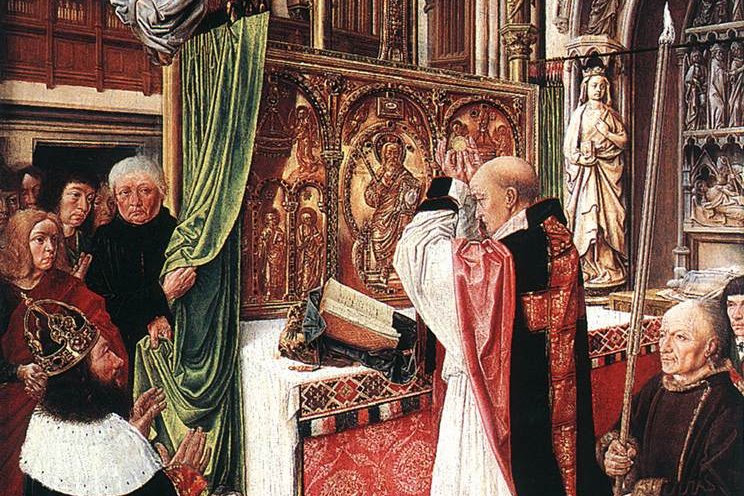
Master of Saint Giles, The Mass of Saint Giles, c. 1500, National Gallery, London — public domain.
This system didn't arrive all at once. Color use in Christian worship developed gradually over the first millennium, with real standardization only settling into something like today's scheme by the late Middle Ages, formalized further after the Council of Trent in the sixteenth century and again after the Second Vatican Council in the twentieth. What emerged is less a rigid rulebook than a visual grammar — a way of letting the eye absorb, instantly, what season the Church is walking through.
White and gold: joy, purity, and the risen Christ
White is the color of joy and triumph, used for the two great festal seasons of the year — Christmas and Easter — along with feasts of Christ that aren't tied to his Passion, feasts of Mary, feasts of angels, and the feast days of saints who weren't martyrs. Gold is treated as an acceptable substitute for white on the most solemn occasions, giving those days an extra visual weight.
The logic is straightforward once you see it: white marks moments the Church wants to hold up as unclouded good news. A wedding at a Catholic parish typically uses white for the same reason a baptism does — both are sacraments centered on new life and covenant, not penance.
Red: blood and fire
Red shows up in two distinct contexts that share a color but not necessarily a mood. It's used on Palm Sunday and Good Friday, when the focus is Christ's Passion and the blood he shed on the cross. It's also used on Pentecost, when the color instead recalls the tongues of fire described in the Acts of the Apostles descending on the disciples, and on the feast days of martyrs, where it again signifies blood — this time that of the saint being honored, shed in witness to the faith.
Confirmation Masses often use red as well, drawing on the Pentecost association, since Confirmation is understood as a deepening outpouring of the same Holy Spirit.
Green: the long ordinary stretch
Green is the color of Ordinary Time, the roughly thirty-three to thirty-four weeks of the year that fall outside the more intensively themed seasons — split into two blocks, one running from after the Christmas season until Ash Wednesday, the other running from after Pentecost until Advent begins again. (For the full shape of how these seasons fit together across the year, see the Saints Home guide to the Catholic liturgical calendar.) Green is meant to suggest growth and hope — the ordinary, unhurried rhythm of a Christian life lived out in the time between the Church's great commemorations, not a lesser or less important stretch, just a less dramatically colored one.
Violet: preparation and repentance
Violet, sometimes called purple, marks Advent and Lent, the Church's two seasons of deliberate preparation. The color signals penance and watchful waiting rather than festivity — a visual cue that something is being readied for, not yet arrived. Violet is also traditionally used for funeral Masses in some places, and for the Sacrament of Reconciliation stole a priest wears, tying the color to repentance more broadly across different contexts, not only the two big seasons.
It's worth noting Advent and Lent are not identical in tone even though they share a color: Advent's violet carries more anticipation than austerity, while Lent's leans harder into penance. The shared color marks a shared category — preparation — without collapsing the two seasons into the same experience. For more on how these two seasons relate to the rest of the year, see the liturgical seasons of the Church year.
Rose: a single day of relief
Rose is the rarest color in ordinary rotation, appearing exactly twice a year: Gaudete Sunday, the third Sunday of Advent, and Laetare Sunday, the fourth Sunday of Lent. Both names come from the Latin opening word of that Sunday's Mass — Gaudete, "rejoice," and Laetare, "rejoice" in a different verb form — and the color functions as a brief loosening of the penitential mood. It signals the season's end is close enough to allow a moment of anticipatory joy, then violet resumes the following week. Not every parish keeps rose vestments on hand, since the occasion is so infrequent, and violet remains a perfectly acceptable substitute where rose isn't available.
Black: the color that mostly disappeared
Black was, for centuries, the standard color for Requiem (funeral) Masses and for All Souls' Day, marking mourning and the sobering reality of death without ambiguity. Since the mid-twentieth century, white and violet have become far more common choices for funerals in most dioceses, reflecting a pastoral shift toward emphasizing the hope of the resurrection alongside grief rather than mourning alone. Black remains a permitted option, and some parishes and religious communities continue to use it, particularly for the Mass on All Souls' Day, but it's now the exception rather than the rule.
Why the system holds together
None of these six colors was chosen arbitrarily, and none stands alone — together they form a single visual vocabulary the Church has maintained, with adjustments, for the better part of a thousand years. A first-time visitor who simply notices the color on the altar cloth already knows, before a word is spoken, whether they've walked into a season of penance, a moment of festival joy, or the long ordinary rhythm of a Christian year that isn't in a hurry to get anywhere in particular. That's the whole point of the system: meaning conveyed instantly, to anyone paying attention, in a language older than most of the languages spoken in the pews.
Trivia
What are the six liturgical colors used in the Catholic Church?
Why is purple used during Advent and Lent?
Why do priests wear red on Palm Sunday, Good Friday, and Pentecost?
What does rose mean, and why does it only appear twice a year?
Is black still used in the Catholic Church today?
Related Reading