The Chaplet of Divine Mercy — How to Pray It

An eighth-grade nun and a diary the Church almost suppressed
Helena Kowalska entered religious life in Poland in 1925, taking the name Sister Maria Faustina, and spent most of her short life — she died of tuberculosis in 1938 at age 33 — performing ordinary convent work as a cook, gardener, and doorkeeper. She had almost no formal education. What she left behind was a diary, kept at the direction of her spiritual director, recording a series of private revelations she believed came from Jesus, centered on the theme of divine mercy.
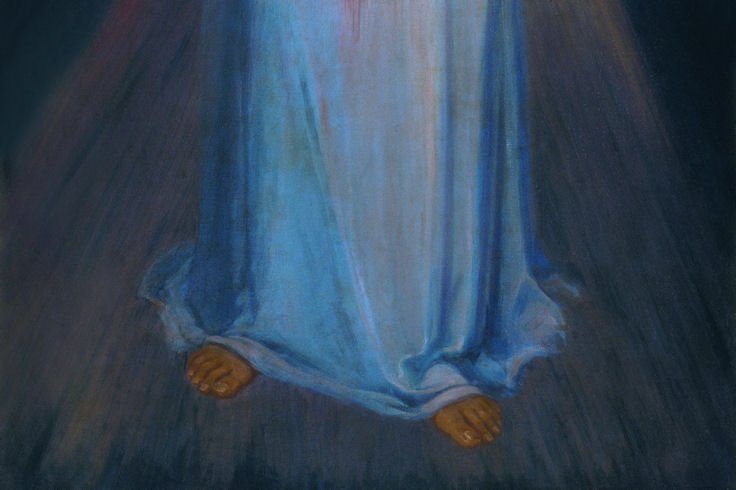
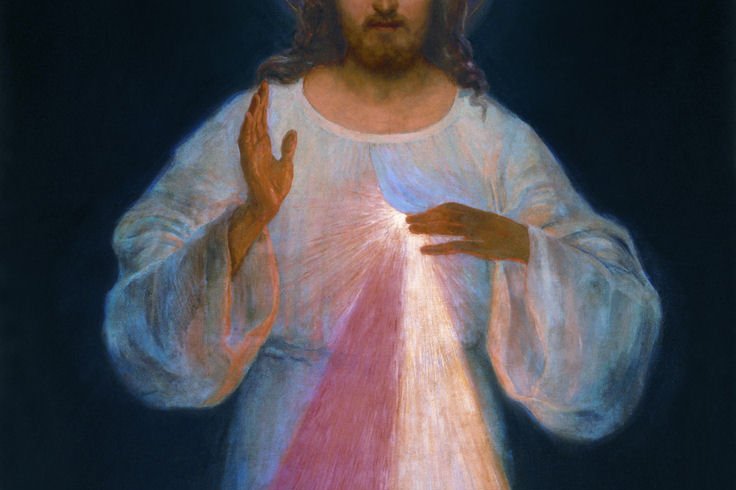
Eugeniusz Kazimirowski, Divine Mercy, 1934, Vilnius — public domain.
Among those entries, dated to September 1935, is the origin of the Chaplet of Divine Mercy: a prayer she recorded Jesus teaching her directly, with instructions to pray it using ordinary rosary beads. The Catholic Church draws a firm distinction between public revelation — the deposit of faith closed with the death of the last apostle — and private revelation like Faustina's, which the faithful are never obligated to believe. But the Church did investigate her writings, and after a period of restriction in the mid-20th century caused by a flawed Italian translation of her diary that produced doctrinally confusing passages, the Vatican lifted those restrictions in 1978 following a review of the original Polish text. Faustina was beatified in 1993 and canonized by Pope John Paul II in 2000 — a pope who had grown up in the same region of Poland and became one of the devotion's strongest promoters.
The words, bead by bead
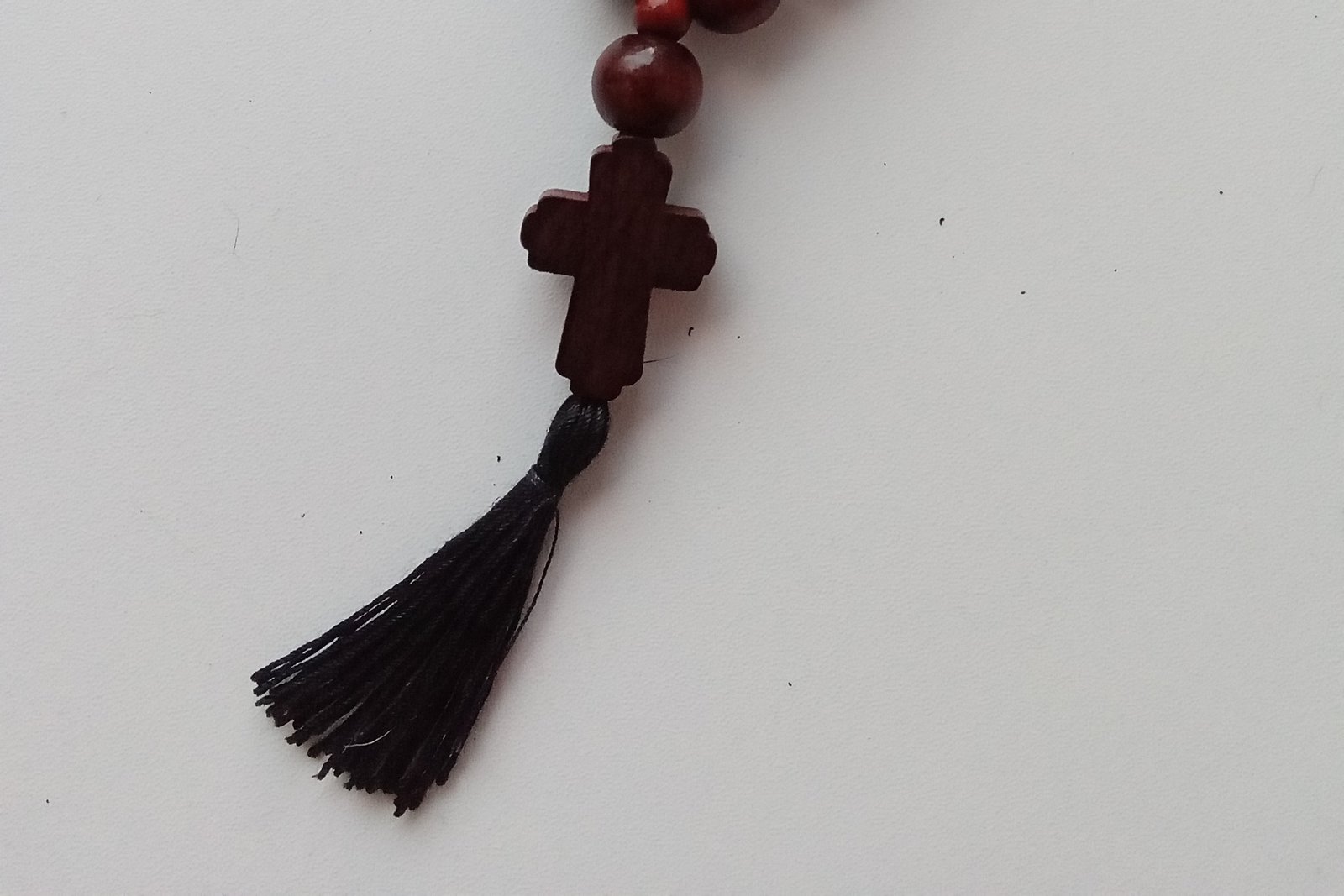
The chaplet uses a standard five-decade rosary, but replaces every prayer with new wording. It opens with an Our Father, a Hail Mary, and the Apostles' Creed, then moves into the chaplet proper:
On each of the four large "Our Father" beads that begin each decade:
Eternal Father, I offer you the Body and Blood, Soul and Divinity of your dearly beloved Son, Our Lord Jesus Christ, in atonement for our sins and those of the whole world.
On each of the ten small beads that follow:
For the sake of His sorrowful Passion, have mercy on us and on the whole world.
After all five decades, the chaplet closes with this line prayed three times:
Holy God, Holy Mighty One, Holy Immortal One, have mercy on us and on the whole world.
Many who pray it add a closing prayer Faustina also recorded, beginning "Eternal God, in whom mercy is endless," though this closing is a devotional addition rather than a fixed part of the chaplet itself.
Why 3:00 p.m.
The chaplet is most closely associated with what the devotion calls the Hour of Great Mercy — 3:00 p.m., the hour tradition holds Christ died on Good Friday. This dating follows the Gospel accounts, which describe darkness covering the land from the sixth hour to the ninth hour before Jesus "cried out again in a loud voice, and gave up his spirit" (Matthew 27:50, NABRE), a span that in the Gospels' Roman-era timekeeping corresponds roughly to noon until 3:00 p.m. Faustina's diary records Jesus asking that this hour be observed with particular attention to his Passion and mercy — either through the chaplet itself or simply a moment of prayer, wherever one happens to be.
Divine Mercy Sunday
Closely tied to the chaplet is Divine Mercy Sunday, the Sunday immediately following Easter, which Faustina's diary records Jesus specifically requesting as a feast honoring divine mercy. Pope John Paul II established it as an official feast for the universal Church at Faustina's canonization Mass in 2000, replacing what had previously been known simply as the Octave of Easter or "Low Sunday" with this dedicated observance — one of the clearest examples of a private revelation directly shaping the Church's liturgical calendar in modern times.
The Divine Mercy image itself
Alongside the chaplet, Faustina's diary also records a specific instruction to have an image painted of what she described seeing in a vision: Christ with one hand raised in blessing and the other touching his breast, from which two rays stream outward — one pale, one red, which the devotion interprets as representing the water and blood that flowed from Christ's side at the crucifixion (John 19:34), and, more broadly, the sacraments of Baptism and the Eucharist. The image typically carries the inscription "Jesus, I trust in You" beneath it. The first version, painted in Vilnius in 1934 under Faustina's direction by the artist Eugeniusz Kazimirowski, became the template for the now widely reproduced Divine Mercy image found in churches and homes worldwide, closely associated with both the chaplet and Divine Mercy Sunday.
How it fits alongside other Catholic prayer
Unlike the Rosary, which meditates on the Mysteries of Christ's life through the Hail Mary, the chaplet is entirely focused on Christ's Passion and the plea for mercy — closer in tone to a litany than a meditative cycle. It's commonly prayed as a novena in the nine days leading up to Divine Mercy Sunday, following a pattern Faustina recorded for interceding for specific groups of souls each day, but it's equally common as a standalone daily prayer, particularly at 3:00 p.m. or for someone who is dying, which the devotion holds it to be especially suited for.
Trivia
Who revealed the Chaplet of Divine Mercy, and when?
What prayer beads are used for the Chaplet of Divine Mercy?
What are the exact words of the Chaplet of Divine Mercy?
Why is the Chaplet of Divine Mercy traditionally prayed at 3:00 p.m.?
Is the Divine Mercy devotion officially recognized by the Catholic Church?
You May Also Like
Related Reading