The Role of a Catholic Godparent


More than a name on a certificate
Ask most Catholics what a godparent does, and the answer usually centers on the baptism ceremony itself: standing near the font, perhaps holding a candle, signing a certificate afterward. The Church's own description of the role, laid out in the Catechism, goes considerably further than that one-day picture. "For the grace of Baptism to unfold, the parents' help is important. So too is the role of the godfather and godmother, who must be firm believers, able and ready to help the newly baptized — child or adult — on the road of Christian life. Their task is a truly ecclesial function" (CCC 1255). Read carefully, that passage places the godparent alongside the parents themselves as someone whose ongoing help matters to whether the grace given at Baptism actually takes root and grows in the person's life — not a witness to a single event, but a participant in a long process.
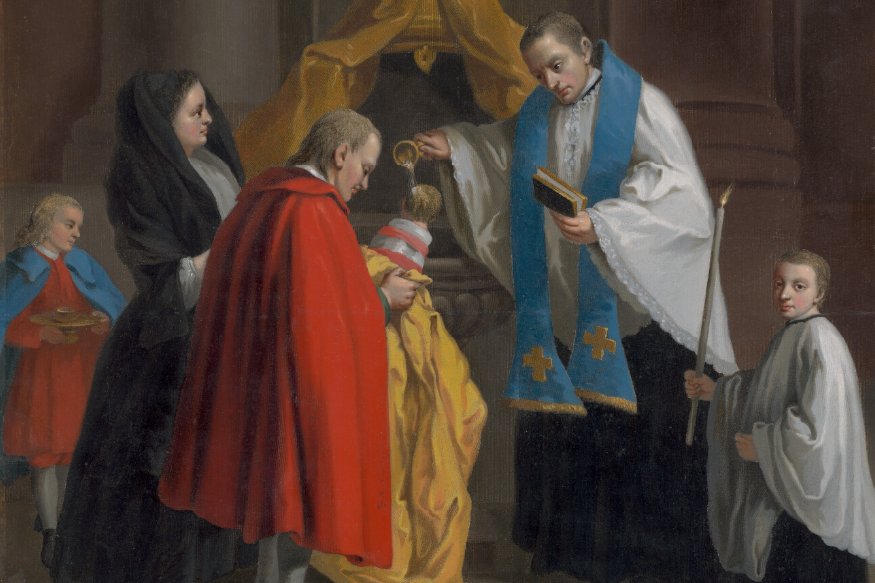
Pietro Longhi, Baptismi Sacramentum (18th century), public domain via Wikimedia Commons
What "ecclesial function" means
The phrase the Catechism uses — "a truly ecclesial function" — is doing specific work. It signals that the godparent's role isn't simply a personal or family arrangement, a favor asked of a trusted friend or relative and granted as an honor. It's a responsibility the Church itself recognizes formally, connecting the individual godparent's task to the Church's own broader mission of forming believers in the faith. The same paragraph adds that "the whole ecclesial community bears some responsibility for the development and safeguarding of the grace given at Baptism" (CCC 1255) — placing the godparent's individual task within that larger communal responsibility, rather than treating faith formation as something that belongs to parents and godparents alone, separate from the wider Church.
Who can actually take on the role
Because the role carries real responsibility, canon law sets out specific requirements for who is eligible to serve as a godparent. A godparent must be a practicing Catholic who has already received Confirmation and the Eucharist, must be living a life consistent with the faith and with the role being undertaken, and must be at least sixteen years old, though canon law allows the local bishop to establish a different age or grant an exception. A godparent also cannot be the child's own father or mother — the role is specifically meant to bring someone beyond the immediate parents into a formal relationship with the child's faith formation. A baptized Christian belonging to a non-Catholic community can participate as a Christian witness alongside a Catholic godparent, but canon law doesn't permit them to serve as the sole or primary godparent in a Catholic baptism.
One or two, never more
Canon law is also specific about numbers: a baptism calls for either one godparent, who may be male or female, or two godparents, one man and one woman — not three, four, or more, whatever family or cultural custom might sometimes suggest. That limit keeps the role focused rather than diffused among a large group of well-wishers, reinforcing that this is meant to be a defined, personal responsibility taken on by one or two specific people, not an honorary title extended broadly to everyone close to the family.
Where the practice comes from
Godparents aren't a medieval or modern invention layered onto baptism — the practice traces back to the early Church, when adult converts preparing for baptism needed a sponsor, someone already established in the faith, to vouch for their sincerity and guide them through the process of initiation. As infant baptism became the Church's more common practice over the following centuries, the sponsor's role shifted accordingly: rather than vouching for an adult's own preparation, the godparent took on responsibility for standing in, alongside the parents, for a faith the infant couldn't yet profess for themselves. The underlying logic — someone beyond the immediate family formally committed to a person's growth in faith — has stayed constant even as the specific shape of the role adapted to who was actually being baptized.
A spiritual relationship the Church still recognizes
Catholic tradition has historically described the bond created at baptism between godparent and godchild, and between godparent and the child's own parents, using the language of spiritual kinship — sometimes called compaternitas in canonical history, a relationship treated with enough seriousness that medieval canon law even barred marriage between a godparent and certain of the godchild's close relatives, similar to rules governing blood relation. While that specific marriage restriction isn't part of current canon law, the underlying idea persists in how the Church frames the role: this isn't a loose social connection but a recognized bond, carrying real obligations in both directions, between the godparent and a family that isn't biologically their own.
Choosing a godparent thoughtfully
Because the role carries this much weight, parents are encouraged to choose godparents deliberately rather than defaulting to whichever relative or close friend seems due for the honor. A good choice is someone whose own faith life the parents can actually point to as worth imitating — someone who prays, who practices the sacraments regularly, and who's likely to remain a steady presence in the child's life for years, not just for the day of the ceremony. Many families also look for a connection between the godparent and the child's patron saint, whether through a shared name, a shared feast day, or simply a godparent with a personal devotion to that saint — a small way of tying the spiritual sponsorship of a living person to the intercession of a saint already believed to be watching over the child.
A relationship meant to outlast the ceremony
What the Catechism's language makes clear is that a godparent's real work begins, rather than ends, at the baptismal font. Helping someone "on the road of Christian life" describes a relationship extended across years, not an afternoon — practically, this can mean anything from praying for the godchild regularly, to being present and involved as they grow, to serving again in a similar formal role when the child is later prepared for Confirmation, where a sponsor plays a closely related part. Not every godparent lives up to that fuller picture in practice, and distance or circumstance can make sustained involvement difficult — but the role the Church actually describes is considerably weightier, and longer-lasting, than the single ceremonial moment most people picture when they hear the word.
Trivia
What does the Catechism say a godparent's role actually is?
What does it mean that a godparent's task is a 'truly ecclesial function'?
What are the basic requirements to serve as a Catholic godparent?
How many godparents can a person have?
Does a godparent's responsibility end after the baptism ceremony?
Related Reading