The Seven Sacraments of the Catholic Church, Explained

Seven doors, one house
Catholic life is punctuated by seven of these thresholds, and the Church has a technical word for the whole set: sacraments, "efficacious signs of grace" as the Catechism puts it — visible rites (water, oil, bread, wine, the laying on of hands) that don't just symbolize an invisible reality but actually communicate it (CCC 1131). The number seven wasn't casually chosen. It was fixed dogmatically at the Council of Trent in the sixteenth century, closing off a long medieval process of sorting which rites counted and which didn't, and it holds firm across the whole Catholic and Eastern Orthodox world today.
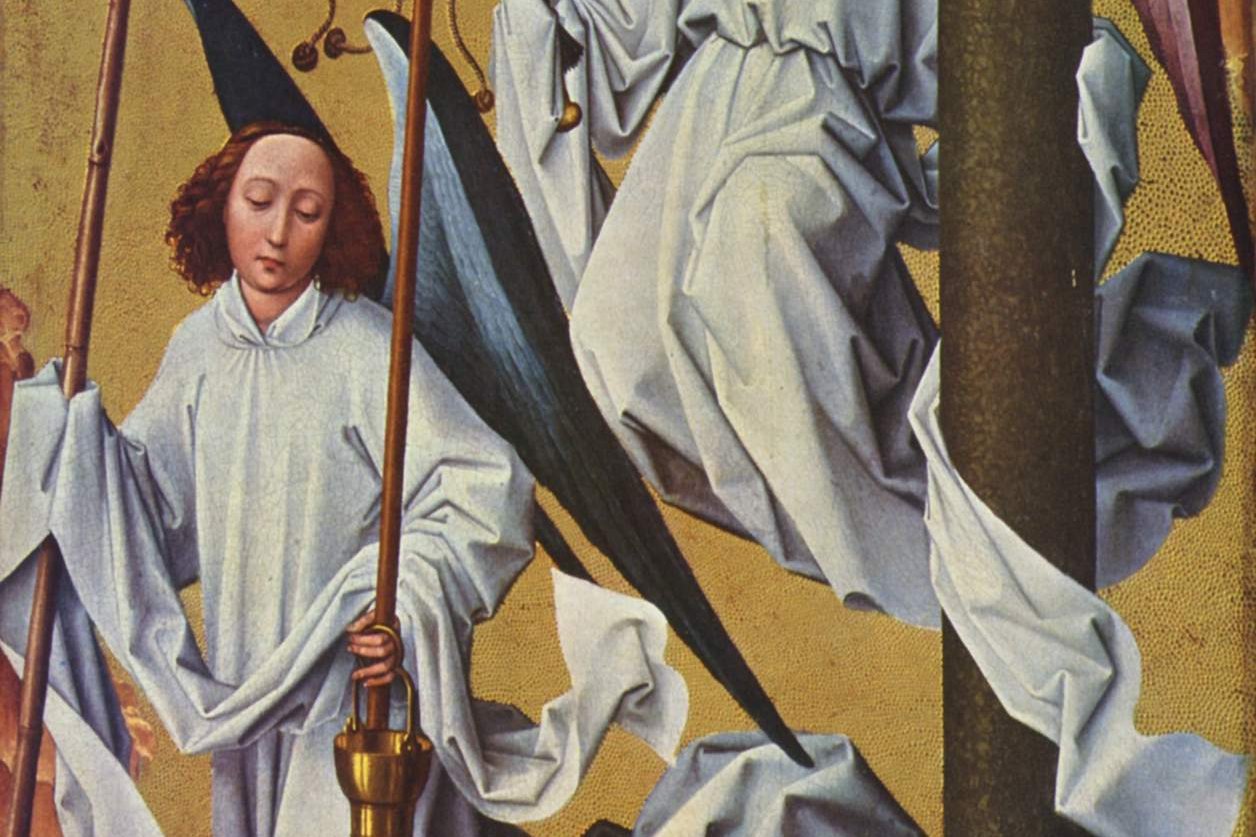
Rogier van der Weyden, The Seven Sacraments Altarpiece, c. 1448–1451 (public domain)
The Catechism doesn't just list the seven — it groups them, and the grouping is the key to understanding what they're for. There are sacraments that get you in (initiation), sacraments that patch you up when something goes wrong (healing), and sacraments that send you out to serve others (communion and mission). Walking through them in that order tells a more coherent story than a flat alphabetical list ever could.
The sacraments of Christian initiation
Baptism
Baptism is the door. Whether it's an infant in a font or an adult stepping into a pool at the Easter Vigil, the water and the words — "I baptize you in the name of the Father, and of the Son, and of the Holy Spirit" — wash away original sin and every personal sin committed before that moment, and make the person a member of the Church for the first time. It's the foundation every other sacrament builds on; nobody receives any of the other six without first having received this one.
Confirmation
Confirmation completes what Baptism begins. Through anointing with sacred chrism and the laying on of hands by a bishop (or a priest delegated by one), the Holy Spirit is given in a fuller way, "strengthening" the baptized — the literal meaning of "confirm" — for adult participation in the Church's mission. In the Latin Church it's typically celebrated in the teenage years; in the Eastern Catholic and Orthodox Churches it's usually given to infants immediately after Baptism.
Eucharist
The Eucharist is, in the Church's own words, "the source and summit of the Christian life" (CCC 1324). At Mass, bread and wine become the Body and Blood of Christ — not a symbol of his presence but, Catholics believe, his actual presence — and receiving Communion nourishes and completes the initiation begun at the font. Every other sacrament, the Catechism says, is ordered toward this one.
The sacraments of healing
Reconciliation
Also called Confession or Penance, this is the sacrament where sins committed after Baptism are forgiven through a priest's absolution, following a penitent's contrition, confession, and willingness to make amends. It restores a relationship with God — and with the Church — that sin has damaged, and Catholics are encouraged to receive it regularly, not only in moments of crisis.
Anointing of the Sick
Anointing of the Sick brings the grace of the Holy Spirit to those suffering serious illness or facing surgery, old age, or danger of death, through anointing with oil and prayer. Contrary to a common misconception, it isn't only for the dying — it's meant for anyone seriously ill, and can be received more than once if a person's condition changes or recurs.
The sacraments at the service of communion
Holy Orders
Holy Orders configures a man to Christ as priest, prophet, and king through the three degrees of bishop, priest, and deacon, empowering him to serve the Church sacramentally — to celebrate the Eucharist, absolve sins, and lead a Christian community. Like Baptism and Confirmation, it leaves what the Church calls an indelible mark and is never repeated.
Matrimony
Matrimony is the covenant in which a baptized man and woman establish a lifelong partnership ordered toward the good of the spouses and the procreation and raising of children, and it becomes, in Catholic theology, a living sign of Christ's love for the Church. Like Holy Orders, it exists to build up others — the family, and through the family, the wider community of faith.
Matter, form, and why the words matter as much as the water
Catholic sacramental theology describes every sacrament as needing two things to be valid: "matter" and "form." The matter is the physical element used — water for Baptism, oil for Anointing of the Sick, bread and wine for the Eucharist. The form is the specific words spoken over that matter, the verbal formula that makes clear what's actually happening. Pour water over someone's head while saying nothing, or say the baptismal words over sand instead of water, and by the Church's own theology, no sacrament occurs — both pieces have to be present together, the visible action and the spoken meaning of that action, for grace to be understood as genuinely conveyed.
This is also why the Church insists a minister must intend to do what the Church does when administering a sacrament, even if his personal faith is weak or his life imperfect. The validity of Baptism, for instance, doesn't depend on the holiness of the person pouring the water — a principle called ex opere operato ("from the work performed"), meaning the sacrament's effectiveness rests on Christ's own action working through the rite, not on the worthiness of the human minister carrying it out. It's a teaching that offered real reassurance to ordinary medieval Catholics who couldn't always be certain their priest was living well, and it still matters today for the same reason.
Sacramentals: a related but distinct category
Alongside the seven sacraments, Catholic practice includes a wider set of blessed objects and practices called sacramentals — holy water, blessed medals, the Sign of the Cross, rosaries, ashes on Ash Wednesday. These are not sacraments in the strict theological sense; Christ didn't institute them directly the way Catholic teaching holds he instituted Baptism or the Eucharist, and they don't confer grace in the same guaranteed way. Instead, sacramentals dispose a person toward grace, preparing the heart and mind to receive it more readily, largely through the prayers of the Church accompanying their use. Holy water at the entrance to a church, for example, invites a small renewal of baptismal intention every time someone dips their fingers in it — a humble echo of the sacrament of initiation it points back toward.
Why the sevenfold structure matters
Seen together, the seven sacraments trace a life: they welcome a person in, feed and strengthen them, heal what breaks along the way, and send some out to serve as priests, deacons, or spouses. It's less a checklist than a shape — one the Church believes Christ himself gave it, meeting ordinary human moments (birth, growth, illness, service, love) with an extraordinary claim: that grace really does pass through matter, water and oil and bread and the words spoken over them.
Trivia
What are the seven sacraments of the Catholic Church?
Who established the seven sacraments?
Why do Protestants recognize only two sacraments?
Can every sacrament be received more than once?
What is the difference between the sacraments of initiation and the sacraments of healing?
You May Also Like
Related Reading