Transubstantiation Explained: What Catholics Believe About the Eucharist

The word, and why it isn't just theological jargon
"Transubstantiation" is a compound of the Latin trans- ("across" or "change") and substantia ("substance"). The word can sound like intimidating scholastic machinery, but the idea it names has been part of Christian belief about the Eucharist since the earliest centuries — the specific term was simply adopted later, at the Fourth Lateran Council in 1215, to give precise philosophical language to something the Church already believed and celebrated at every Mass. The Council of Trent, responding directly to Reformation-era challenges to the doctrine, restated it carefully: "by the consecration of the bread and wine there takes place a change of the whole substance of the bread into the substance of the body of Christ our Lord... This change the holy Catholic Church has fittingly and properly called transubstantiation" (quoted in CCC 1376).
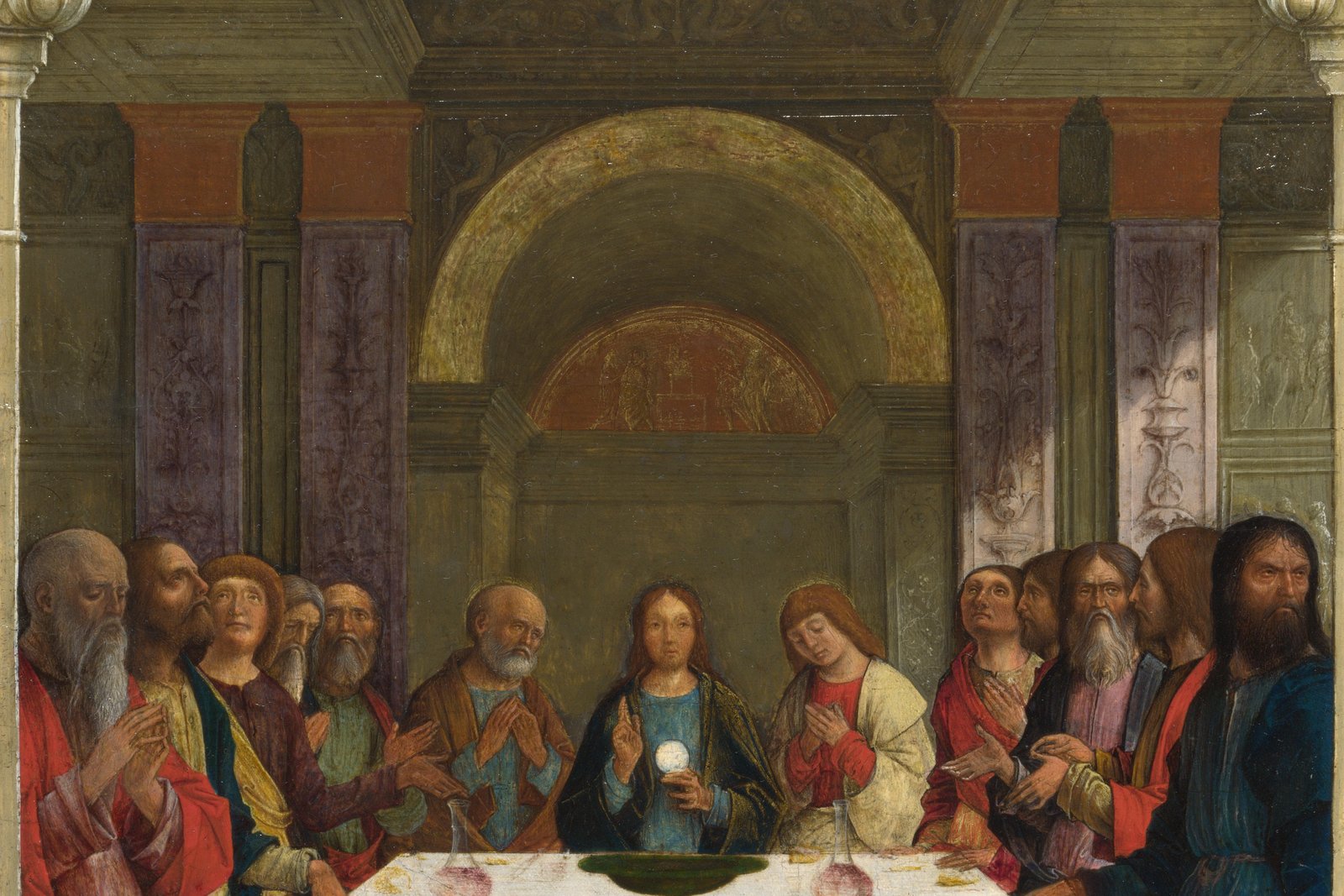
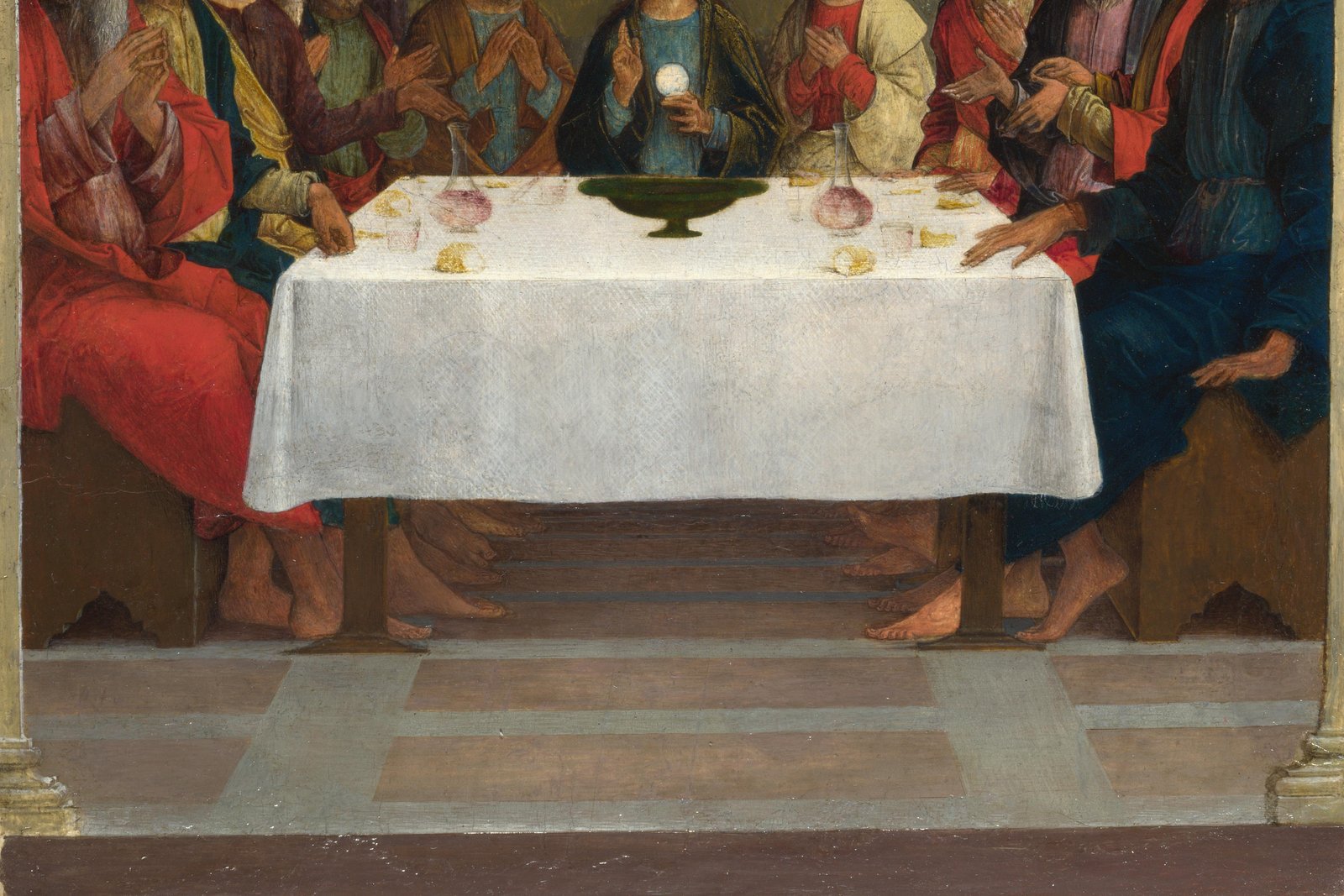
Ercole de' Roberti, The Institution of the Eucharist, c. 1490s, National Gallery, London — public domain.
Substance and accidents: the distinction that does all the work
To understand what's actually being claimed, it helps to know the philosophical vocabulary the Church borrowed — largely from Aristotelian philosophy as developed by theologians like Saint Thomas Aquinas — to explain it. "Substance" refers to what something fundamentally is, its underlying reality. "Accidents" (sometimes called "species") refer to its observable, measurable properties: color, taste, weight, chemical structure, everything a laboratory could detect.
Catholic teaching holds that at the moment of consecration, the substance of the bread and wine changes entirely into the Body and Blood of Christ, while the accidents — everything physically observable — remain exactly those of bread and wine. Nothing changes under a microscope, on the tongue, or in a chemical analysis, because those tools only ever measure accidents, never substance. This is precisely why the Church rejects the common caricature that Catholics believe they're eating detectable human tissue: the doctrine explicitly denies that any physical change occurs, while affirming that the deepest reality of what's present has changed completely (CCC 1374-1377).
The biblical basis for the claim
The doctrine's starting point is Christ's own words at the Last Supper, instituting the Eucharist the night before his crucifixion. Taking bread, he said, "Take and eat; this is my body," and over the cup, "this is my blood of the covenant, which will be shed on behalf of many for the forgiveness of sins" (Matthew 26:26-28, NABRE) — language the Church has always read as intentional and literal, not merely a poetic gesture toward memory or symbol.
The other pillar is John chapter 6, where Jesus tells a crowd, "Whoever eats my flesh and drinks my blood remains in me and I in him." (John 6:56), insisting on the point even as it scandalizes many listeners. The Gospel records that "many of his disciples... walked no more with him" after this teaching (John 6:67) — and notably, Jesus does not call them back to clarify that he only meant it symbolically, a detail the Church has long taken as evidence the literal reading was the intended one, since a merely figurative teaching would have been an easy misunderstanding for Jesus to correct.
What actually happens at Mass
During the Mass, at the point called the consecration, the priest repeats Christ's words over the bread and wine — "This is my body... this is my blood" — acting, Catholic teaching holds, in persona Christi, in the person of Christ, not merely narrating a past event. The Catechism describes what results as a "real" presence "in the fullest sense": Christ "wholly and entirely" present, "body, blood, soul, and divinity," under what still appear to be ordinary bread and wine (CCC 1374, quoting the Council of Trent). This is called the Real Presence, and it's the reason Catholics genuflect toward the tabernacle where consecrated hosts are reserved, and why Eucharistic adoration — quiet prayer before the consecrated host displayed in a monstrance — is a significant devotional practice in Catholic life.
How this differs from other Christian views of Communion
This is one of the sharpest doctrinal lines separating Catholic from Protestant Christianity, discussed more broadly in Catholic vs. Protestant Differences. Many Protestant traditions, following reformers like Zwingli, hold a symbolic or memorial view: the bread and wine represent Christ's body and blood without becoming them in any substantial sense. Others, notably Martin Luther's own tradition and some strands of Anglicanism, affirm a genuine real presence of Christ in the Eucharist without adopting the specific Aristotelian substance-and-accidents framework of transubstantiation as the Catholic Church defines it — a real but differently explained presence, rather than a purely symbolic one.
Why the doctrine matters beyond philosophy class
None of this is presented by the Church as abstract metaphysics for its own sake. The stakes, in Catholic belief, are that Communion is not primarily a remembrance or a symbol of Christ's sacrifice, but a real encounter with the same Christ who died and rose — received, as the Catechism puts it, as "the source and summit of the Christian life" (CCC 1324). That's the weight behind the careful, precise language of substance and accident: not an attempt to complicate a simple ritual, but an attempt to state, as exactly as language allows, what the Church has believed happens at the altar since its very first celebrations of the Lord's Supper.
Trivia
What does transubstantiation actually mean?
Do Catholics believe they are eating literal human flesh?
Where does this teaching come from in the Bible?
Do all Christians believe in transubstantiation?
When did the Church formally define this teaching?
Related Reading