What Happens at Confirmation? The Rite Explained

Not a graduation ceremony
A lot of confusion around Confirmation starts with what it looks like from the outside — a formal, once-in-a-lifetime church event with robes, a bishop, and often a class of teenagers dressed for the occasion. That surface resemblance to a school graduation misleads people into treating Confirmation as a completion ceremony, a mark that a young Catholic has finished religious education. The Church's own theology says something different: Confirmation doesn't graduate anyone out of anything. It completes, sacramentally, what began at Baptism, deepening a bond that's meant to be lived out actively for the rest of a person's life, not filed away as accomplished. Picking a Confirmation saint beforehand is part of that same forward-looking logic — a patron chosen to accompany a lifelong relationship, not to mark its end.
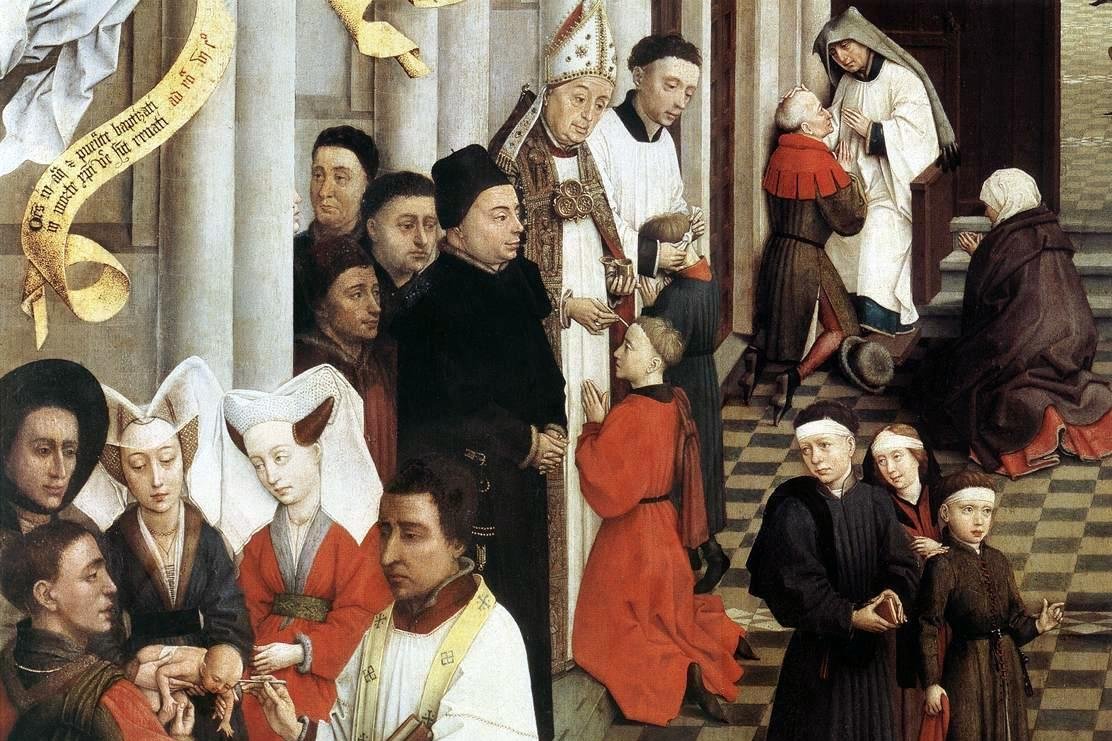
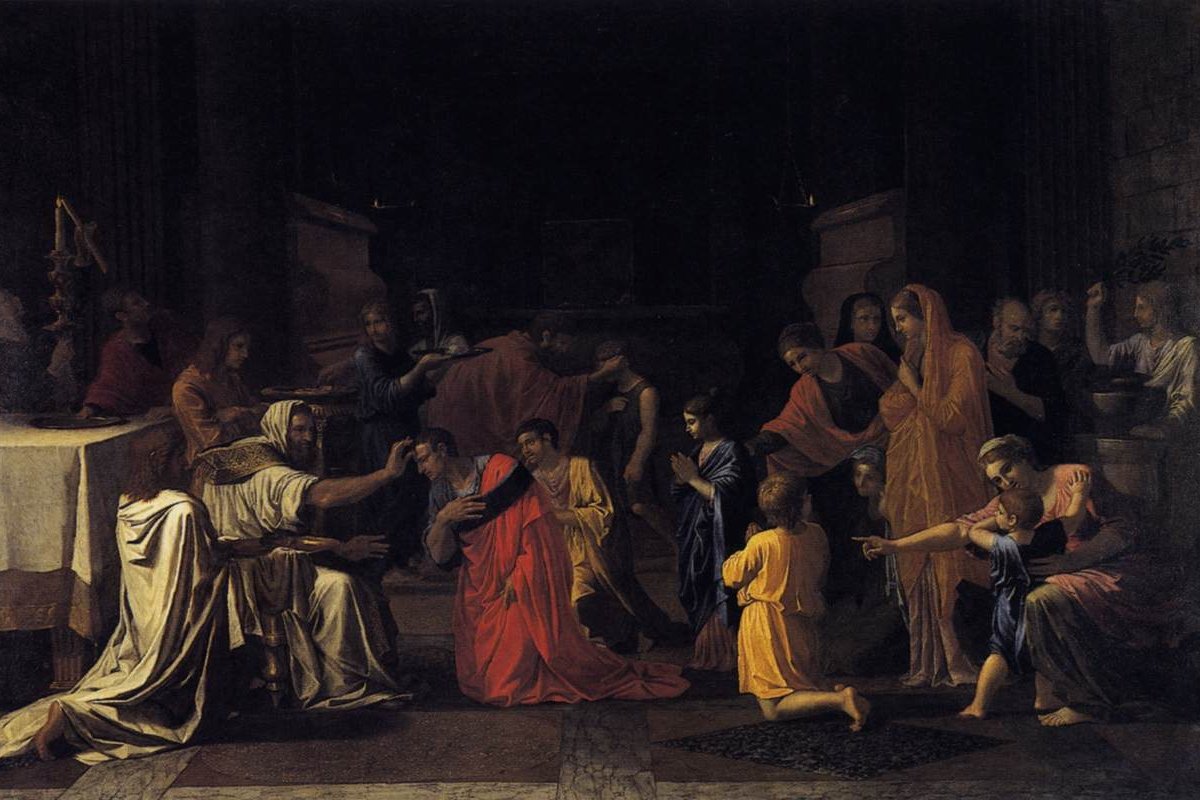
Rogier van der Weyden, "Seven Sacraments Altarpiece" (Confirmation panel), c. 1445-1450, Royal Museum of Fine Arts Antwerp — public domain.
The structure of the rite itself
Confirmation is normally celebrated within Mass, and the rite has a clear sequence. After the homily, candidates are called forward, often by name, and renew their baptismal promises together — rejecting sin and professing faith in essentially the same words used at Baptism, reinforcing that this sacrament is explicitly tied to that earlier one, not a separate event standing on its own. The bishop then extends his hands over the whole group and prays for the sevenfold gifts of the Holy Spirit: wisdom, understanding, counsel, fortitude, knowledge, piety, and fear of the Lord — language drawn from Isaiah 11:2-3 and central to Catholic teaching on what Confirmation specifically strengthens in a believer.
The anointing: the sacrament's central act
The heart of the rite comes next. Each candidate, usually with a sponsor's hand on their shoulder, approaches the bishop individually. The bishop dips his thumb in chrism — consecrated, perfumed oil — and traces a cross on the candidate's forehead while speaking the sacramental formula: "Be sealed with the Gift of the Holy Spirit." The candidate answers, "Amen." That exchange, brief as it is, is the sacramental act itself — everything before it in the Mass is preparation, and everything after is response. The Eastern Catholic and Orthodox churches use very similar language for their parallel sacrament, chrismation, which underscores how ancient this formula's roots actually are, even though the precise Latin-rite wording was revised by Pope Paul VI in 1971.
What chrism is, and why it matters that it's chrism
Not just any oil will do. Chrism specifically is olive oil (or a similar base oil) blended with balsam or another fragrant substance, consecrated once a year, typically at the Chrism Mass celebrated by the bishop during Holy Week, alongside the oils used for the sick and for catechumens. Its use is deliberately restricted to three sacraments involving a permanent seal on the soul in Catholic theology: Baptism (on the crown of the head), Confirmation (on the forehead), and Holy Orders (on the hands of a newly ordained priest, or the head of a newly ordained bishop). That overlap is theologically pointed — the Church is signaling, through the shared material, that Confirmation belongs to the same family of permanent, character-imprinting sacraments as Baptism and priestly ordination, not a lesser or optional add-on.
Why a bishop, specifically
Ordinarily, only a bishop confirms in the Latin Church, which is why Confirmation Masses often happen only when the bishop can personally visit a parish, sometimes creating years-long gaps between visits in large dioceses. This isn't incidental. The Church has historically tied Confirmation to the bishop's ministry specifically to emphasize the candidate's connection to the wider Church beyond their home parish — a link back to the apostles, whose successors bishops are considered to be. In practice, bishops frequently delegate the faculty to confirm to priests, especially pastors confirming adult converts at the Easter Vigil (where Baptism, Confirmation, and First Communion are often received together in a single liturgy) or when a diocese's size makes the bishop's personal presence at every parish impractical.
The tap on the cheek, mostly retired
Older Catholics sometimes recall, or ask about, a light tap or slap on the cheek that historically accompanied the anointing, a gesture with roots in medieval symbolism of a soldier being struck to remember his readiness to endure hardship for Christ. The 1971 revision of the rite largely dropped this gesture from the Roman rite's official text, though the underlying symbolism — that Confirmation strengthens a Catholic for active discipleship, not passive belief — remains very much part of the Church's teaching on what the sacrament is for, expressed now mainly through the sevenfold gifts prayer rather than a physical gesture.
What the Church says actually changes
Catholic theology holds that Confirmation imprints an indelible spiritual mark, called a character, on the soul, meaning it — like Baptism and Holy Orders — cannot be repeated or undone (CCC 1304). Practically, the Church teaches the sacrament increases and deepens the graces of Baptism, roots a person more firmly as a child of God, and unites them more perfectly to Christ and the Church, while strengthening their bond to those seven gifts of the Spirit named centuries ago in Isaiah's prophecy of the coming Messiah (CCC 1303). None of that is visible in the ceremony itself — a thumb, some oil, a sentence — which is exactly the point Catholic sacramental theology keeps returning to: the outward sign is simple, deliberately so, precisely because what it's understood to accomplish is not.
Trivia
Who normally administers Confirmation in the Catholic Church?
What are the exact words spoken during Confirmation?
Why does the bishop lightly tap or touch the candidate's cheek?
What is chrism, and how is it different from the oil used at Baptism?
Do candidates choose a sponsor for Confirmation the way they do a godparent for Baptism?
You May Also Like
Related Reading