The Cathedral of Córdoba: A Church Built Inside a Mosque

Layers of empire, one on top of the other
The site occupied by the Cathedral of Córdoba has carried religious buildings for well over a thousand years, and each layer of that history remains at least partly visible in the structure that stands today. Archaeological evidence indicates the site held a Visigothic Christian church, the Basilica of Saint Vincent, before the Umayyad conquest of the Iberian Peninsula in the early 8th century. In 785, the Umayyad emir Abd al-Rahman I began construction of a new mosque on the site, reportedly purchasing the existing church from the Christian community rather than simply seizing it, and the Great Mosque of Córdoba grew through several major expansions over the following two centuries under his successors, eventually becoming one of the largest and most architecturally significant mosques in the Islamic world, a testament to Córdoba's status as the capital of a wealthy, sophisticated Umayyad caliphate that briefly rivaled Baghdad and Constantinople in scale and cultural achievement.
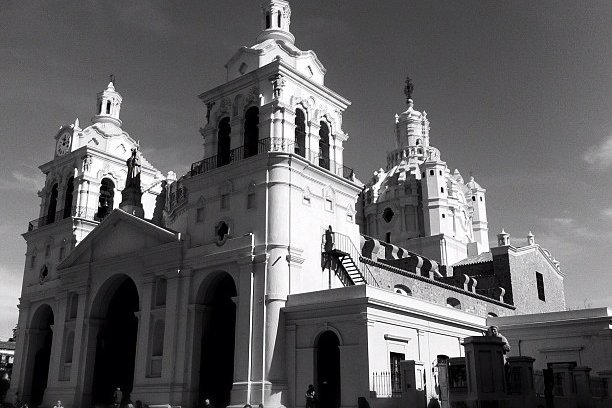
Photograph by Mtoranzo, Catedral de Córdoba, Spain — CC BY-SA 3.0, Wikimedia Commons.
The mosque's defining architectural feature — a vast hypostyle prayer hall filled with hundreds of columns supporting a distinctive system of two-tiered, alternating red-and-white voussoir arches — was designed in part to reuse columns and capitals salvaged from earlier Roman and Visigothic buildings across the region, giving the structure both remarkable material diversity and a visual rhythm still striking to modern visitors. At its largest extent, the mosque covered nearly six acres and could hold tens of thousands of worshippers, reflecting Córdoba's status at the time as one of the largest and most populous cities in Europe.
Reconquest, and a cathedral built inside a mosque
Córdoba fell to the forces of King Ferdinand III of Castile in 1236, during the broader Christian Reconquista of the Iberian Peninsula, and the mosque was promptly consecrated as a Catholic cathedral, with relatively modest initial modifications — a chapel here, an altar there — inserted into the existing Islamic structure without fundamentally altering its overall form. That changed dramatically in the 16th century, when the Bishop of Córdoba and the cathedral chapter secured permission from Holy Roman Emperor Charles V to construct a full Renaissance-style cathedral nave, choir, and transept directly through the center of the old mosque's hypostyle hall, a massive undertaking that proceeded between 1523 and 1607.
The insertion required demolishing a substantial section of the mosque's original columned hall to make room for the new Gothic-Renaissance structure rising through the middle of the building, an intervention that has generated debate among historians and preservationists ever since — even, according to a widely repeated but unverified anecdote, from Charles V himself, who is said to have expressed regret upon seeing the finished result, remarking that the builders had destroyed something unique to build something that could be found anywhere. Whatever the truth of that specific story, the outcome today is a genuinely singular building: walk through the surviving mosque hall and you move through an unmistakably Islamic architectural space, but arrive at the center and you find yourself inside a soaring Spanish Renaissance cathedral, choir stalls, altarpieces, and all.
A name that holds both histories
The building's official Spanish name, Mezquita-Catedral — literally "Mosque-Cathedral" — reflects an unusually direct acknowledgment of its layered identity, used by both the Spanish Catholic Church, which administers the site as an active cathedral, and by tourism and heritage authorities describing it to visitors. The building continues to function as a working Roman Catholic cathedral, holding regular Masses and remaining the seat of the Diocese of Córdoba, even as it draws millions of annual visitors specifically for its Islamic architectural heritage — a duality the Church has maintained rather than downplayed, treating the site's Islamic history as a documented and significant part of the building's identity rather than something to be minimized. Comparisons are sometimes drawn to Toledo Cathedral and other former Spanish mosques converted to churches during the Reconquista, though few retain anything close to the scale and completeness of the original Islamic structure that survives at Córdoba.
A UNESCO landmark today
The Cathedral of Córdoba was inscribed as part of the Historic Centre of Córdoba on the UNESCO World Heritage list in 1984, recognized for its exceptional testimony to the succession of civilizations — Roman, Visigothic, Islamic, and Christian — that have shaped the city across two millennia. It remains one of the most visited monuments in Spain, drawing visitors and scholars from around the world interested in Islamic architecture, Spanish Renaissance church design, and the complex, sometimes contested history of religious coexistence and conquest that produced a building unlike almost any other in the world.
The building's most photographed feature remains the so-called forest of columns, a vast hall of more than 850 surviving columns supporting double-tiered red-and-white striped arches, a design achieved by reusing salvaged columns from earlier Roman and Visigothic buildings across the region — a practical solution to the scale of the original mosque's construction that has since become one of the most instantly recognizable interior spaces in world architecture, photographed and studied as much for its structural ingenuity as for its later Catholic additions.
Trivia
Why does the Cathedral of Córdoba look like a mosque from the inside?
When did the building become a Christian cathedral?
Was Emperor Charles V in favor of building a cathedral nave inside the mosque?
Why is the building called the Mezquita-Catedral?
Is the Cathedral of Córdoba a UNESCO World Heritage Site?
Related Reading