Aachen Cathedral

Building a Roman Empire's Church in the Dark Ages
By the late 8th century, most of what is now Germany, France, and the Low Countries had seen very little large-scale stone building since the fall of the Western Roman Empire three centuries earlier. Charlemagne, the Frankish king who would be crowned Holy Roman Emperor by Pope Leo III on Christmas Day in the year 800, set out to change that at his chosen residence in Aachen — a city he favored partly for its natural hot springs, which had drawn Roman settlers there centuries before.
Photograph by CEphoto, Uwe Aranas, Aachen Cathedral exterior — CC BY-SA 3.0, Wikimedia Commons.
Construction of the Palatine Chapel, the octagonal core that still forms the heart of today's cathedral, began around 796 and was largely complete by 805, when it was consecrated by Pope Leo III himself. Charlemagne's architects, working under the direction of a builder named Odo of Metz, modeled the design directly on the Basilica of San Vitale in Ravenna, a 6th-century Byzantine church built under Emperor Justinian — Charlemagne was consciously invoking the authority and grandeur of the earlier Roman and Byzantine imperial tradition, using architecture to make a political claim about his own empire's legitimacy. Building materials were brought from as far as Rome and Ravenna, including ancient columns reused in the chapel's interior.
An Emperor's Tomb and a Golden Shrine
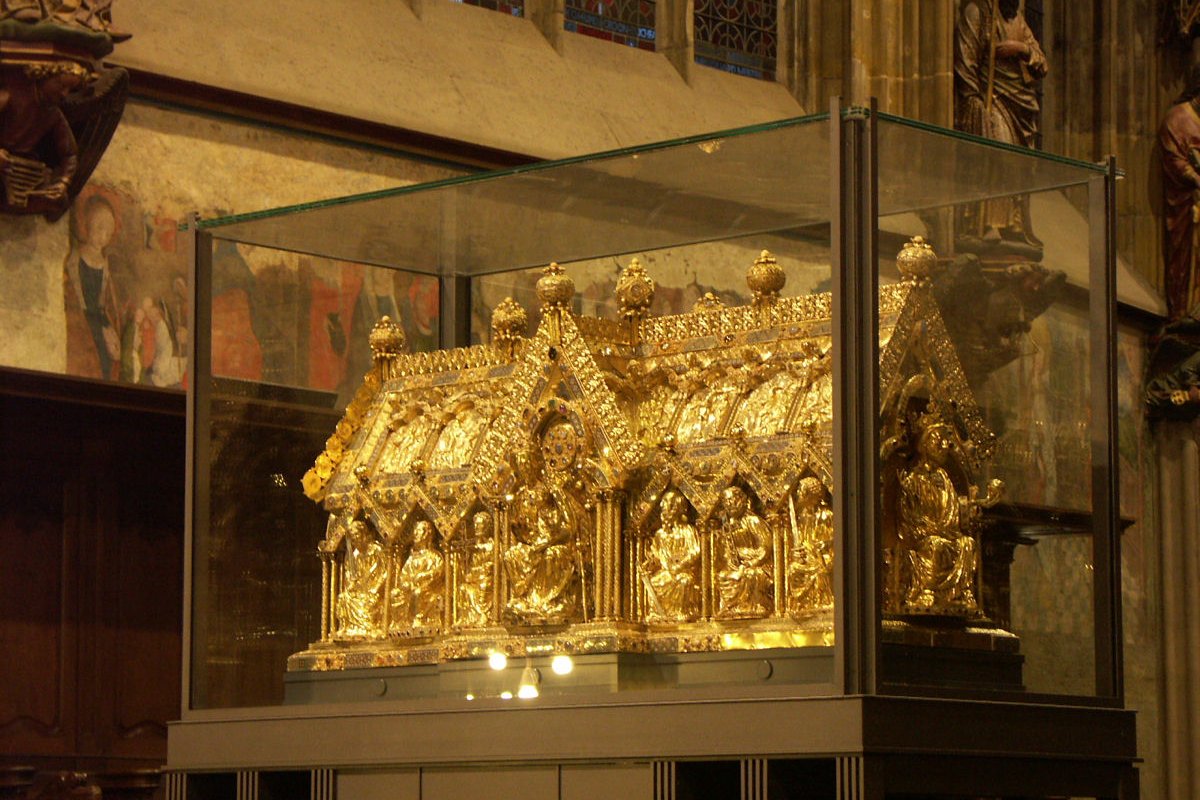
Charlemagne died in Aachen in January 814 and was buried inside the chapel he had built, though the exact original form of his burial remains debated by historians. What is certain is that his remains became the object of intense veneration in the centuries that followed: he was canonized, controversially and without formal papal ratification recognized universally, by the antipope Paschal III in 1165 at the urging of Emperor Frederick Barbarossa, and in 1215 his relics were transferred into a magnificent gilded reliquary known as the Karlsschrein, or Shrine of Charlemagne — a masterpiece of medieval goldsmithing that still rests in the cathedral's Gothic choir hall today.
Charlemagne's tomb and reputation made Aachen an enduring pilgrimage destination and, more consequentially, the preferred coronation site for German kings for centuries. Beginning with Otto I in 936 and continuing until 1531, thirty-one kings were crowned within its walls, seated for the ceremony on a marble throne — built for Charlemagne himself, and still preserved in the cathedral's upper gallery — that visibly linked each new ruler to the first emperor's legacy.
A Cathedral Built in Layers
Aachen Cathedral as it stands today is not a single architectural moment but a building that grew across more than a thousand years. The original Carolingian octagon, with its heavy round arches, tiered galleries, and dark, weighty stonework, remains the oldest and most distinctive part — one of the very few substantially intact buildings surviving from Charlemagne's reign anywhere in Europe. In the 14th and 15th centuries, a soaring Gothic choir hall was added to the east end, its glass walls and slender tracery a deliberate contrast to the older octagon, built to give the growing crowds of pilgrims more room to venerate Charlemagne's shrine and the cathedral's other treasured relics. Further chapels were added in subsequent centuries, giving the building its present sprawling, layered footprint around the original core.
The cathedral's treasury, one of the most important collections of medieval religious art north of the Alps, holds objects including the Cross of Lothair, the Bust of Charlemagne reliquary, and vestments and liturgical objects spanning centuries of imperial and ecclesiastical history.
First on the List
When UNESCO drew up its first-ever World Heritage List in 1978, Aachen Cathedral was one of only twelve sites chosen worldwide — and it holds the honor, by the ordering of that original list, of being cited as the very first. The recognition reflected both the exceptional survival of its Carolingian core and the building's unbroken significance across the whole sweep of medieval and modern European history, from imperial coronations to its continued function today as the seat of the Roman Catholic Diocese of Aachen.
Bronze Doors and a Wolf Legend
Among the cathedral's oldest surviving furnishings are its great bronze doors, cast during Charlemagne's own reign and still hung at the west entrance — one of the few sets of large-scale bronze casting to survive from the early medieval period anywhere in Europe, evidence of the sophisticated metalworking Charlemagne's court could command. Local legend attached a colorful story to one of the smaller doors centuries later: that the city, needing funds to finish the church, made a bargain with the devil, who demanded the first soul to enter the completed building as payment — and that the Aachen townsfolk outwitted him by sending in a wolf first, leaving the devil to slam the door in fury and, in some versions of the tale, trap his own thumb in it. The story is folklore rather than history, but it remains a popular part of local tradition, and a bronze wolf statue still stands in the atrium as a nod to the legend.
A Cathedral That Survived War
Aachen suffered serious damage during Allied bombing raids in World War II, particularly in 1944, when incendiary bombs destroyed much of the roof and damaged sections of the interior, though the core Carolingian structure survived largely intact thanks to its massive stone construction. Post-war restoration work, continuing for decades, carefully repaired the damage while preserving the building's medieval character, and further conservation efforts in the late 20th and early 21st centuries have focused on stabilizing the octagon's mosaics and the surrounding Gothic choir hall's extensive stained glass, ensuring the building's twin identities — as Carolingian monument and as active cathedral of a modern diocese — both endure.
For other examples of how medieval Christian architecture drew on earlier Roman and Byzantine models, see Chartres Cathedral and Saint Vitus Cathedral, Prague, another coronation church built centuries later in the same imperial tradition Charlemagne began at Aachen.
Trivia
Why did Charlemagne build his chapel in Aachen specifically?
What architectural style is Aachen Cathedral's oldest part?
Is Charlemagne actually buried at Aachen Cathedral?
How many Holy Roman Emperors were crowned at Aachen?
Why was Aachen Cathedral the first UNESCO World Heritage Site?
Related Reading