Durham Cathedral: Built to Guard Saint Cuthbert's Body

A saint who wouldn't stay buried in one place
The story of Durham Cathedral begins not with an architect or a king, but with a coffin that spent over a century on the move. Saint Cuthbert, a monk and later bishop closely associated with the island monastery of Lindisfarne off England's northeast coast, died in 687, revered even in his own lifetime for a combination of ascetic discipline, tireless pastoral care for ordinary people across a rugged diocese, and a reputation for miracles that only grew after his death.
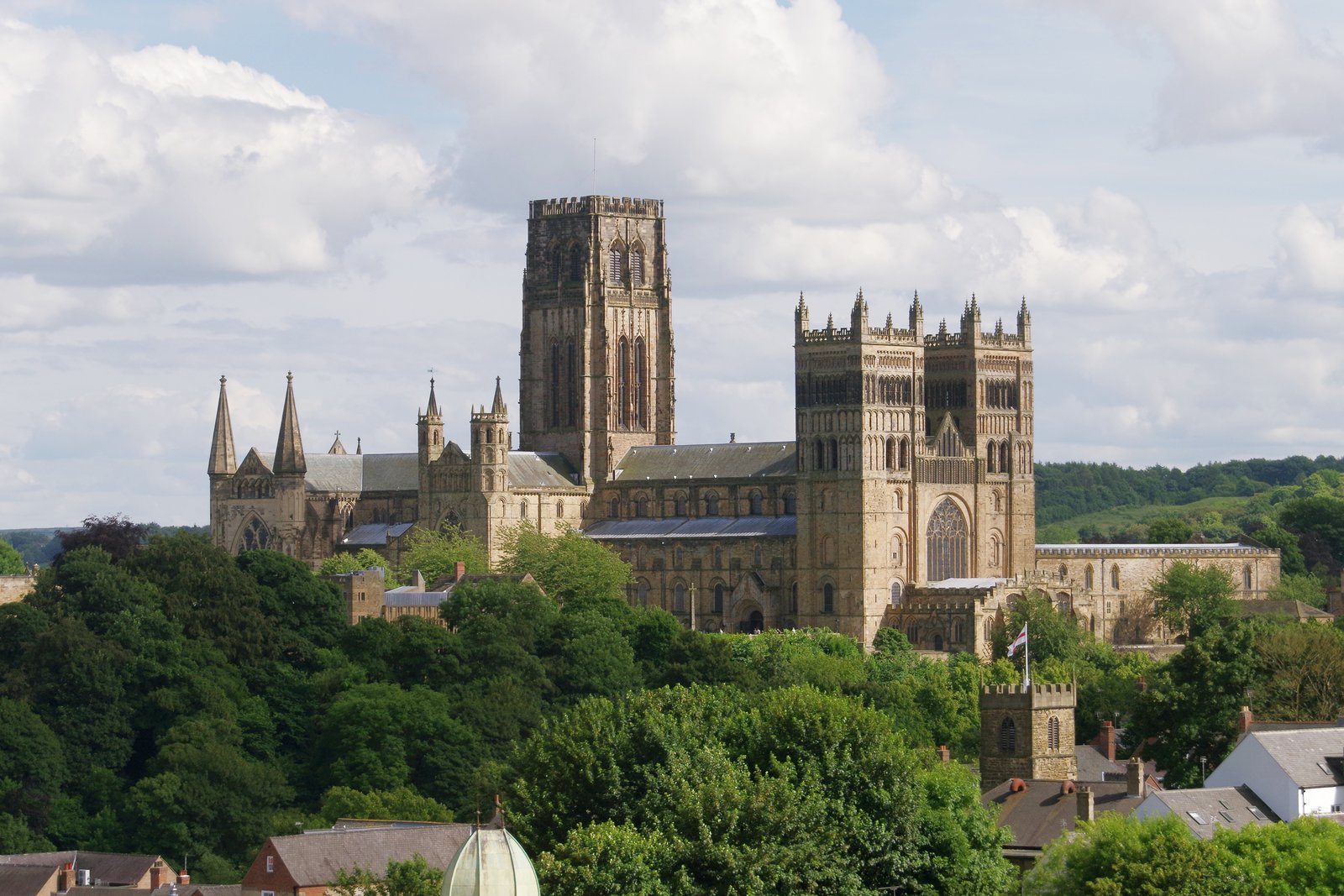
Photograph by Mattbuck, Durham Cathedral, 2014 — CC BY-SA 4.0, Wikimedia Commons.
When his tomb was opened eleven years later, in keeping with the era's practice of formally elevating a holy person's relics, his body was reportedly found completely uncorrupted — a detail his monastic community took as powerful confirmation of his sanctity. That claim of incorruption would matter enormously to what followed: when Viking raids began devastating the coast of northern England starting with the notorious attack on Lindisfarne itself in 793, the monks eventually judged the island too dangerous to remain, and in 875 they took up Cuthbert's coffin and left, carrying it with them across northern England for well over a century in search of a place secure enough to finally stay.
Settling on a defensible hill
According to the traditional account of this long wandering — recorded generations later and carrying the particular embellishments medieval hagiography often added to such stories — the monks were guided at last to a wooded, easily defensible peninsula formed by a bend in the River Wear, where a vision or sign indicated Cuthbert's body should finally rest. Whatever the precise circumstances, the community settled at Durham in 995, building a modest church to house the relics on a site whose natural defenses — steep banks on three sides, encircled by the river — made it an obvious choice after a century spent fleeing exposed, vulnerable locations.
That original Saxon church didn't last as the cathedral we know today. Following the Norman Conquest of 1066, the new Norman ecclesiastical establishment in England undertook an ambitious rebuilding campaign at many of the country's most important religious sites, and Durham was no exception. Construction of the massive stone cathedral standing today began in 1093, under the direction of Bishop William of Saint-Calais, and the main body of the building was substantially complete within just forty years, by 1133 — a remarkably fast pace for a structure of its scale by medieval standards.
An architectural landmark in its own right
Durham's significance extends well beyond its role as Cuthbert's shrine. Architectural historians regard it as one of the finest and most complete surviving examples of Norman Romanesque architecture in Europe, distinguished in particular by its early and extensive use of ribbed vaulting across the entire nave ceiling — a structural technique that distributed weight more efficiently than earlier flat or barrel-vaulted ceilings, allowing for larger windows and more open interior space, and one that would go on to become a defining feature of the Gothic architecture that followed across the continent in subsequent centuries.
The cathedral also became the final resting place of another towering figure in early English Christianity: the Venerable Bede, the eighth-century Northumbrian monk whose Ecclesiastical History of the English People, completed around 731, remains the single most important surviving historical source for the early centuries of English Christianity, including much of what is known about Cuthbert himself. Bede's remains were brought to Durham in the eleventh century and now rest in the cathedral's Galilee Chapel, giving Durham the distinction of housing two of the most significant figures in Anglo-Saxon religious history under one roof.
Surviving the Reformation intact
Like nearly every major English monastic shrine, Durham suffered under Henry VIII's dissolution of the monasteries in the 1530s. Commissioners stripped Cuthbert's shrine of its elaborate jeweled and gold decoration in 1539, and the visible monument that had drawn pilgrims for over five centuries was destroyed. But — in a detail that distinguishes Durham from many comparable sites — the tomb itself, and the body within it, were left undisturbed beneath the cathedral floor rather than being scattered or removed.
When antiquarians opened the grave in 1827, driven largely by scholarly curiosity rather than religious motive, they reportedly found Cuthbert's skeletal remains still wrapped in remnants of vestments, along with a portable altar and other objects associated with his original burial — evidence, whatever one makes of the earlier incorruption claims, that the identification of the grave itself had likely remained accurate across more than a thousand years of upheaval. Cuthbert's remains rest there still today, beneath a plain marked slab behind the high altar, in the cathedral his community built specifically to finally give him a permanent home.
A landmark that still commands the skyline
Durham Cathedral remains one of the most visually commanding buildings in England, its twin western towers and massive central tower still dominating the city's skyline from the river below almost exactly as they did when construction finished nine centuries ago. For a saint whose body spent over a hundred years never staying in one place for long, it's a fittingly permanent monument — built not for grandeur's own sake, but because a community of monks finally found somewhere they judged worthy, and safe enough, to let him rest.
Trivia
Why was Durham Cathedral built?
Who was Saint Cuthbert and why did monks carry his body for so long?
When was the current cathedral building constructed?
What else besides Cuthbert's shrine is significant about Durham Cathedral?
Is Saint Cuthbert's body still at Durham Cathedral today?
Related Reading