Salisbury Cathedral: Britain's Tallest Spire

An unusually unified Gothic design
Most great medieval cathedrals grew over centuries, with each generation adding a chapel here, rebuilding a choir there, in whatever style was fashionable at the time — the result is often a patchwork of Romanesque, Early Gothic, and Flamboyant Gothic stitched together across three or four hundred years. Salisbury Cathedral is the exception. Construction on the main body of the building began in 1220 and was substantially complete by 1258, a span of only 38 years that gave the cathedral a coherence of style almost unmatched among its English peers. Architectural historians point to Salisbury as the purest surviving example of Early English Gothic — the earliest phase of Gothic architecture in England, marked by tall, narrow lancet windows, minimal ornamentation compared to later Gothic phases, and a restrained, almost austere elegance built from Chilmark limestone and dark Purbeck marble.
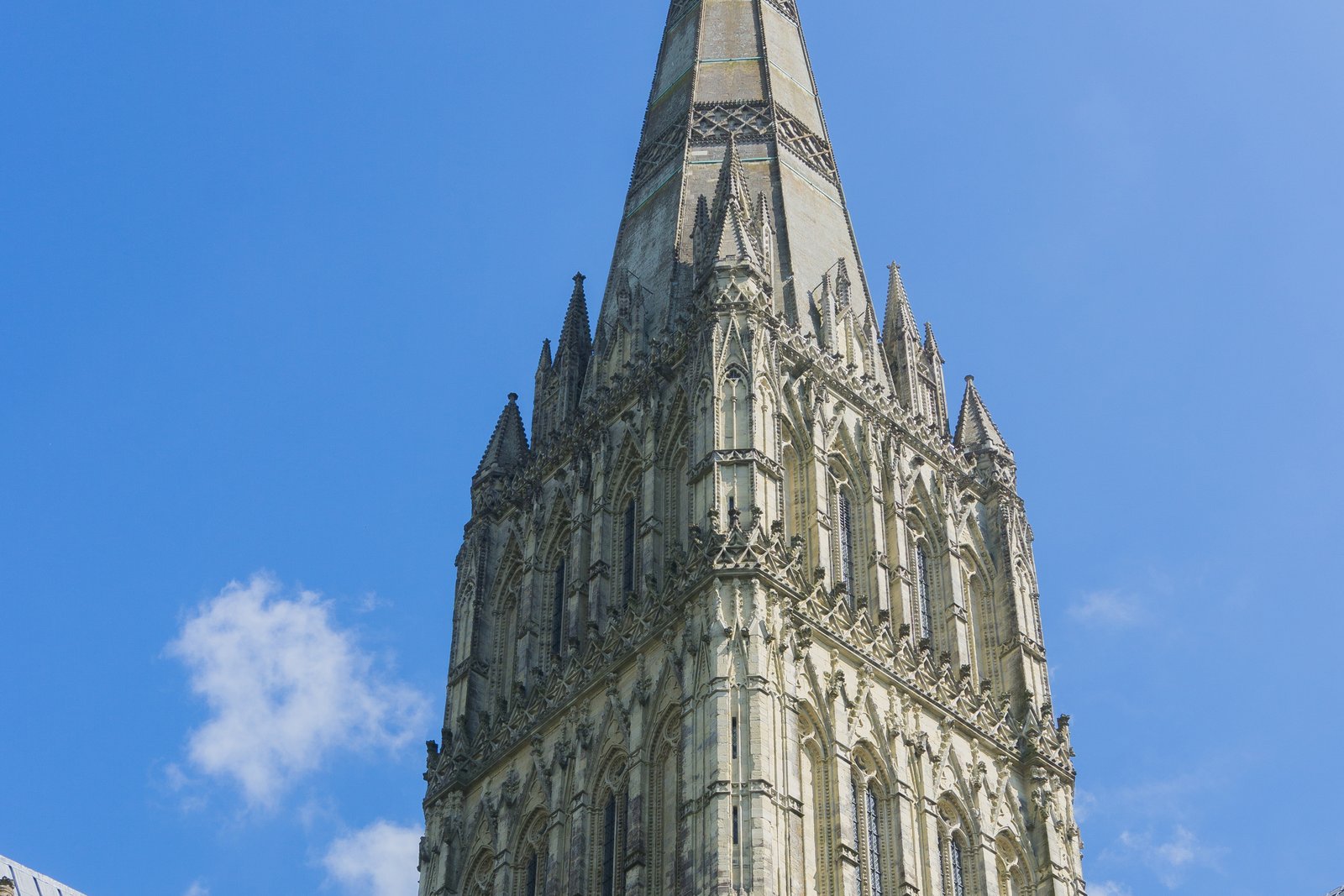
Photograph by Sumit Surai, Salisbury Cathedral Spire, Wiltshire — CC BY-SA 4.0, Wikimedia Commons.
The cathedral's move to its current site was itself a dramatic break with the past. The original cathedral had stood at Old Sarum, an Iron Age hillfort a few miles to the north that the Normans had refortified into a castle and cathedral complex. By the early 13th century, relations between the cathedral clergy and the castle's military garrison had deteriorated badly, worsened by the site's exposed, windswept position and its lack of a reliable water supply. Bishop Richard Poore obtained permission to relocate the cathedral to open meadowland beside the River Avon, and tradition holds that the exact spot was chosen by an arrow shot from the old hilltop — a colorful story, though most historians treat it as legend rather than a literal account of events.
The spire that was never part of the plan
The cathedral as consecrated in 1258 had no spire at all — just a modest tower. The soaring 404-foot spire that now defines Salisbury's skyline, and remains the tallest church spire anywhere in Britain, was added roughly seventy years later, between about 1300 and 1330, an ambitious afterthought bolted onto a building whose foundations had never been engineered to support it. The consequences showed almost immediately: the four central piers supporting the tower and spire began to bend visibly under the additional weight, a deformation still measurable in the stonework today. Medieval builders responded with an ingenious set of internal reinforcements — scissor arches, strainer arches, and iron ties — that have kept the spire standing for nearly seven centuries despite the strain, a quiet testament to medieval engineering under pressure. The architect and restorer Christopher Wren inspected the structure in the 17th century and found the spire leaning slightly off true, a tilt that persists today but has never worsened enough to threaten the building's stability.
Magna Carta and the oldest working clock in Europe
Salisbury's Chapter House, an octagonal room off the cathedral's cloisters, holds one of the building's true treasures: an original 1215 copy of Magna Carta, the charter King John of England sealed at Runnymede to limit royal authority and guarantee certain rights to his barons. Only four originals from that first 1215 sealing survive anywhere in the world — two in the British Library, one at Lincoln Cathedral, and Salisbury's, which conservators generally regard as the best-preserved of the four, its Latin text still crisply legible after more than 800 years.
Elsewhere in the cathedral, near the north nave aisle, stands a very different kind of treasure: a mechanical clock built around 1386, among the oldest working clock mechanisms in Europe still functioning in essentially its original form. The clock has no dial and no hands — its sole purpose was to strike a bell on the hour, a functional design typical of the very earliest mechanical clocks, which existed to mark time for a religious community's daily round of prayer rather than to display it. The mechanism was restored to working order in the 20th century and, remarkably, still keeps time using much of its original medieval ironwork.
A cathedral still in active use
Salisbury Cathedral today functions much as it always has: as the seat of the Anglican Bishop of Salisbury and a working cathedral holding daily services, alongside its role as one of England's most visited historic sites. The cathedral close surrounding it — a broad green precinct of historic houses, one of the largest and best-preserved cathedral closes in England — is itself a protected heritage site. Visitors can view the Magna Carta in the Chapter House, hear the medieval clock's bell still marking the hours, and climb into the tower on guided tours that bring them close to the reinforcing ironwork that has held the great spire aloft since the 14th century. Like other great English Gothic cathedrals such as Canterbury Cathedral and Durham Cathedral, Salisbury remains both an architectural landmark and a living house of worship, its spire visible for miles across the Wiltshire countryside just as it was intended to be nearly 700 years ago.
Trivia
How tall is Salisbury Cathedral's spire, and is it really the tallest in Britain?
Does Salisbury Cathedral really have an original copy of Magna Carta?
What is the oldest working clock in Europe, and where is it kept?
How long did it take to build Salisbury Cathedral?
Why was Salisbury Cathedral built on a new site instead of at Old Sarum?
Related Reading