Artemisia Gentileschi's Judith Beheading Holofernes

A subject painted with unusual force
The Book of Judith recounts one of the more dramatic episodes in the deuterocanonical books of the Old Testament: the Israelite city of Bethulia, besieged by the Assyrian army under the general Holofernes, is saved when the widow Judith enters the enemy camp under the pretense of defecting, wins Holofernes's trust and admiration over several days, and then, once he has fallen into a drunken sleep in his tent, beheads him with his own sword. Judith and her maidservant Abra carry the severed head back to Bethulia, and the leaderless Assyrian army, discovering their general's fate the following morning, retreats in disarray.
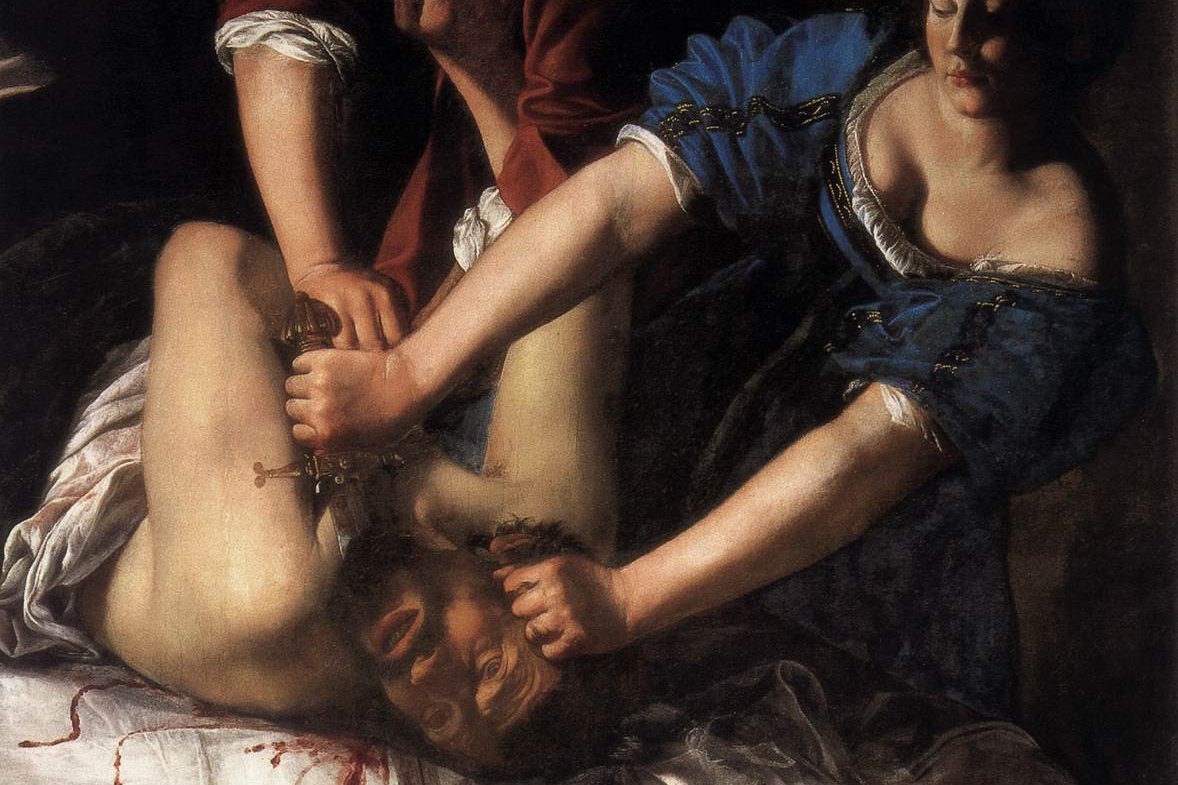
Artemisia Gentileschi, Judith Beheading Holofernes, c. 1620, Uffizi Gallery, Florence — public domain.
Artemisia Gentileschi returned to this subject more than once across her career, and her two major surviving treatments — an earlier version now in the Museo di Capodimonte in Naples, generally dated around 1612-1613, and a larger, more fully resolved version in the Uffizi Gallery in Florence, usually dated to around 1620 — rank among the most intensely physical depictions of the scene ever painted. Both show Judith and her maidservant working together, their sleeves pushed back, bearing down with real physical effort on a Holofernes who is still very much alive and struggling as the sword does its work. Blood spatters realistically across the white sheets, rendered with none of the decorous restraint many earlier and contemporary treatments of violent biblical subjects tended to apply.
Comparing Gentileschi to Caravaggio
Gentileschi's approach to the subject is frequently, and usefully, compared to Caravaggio's own Judith Beheading Holofernes, painted around 1599 and one of the works that helped establish the dramatic lighting and psychological intensity — tenebrism, the dramatic use of light and shadow — that came to define the style of painters influenced by him, a group art historians call the Caravaggisti, among whom Gentileschi is counted as one of the most significant figures. Caravaggio's version places Judith at a slight physical remove from her victim, her arm extended almost delicately, her expression registering a kind of controlled distaste rather than exertion, while an elderly maidservant looks on from beside her, present but passive, holding out the cloth meant to receive the severed head.
Gentileschi's compositions depart from that staging in a way many art historians consider a deliberate and significant reworking rather than simple stylistic variation: both women in her paintings are physically implicated in the killing, their combined weight and strength required to restrain a still-struggling man, the maidservant no longer a passive bystander but an active participant pinning Holofernes down. This shift — from a somewhat distanced, almost ceremonial execution in Caravaggio's version to a shared, strenuous, visibly difficult act of violence in Gentileschi's — has become one of the most frequently discussed points of comparison in Baroque scholarship, often cited as evidence of how differently the same biblical episode could be staged even within a shared stylistic tradition.
Biography, trauma, and the limits of interpretation
No discussion of Gentileschi's Judith paintings can honestly avoid the question of her own biography, though it deserves careful and responsible handling rather than sensationalized certainty. In 1611, when Gentileschi was seventeen or eighteen, the painter Agostino Tassi, a colleague of her father, sexually assaulted her. The resulting 1612 trial is unusually well documented, with surviving court transcripts recording Gentileschi's testimony, given in part under judicial torture applied at the time to verify witness statements — a legal practice of the era, not evidence bearing on the truth of her account, which historians generally regard as credible.
Given this documented history, many art historians and critics have proposed a connection between Gentileschi's personal trauma and the unusual physical intensity and directness of her Judith paintings, reading the works as channeling anger, resistance, or a reclaiming of agency through the biblical figure of a woman who overcomes a powerful, threatening man through decisive violence. This is a legitimate and widely held scholarly interpretation, and it has shaped how the paintings are taught and discussed for decades. It is important, though, to describe it accurately as an interpretation — a reading scholars have proposed based on biographical context and the visual evidence of the paintings themselves — rather than as a documented statement of what Gentileschi herself intended or felt while painting these works. Gentileschi left no surviving written account explicitly connecting the two, and reducing her artistic achievement solely to a reflex of personal trauma risks underselling her considerable technical skill, professional ambition, and command of an already well-established pictorial tradition that other, male painters had also treated with violence and force.
A rare success in a closed field
Whatever weight one gives to the biographical reading, Gentileschi's professional career stands on its own as remarkable for the period. In 1616, she became the first woman admitted to the Accademia di Arte del Disegno in Florence, a significant institutional recognition in a field almost entirely closed to women artists at the time. She worked for prominent patrons, including members of the Medici family, and later traveled to England, working at the court of King Charles I alongside her father, the painter Orazio Gentileschi, himself an important figure among the early Caravaggisti.
Today, Gentileschi is recognized as one of the most significant painters of the Italian Baroque, and her two Judith Beheading Holofernes paintings remain central to that reputation — powerful, technically accomplished works that reward viewing both for their place within the broader tradition of the Judith and Holofernes story in art and for what they reveal about one of the few women who managed to build a major painting career in seventeenth-century Europe.
Trivia
What biblical story does Judith Beheading Holofernes depict?
How many versions of this subject did Artemisia Gentileschi paint?
How is Gentileschi's version different from Caravaggio's earlier treatment of the same subject?
Why do art historians often connect this painting to Gentileschi's own biography?
Was Artemisia Gentileschi a successful painter in her own lifetime?
Related Reading