Judith and Holofernes

A City on the Edge of Surrender
The Book of Judith opens with the Assyrian general Holofernes at the height of an unstoppable military campaign, sweeping through the region under orders from King Nebuchadnezzar to subjugate every people who had refused him tribute. When his army reached Bethulia, a small town guarding a strategic mountain pass, he laid siege and cut off its water supply rather than attack directly, content to let thirst do the work.
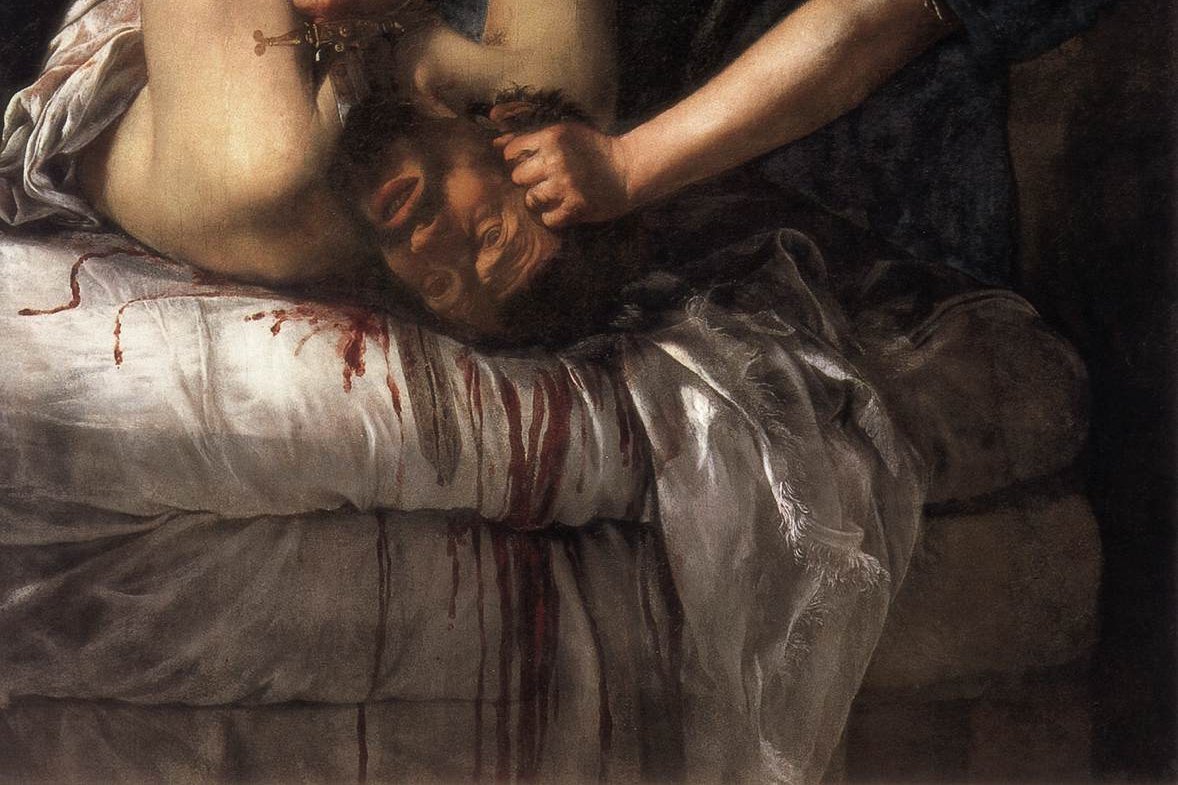
Artemisia Gentileschi, Judith Beheading Holofernes, c. 1611-1612 — public domain.
After thirty-four days, the townspeople, desperate, pressured their elders into a fixed deadline: surrender the city within five days if God had not sent deliverance by then. It is at this point, with the town's own leadership effectively giving up, that Judith enters the story.
A Widow's Rebuke and a Plan
Judith was a wealthy, devout widow, known for her piety and fasting since her husband's death years earlier. Hearing of the elders' agreement, she summoned them and delivered a sharp rebuke — accusing them of testing God with an ultimatum rather than trusting him. Then she announced she had her own plan, one she would not fully explain in advance: "I will perform a deed that will go down from generation to generation among our descendants. Stand at the city gate tonight to let me pass through with my maid... the Lord will deliver Israel by my hand" (Judith 8:32-33).
Into the Enemy Camp
Judith removed her widow's garments, dressed and adorned herself deliberately, and went with her maid to the Assyrian camp, presenting herself as a defector willing to betray her own people's weaknesses in exchange for safety. Her composure and beauty impressed Holofernes's own guards before she even reached him, and once in his presence, she offered flattering, carefully constructed reassurances that God himself would soon hand Israel over to him — allowing her, in the meantime, to remain in the camp, praying privately outside its boundaries each night, ostensibly to receive divine guidance to share with him. For several days, this routine built genuine trust.
The Fourth Night
Holofernes, increasingly captivated, invited Judith to a private banquet, intending to seduce her that night. Judith accepted, and through the evening let him drink far more wine than he could handle, until he collapsed into unconsciousness on his own bed. Once his servants and attendants had left them alone, Judith acted. "She went to the bedpost near the head of Holofernes, and taking his sword from it, she drew close to the bed, grasped the hair of his head, and said, 'Strengthen me this day, Lord, God of Israel!' Then with all her might she struck his neck twice and cut off his head" (Judith 13:6-8).
She handed the head to her waiting maid, who placed it in their food bag, and the two women walked calmly out of the camp exactly as they had each night before — passing guards accustomed to their prayer routine — and returned to Bethulia before the army realized anything had happened.
A Fast Broken and a Song Composed
Before any of this, the text is careful to establish just how deliberately Judith had prepared herself. Since her husband Manasseh's death she had lived in strict mourning, fasting "all the days of her widowhood, except sabbath eves and sabbaths, new moon eves and new moons, feastdays and holidays of the house of Israel" (Judith 8:6), a discipline the narrative treats as the source of the spiritual authority she draws on when she confronts the town's elders. That same rigor shapes the entire mission: even inside the enemy camp, surrounded by soldiers, she insists on keeping her own dietary practice and continues her private nightly prayer rather than adapting herself to Assyrian customs, a detail the text returns to more than once as proof that her outward compliance with Holofernes never touched her actual loyalties.
After the victory, Judith composed a hymn of thanksgiving sung by the whole assembly, a lengthy canticle in the tradition of Miriam's song after the crossing of the Red Sea and Deborah's after the defeat of Sisera — placing Judith's triumph explicitly within a scriptural pattern of women whose decisive action delivered Israel at moments when its own leaders had faltered.
Victory and Recognition
When Holofernes's body was discovered the next morning, panic swept through the Assyrian camp; without its commander, the army broke and fled, and the Israelites, seeing the disarray, pursued and won a complete victory. Judith was honored publicly, credited by the high priest and the whole assembly with saving the nation, and a hymn celebrating her by name was sung throughout Israel in the aftermath.
Catholic Reading: An Unlikely Deliverer
Judith belongs to the Catholic canon's deuterocanonical books, and the Church has long held her up, alongside figures like Esther, as an Old Testament type of courage exercised by the powerless against overwhelming force — a widow with no army accomplishing what soldiers could not. Catholic art and liturgy have also traditionally drawn a Marian typology from Judith's story: her praise in the text, "Blessed are you, daughter, by the Most High God, above all the women on earth" (Judith 13:18) is echoed in the language used of Mary in the Gospel of Luke, and patristic commentary frequently reads Judith's decisive strike against the enemy commander as prefiguring the ultimate triumph of good over evil accomplished through God's chosen instrument, however unexpected that instrument may be.
The story does not shy away from the violence at its center, but its emphasis throughout is on Judith's deliberate reliance on prayer before every step — she credits the victory to God's strength, not her own cunning, even as her cunning is what makes the plan possible at all.
Related reading: see Susanna and the Elders for another deuterocanonical woman whose integrity under pressure shapes her story, and Esther Saves Her People for a parallel account of a woman risking everything to save her nation.
Trivia
Why was Judith's city under siege?
What did Judith do about the siege?
How did Judith gain access to Holofernes?
What happened on the final night?
What happened to the Assyrian army afterward?
Related Reading