Rembrandt's The Return of the Prodigal Son

A painting from the last, hardest years of Rembrandt's life
By the late 1660s, Rembrandt van Rijn's circumstances had changed drastically from the wealthy, celebrated portraitist he had been decades earlier in Amsterdam. He had declared insolvency in 1656, lost his house and most of his art collection to creditors, buried his wife Saskia and, over the years, several of his own children, and by the time he painted The Return of the Prodigal Son — generally dated to around 1668, the year before his death — he was living in considerably reduced circumstances, his once-fashionable reputation eclipsed by younger painters. Whether or not Rembrandt intended the painting as any kind of personal statement, its focus on an aged father's unguarded, wordless welcome of a broken son carries a weight that many art historians and viewers alike connect to the losses and hardships of his own final years.
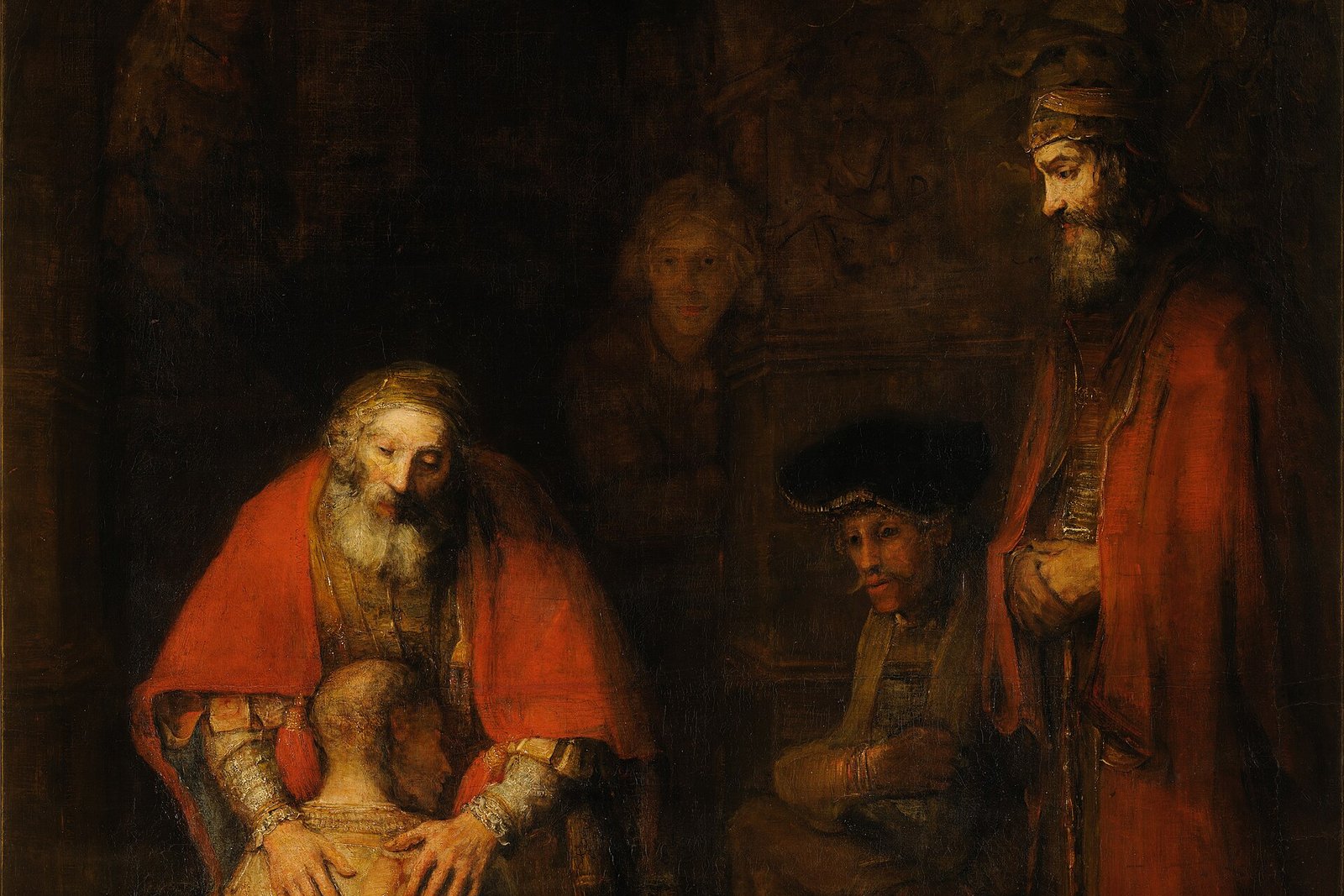
Rembrandt van Rijn, "The Return of the Prodigal Son," circa 1668, The State Hermitage Museum, Saint Petersburg — public domain.
The subject is drawn from the Parable of the Prodigal Son, told by Jesus in the Gospel of Luke: a younger son demands his inheritance early, squanders it in "loose living" in a distant country, and returns home destitute, rehearsing an apology, only to be met by his father, who "While he was still a long way off, his father caught sight of him, and was filled with compassion. He ran to his son, embraced him and kissed him." (Luke 15:20, RSV-CE). This is the same parable examined for its full narrative and theological context in The Prodigal Son; this article instead focuses specifically on Rembrandt's late-career painting of it — how he composed it, why it looks the way it does, and what makes it distinct among the many artistic treatments of the same parable.
The embrace at the center
Rembrandt strips the parable down to its single most emotionally charged instant: not the father running to meet his son, not the celebratory feast that follows in Luke's account, but the embrace itself, held in complete stillness. The son kneels before his father, his back turned to the viewer, dressed in tattered, roughly textured robes and a single worn sandal — his other foot bare and bruised, a small detail that concentrates an enormous amount of the painting's emotional and physical storytelling into a single limb. His head is shaved, evoking either illness, poverty, or possibly a reference to enslavement or extreme destitution during his time away, and he presses his face into his father's chest in a posture of complete surrender and exhaustion.
The father, rendered as an elderly, nearly blind figure — some scholars connect his unfocused gaze to contemporary reports of Rembrandt's own son Titus's illness or to broader ideas about spiritual blindness and unconditional love — bends over his kneeling son with both hands resting on his back. Art historians have long noted an asymmetry in the two hands: the left appears larger, rougher, more clearly masculine, while the right appears softer, more delicate, almost maternal, leading some interpreters to read the father's dual gesture as embodying both paternal and maternal love simultaneously, though this remains an interpretive reading rather than a documented statement of Rembrandt's intention.
Light, color, and restraint
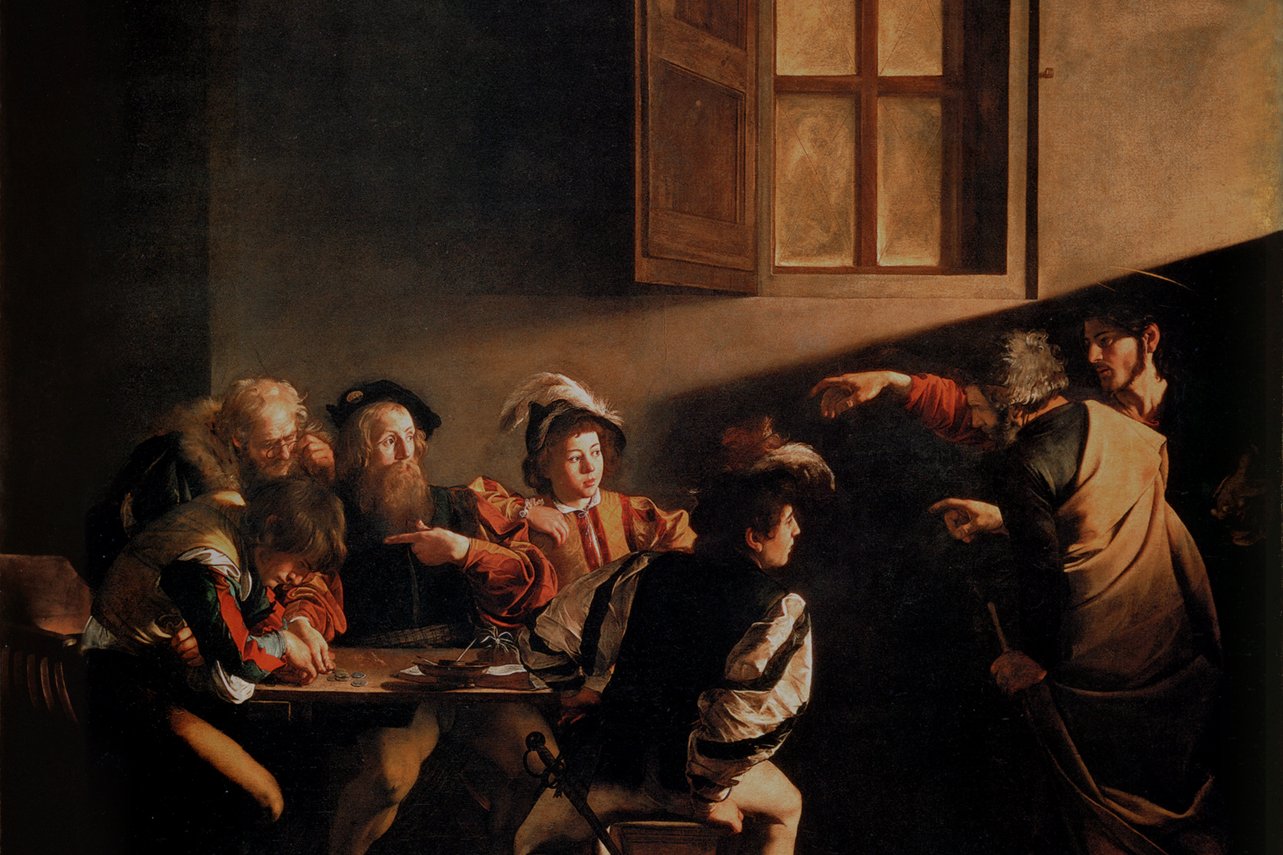
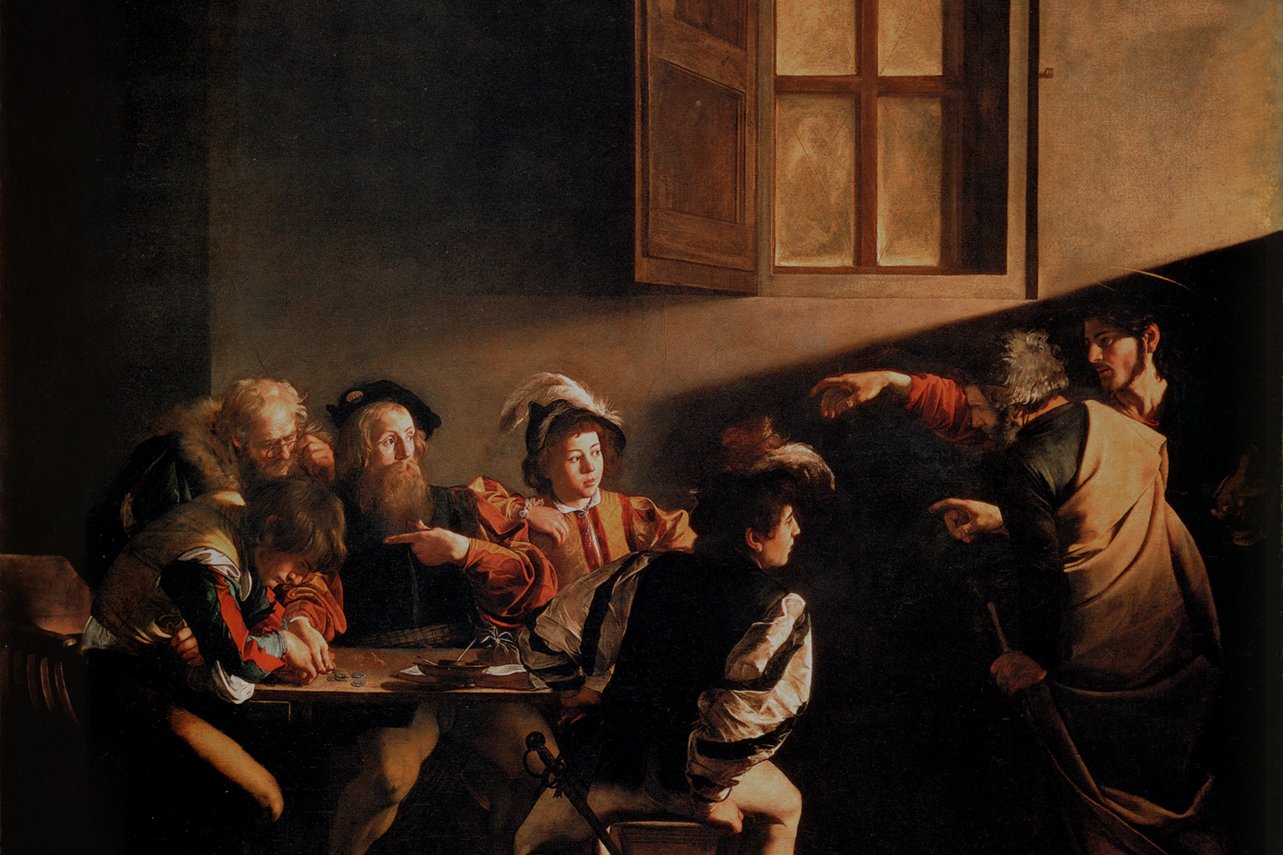
Rembrandt's late style favored a warm, deeply saturated palette of reds, browns, and golds, applied in thick, textured brushwork that gives the fabric of the father's robe an almost sculptural quality — a technique quite different from the sharper, more theatrical use of light seen in Caravaggio's earlier treatment of a related theme of moral transformation in The Calling of Saint Matthew, though both painters use concentrated light to draw the eye directly to a moment of spiritual turning point. In Rembrandt's composition, a soft, diffuse light falls on the father and son at the center while the surrounding figures recede into shadow, their faces only partially visible, watching the reunion with expressions ranging from apparent sympathy to what several scholars read as quiet disapproval, most likely from the elder son of the parable, who in Luke's account resents his father's generosity toward his prodigal brother.
An unfinished painting, perhaps deliberately so
Several areas of the canvas, particularly around the edges and in some of the background figures, appear less resolved than the central embrace, leading some art historians to debate whether Rembrandt left the work genuinely unfinished at his death in 1669 or whether the looser, more suggestive brushwork in peripheral areas was itself a deliberate late-career stylistic choice, consistent with the freer, more expressive technique Rembrandt increasingly favored in his final years compared to the more polished finish of his earlier career. Either way, the effect concentrates the viewer's attention almost entirely on the embrace itself, with the surrounding details rendered secondary to that central, wordless act of forgiveness.
From an Amsterdam studio to the Hermitage
The painting's early ownership history before the eighteenth century is not fully documented, but it eventually entered a private collection in France before being acquired for the Russian imperial art collection by Empress Catherine the Great in 1766, as part of her broader effort to build one of Europe's great art collections in Saint Petersburg. It has remained in the Hermitage Museum's collection ever since, and today stands among the most visited and reproduced works in the museum, frequently cited by theologians, art historians, and writers — including, notably, the priest and author Henri Nouwen, who wrote an entire book-length meditation on the painting — as one of the most profound visual meditations on forgiveness in the entire history of Western art.
Trivia
When did Rembrandt paint The Return of the Prodigal Son?
What parable does the painting illustrate?
Who are the other figures standing in the shadows of the painting?
How is Rembrandt's painting different from the biblical parable of the prodigal son?
Where can you see The Return of the Prodigal Son today?
Related Reading