Murillo's Immaculate Conception

A doctrine painted long before it was formally defined
The Immaculate Conception — the belief that Mary herself was conceived free from original sin — was already a widely held and passionately debated devotional tradition in the Catholic world for centuries before Pope Pius IX formally defined it as dogma in 1854. In seventeenth-century Seville, where Bartolomé Esteban Murillo spent nearly his entire working life, devotion to the doctrine ran especially deep, championed above all by the Franciscan order, which had long argued in its favor against theological objections raised by some Dominican theologians. Religious confraternities, hospitals, and convents across the city repeatedly commissioned paintings of the subject, and Murillo, who became Seville's most sought-after religious painter during the second half of the century, ended up producing more versions of the Immaculate Conception than any other single subject in his career — estimates among art historians typically range from around twenty to as many as thirty separate paintings over his lifetime.
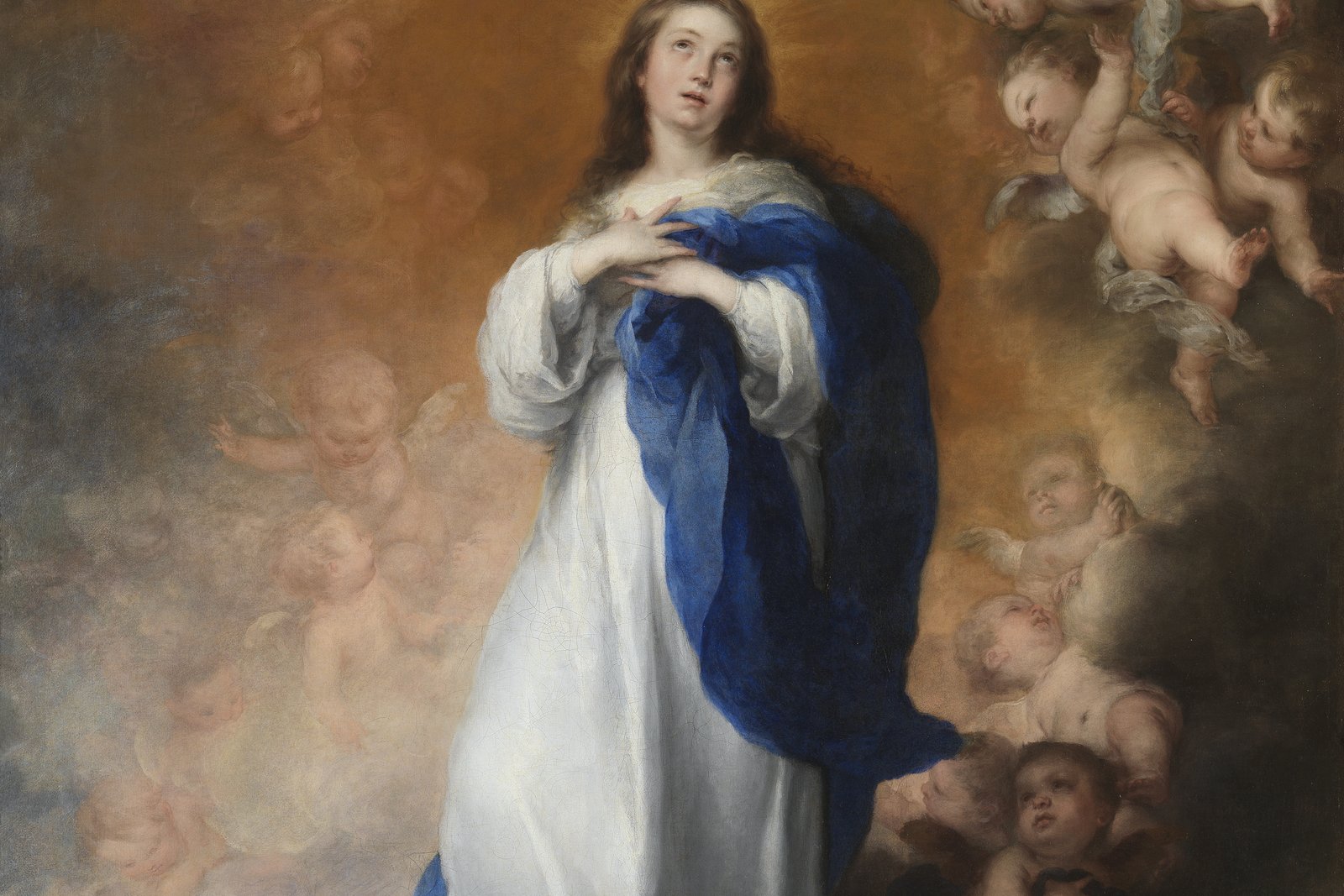
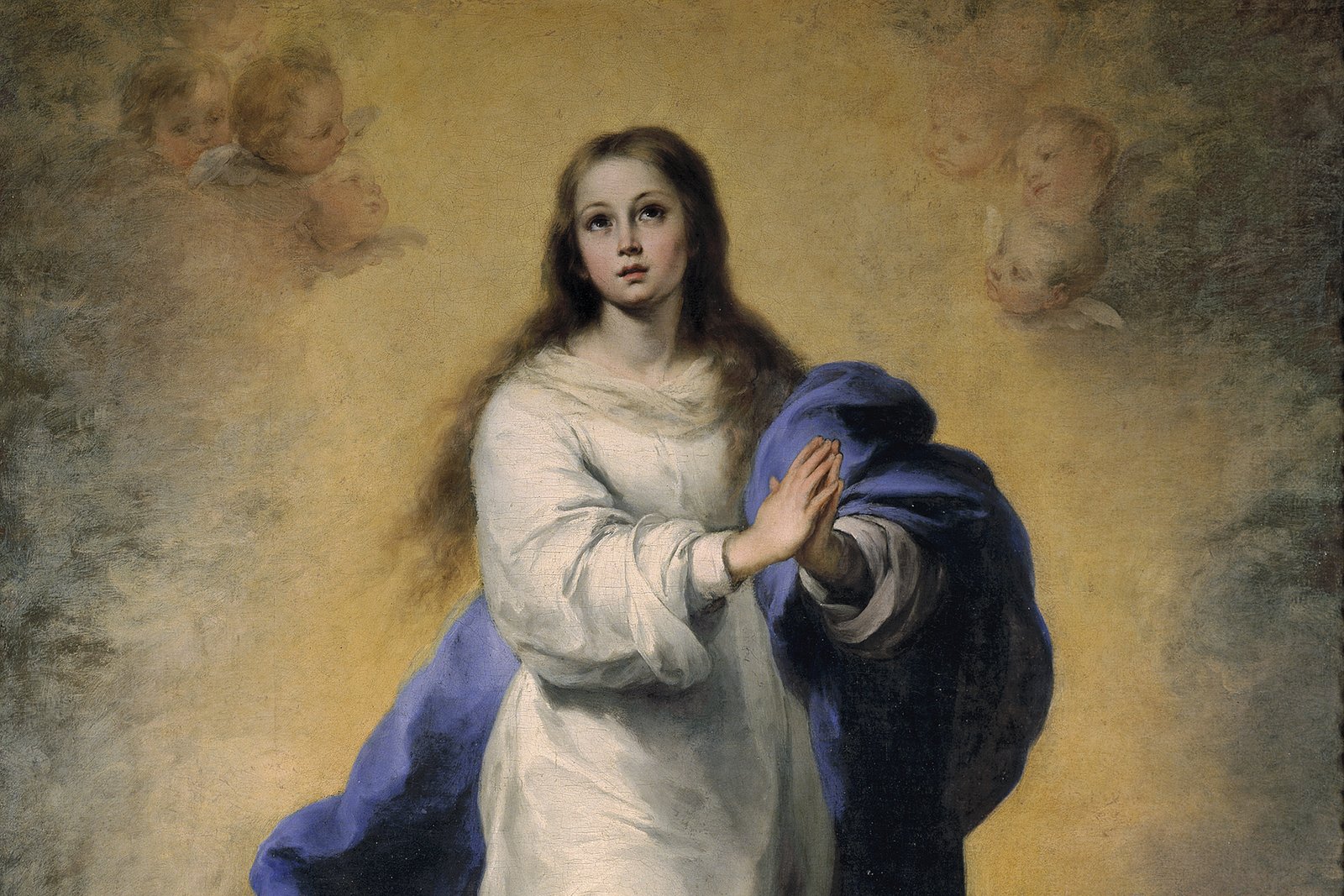
Bartolomé Esteban Murillo, "The Immaculate Conception," 17th century, Museo del Prado, Madrid — public domain.
This sheer repetition gave Murillo an outsized role in shaping how the subject would be visually understood well beyond Spain. While earlier artists had experimented with various compositions for the Immaculate Conception, Murillo's particular formula — refined and repeated across decades — became so widely reproduced and admired that it effectively became the default visual template most people still picture today when the subject comes up.
The formula: moon, mantle, and cherubs
Murillo's mature Immaculate Conception compositions share a consistent set of visual elements. Mary stands on a crescent moon, her hands typically clasped in prayer or crossed over her chest, dressed in a white gown symbolizing purity beneath a blue mantle traditionally associated with her throughout Christian art. She is lifted and surrounded by billowing clouds filled with cherubs, their small faces and wings emerging from soft, luminous atmosphere rather than occupying clearly defined space — a technique that gives Murillo's paintings their characteristically hazy, ethereal quality, quite different from the sharper, more architecturally structured Marian compositions of earlier artists.
The visual source for this imagery draws on the Book of Revelation's description of "a woman clothed with the sun, with the moon under her feet, and on her head a crown of twelve stars" (Revelation 12:1, RSV-CE) — a passage originally understood in its immediate context as referring to Israel or the Church, but which Catholic tradition came to apply typologically to Mary as well, providing the crescent moon and radiant light that became standard features of Immaculate Conception imagery well before Murillo's time. Murillo's genius was less in inventing new iconographic elements than in perfecting their execution — a soft, atmospheric handling of light and color that made his versions feel less like static doctrinal illustrations and more like genuine visions caught in the act of happening, a quality that shares some kinship with the visionary, curtain-parted staging of Raphael's earlier Sistine Madonna, even though the two painters worked in very different eras and stylistic traditions.
The Soult Immaculate: a painting stolen twice over
Among Murillo's many versions, one in particular became especially celebrated: a large canvas originally painted for the church of the Hospital de los Venerables Sacerdotes in Seville. During the Napoleonic occupation of Spain in the early nineteenth century, French Marshal Jean-de-Dieu Soult, commanding troops in Andalusia, systematically looted major artworks from churches and religious houses across the region, and this Immaculate Conception was among the works he removed from Seville and kept in his own private collection for decades afterward. After Soult's death, his heirs sold the painting, and it was acquired by the Louvre in Paris in 1852 for what was, at the time, one of the highest prices ever paid for a painting at public auction — a striking testament to how thoroughly Murillo's reputation had grown across Europe by the mid-nineteenth century. The painting has remained in the Louvre ever since, still carrying the nickname of the marshal who took it. Spain has periodically requested the return of works looted during the Napoleonic occupation, and the Soult Immaculate remains one of the most frequently cited examples in ongoing conversations about restitution of art seized during that period, even though no formal transfer has taken place in the nearly two centuries since Soult first removed it from Seville.
A visual legacy beyond Spain
Murillo's soft, luminous style and his repeated refinement of the Immaculate Conception composition influenced devotional art across the Catholic world for generations, reproduced in prints, smaller copies, and later in mass-produced devotional imagery that carried his particular vision of Mary — youthful, serene, lifted weightlessly on clouds of cherubs — into churches and homes far beyond Seville. Even today, popular devotional images of the Immaculate Conception frequently echo Murillo's basic formula so closely that the connection, whether consciously recognized or not, traces directly back to a Baroque painter working almost exclusively for Seville's churches and confraternities, who simply returned to the same subject more often, and with more sustained skill, than any other artist of his era.
Trivia
What does the Immaculate Conception actually refer to?
Why did Murillo paint the Immaculate Conception so many times?
What is the Soult Immaculate Conception and why is it called that?
What visual elements define Murillo's typical Immaculate Conception composition?
Where can Murillo's Immaculate Conception paintings be seen today?
You May Also Like
Related Reading