The Icon of Our Lady of Perpetual Help

An icon with an uncertain early history
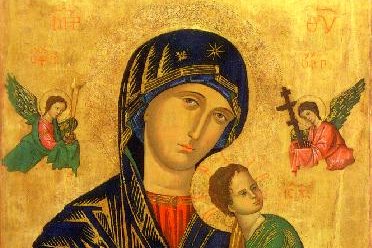
The precise origins of the icon known today as Our Lady of Perpetual Help are genuinely uncertain, which is typical for devotional images of this age and type. Art historians generally date the panel to somewhere between the late fourteenth and fifteenth centuries, attributing it to an unknown painter working within the Byzantine iconographic tradition, likely on the island of Crete, which was a major center of icon production supplying churches across the Mediterranean during this period. According to a tradition recorded in later centuries, the icon was brought to Rome sometime around 1499 by a merchant, and it passed through the care of at least one Roman religious community before a long stretch during which its whereabouts were less clearly documented.
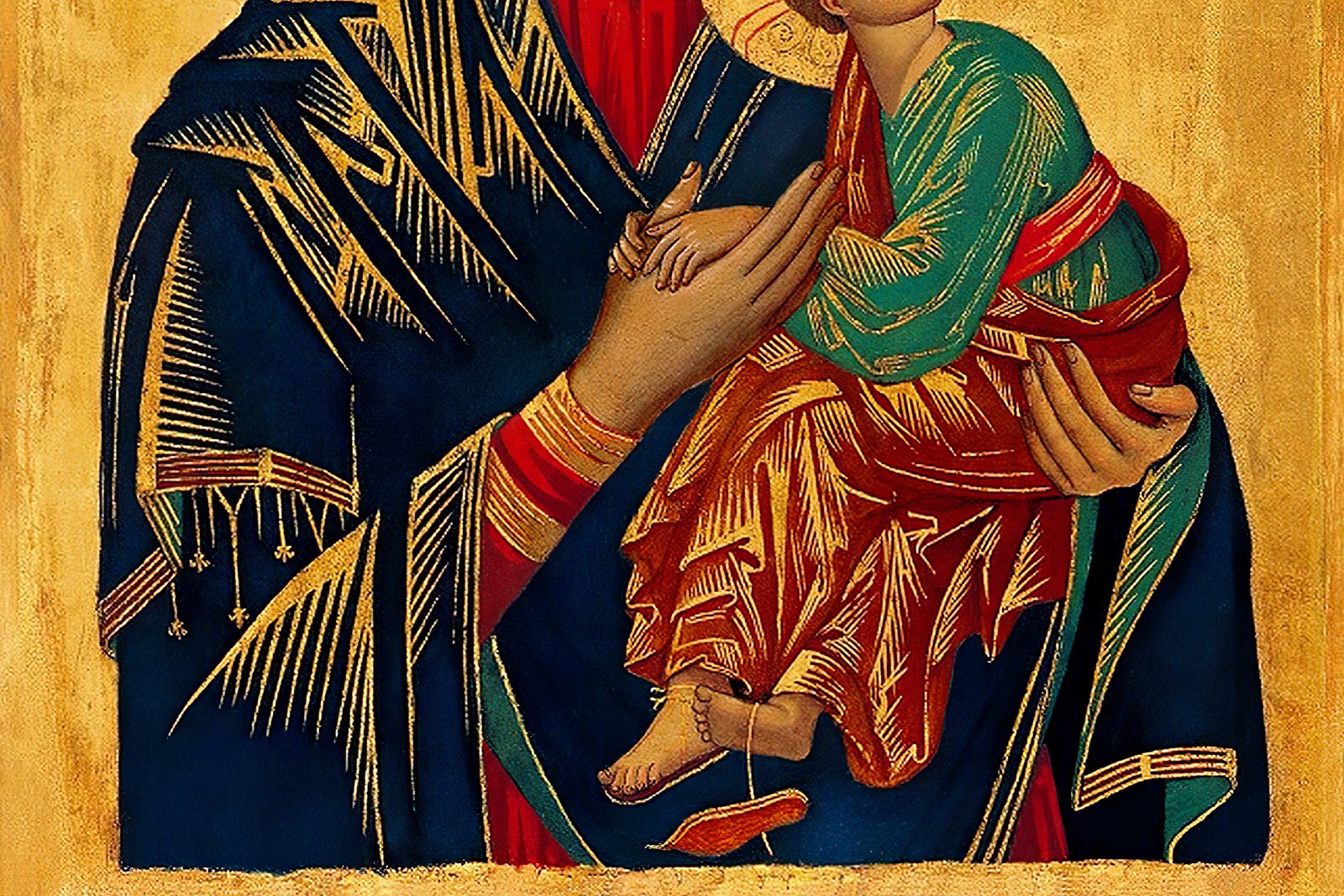
Byzantine school, icon of Our Lady of Perpetual Help, church of Sant'Alfonso di Liguori, Rome — reproduction photograph CC BY-SA 4.0, Wikimedia Commons.
By the early nineteenth century, the icon had ended up in a private chapel attached to a religious house in Rome that was demolished in 1798, and the painting itself was moved to a nearby church, where it remained relatively obscure for several decades — its fame at this point limited mostly to the neighborhood around it, rather than the international devotion it would later attract.
The composition and its symbolism
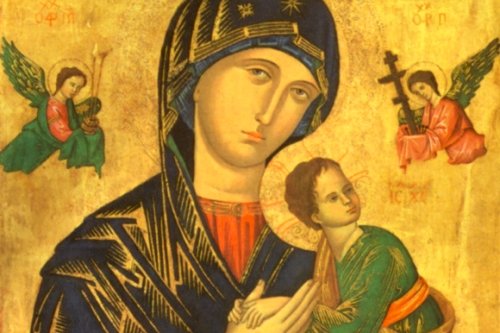
The icon follows a recognizable type within Byzantine Marian iconography sometimes called the Hodegetria variant, though modified with distinctive additional elements that give this particular image its identifying character. Mary is shown holding the Christ Child, her expression solemn rather than tender in the way some later Western Madonnas would be painted, her gaze directed outward toward the viewer rather than down at her son. Flanking the central figures are two archangels, traditionally identified as Michael and Gabriel, each holding an instrument associated with Christ's Passion — a lance and a vessel containing vinegar and gall on one side, a cross on the other.
The Christ Child's reaction to these instruments is the icon's most distinctive and often-noted detail. Rather than sitting calmly, the child is shown startled, gripping his mother's hand tightly, and one of his small sandals has slipped loose from his foot in the sudden motion — traditionally read as a sign of fright at the sight of the suffering to come, foreshadowed by the objects the archangels present. Mary's steady, direct gaze, by contrast, has often been interpreted as an invitation to the viewer: an assurance that despite the coming sorrow visible in her child's fear, she offers perpetual help and intercession to those who come to her in prayer.
From obscurity to a mandate to "make her known"
The icon's transformation from a relatively obscure Roman devotional image into the image behind the devotion known today as Our Lady of Perpetual Help traces back to a single, well-documented moment in 1866. Pope Pius IX, who as a young boy had reportedly prayed before the icon when it hung in its earlier location near a school he attended, entrusted the painting to the Redemptorists — the Congregation of the Most Holy Redeemer, a missionary religious order — along with an instruction remembered simply as "make her known throughout the world."
The Redemptorists took the mandate seriously. Building a new church, Sant'Alfonso all'Esquilino, specifically to house the icon above its high altar, they also began the systematic work of distributing prints, reproductions, and devotional materials bearing the image through their missionary activity across Europe, the Americas, Asia, and beyond — a distribution effort that, over the following century and a half, made this particular icon's likeness recognizable in Catholic parishes on nearly every continent, often reproduced as stained glass, statuary, or framed prints even in churches with no direct historical connection to Rome or the Redemptorist order itself.
A devotion still actively practiced
Today, the original icon remains enshrined at Sant'Alfonso in Rome, still an active site of pilgrimage and prayer, with a perpetual novena tradition — regular, ongoing devotions held on a fixed weekly or periodic schedule — practiced not only there but in countless parishes worldwide that have adopted the image and its associated prayers into their own regular devotional life. Unlike some Marian devotions tied to a single reported historical apparition, the devotion to Our Lady of Perpetual Help centers on the continuous presence and intercession the image represents, sustained across more than five centuries by a painting whose original maker never signed a name to it, yet whose work has ended up known by sight to millions of people who may never see the original in Rome at all.
Countless parishes and cathedrals around the world carry the icon's name directly, from national shrines in the Philippines and Canada to ordinary parish churches on nearly every continent, each typically housing its own painted or printed copy above a side altar dedicated specifically to this devotion. That sheer geographic spread, achieved almost entirely through reproduction rather than relics or physical fragments of the original, is itself part of what makes this icon's story unusual among Marian devotional images: its influence travels through copies, not pilgrimage to a single physical object, even as the original panel in Rome remains the devotion's continuously venerated source.
Trivia
Where is the original icon of Our Lady of Perpetual Help kept?
What do the archangels in the icon represent?
What is the significance of the Christ Child's sandal in the image?
How did the icon come to be associated with the Redemptorists?
Is Our Lady of Perpetual Help the same as other Marian titles like Fatima or Lourdes?
Related Reading