Diego Velázquez's Immaculate Conception

A formula in the hands of a teenager
By the time Diego Velázquez painted his Immaculate Conception around 1618 or 1619, he was still a very young man — likely no more than nineteen years old — working in the Seville studio of Francisco Pacheco, the older painter who had trained him and who, in that same year, became his father-in-law when Velázquez married Pacheco's daughter Juana. What makes the painting remarkable isn't that a teenager produced accomplished religious art; plenty of young painters in workshop systems across early modern Europe did competent devotional work under supervision. What stands out is how much of Velázquez's later, mature style is already visible here: a restraint of gesture, a stillness in the figure's expression, and a naturalism in how light falls across drapery that already separates this young Mary from the more theatrical, swirling compositions many contemporaries favored for the same subject.
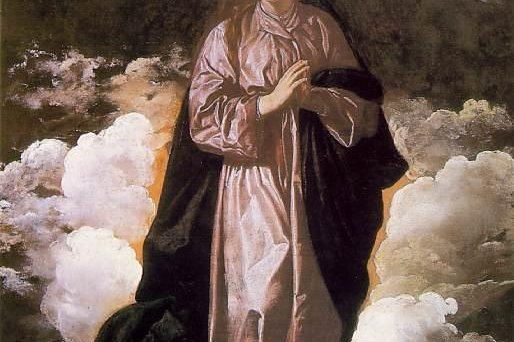
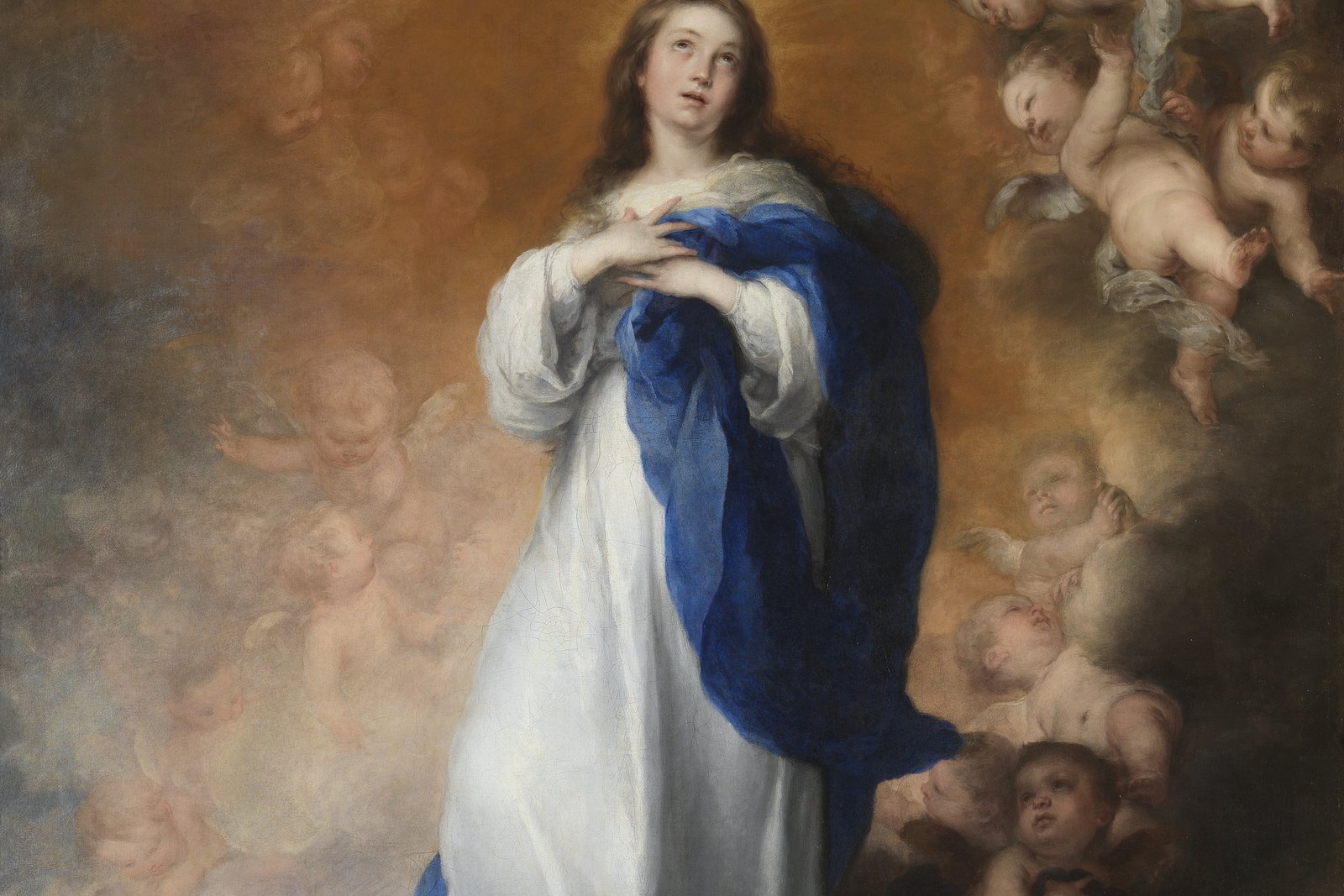
Diego Velázquez, The Immaculate Conception, c. 1618-19, National Gallery, London — public domain.
The subject itself came with an unusually strict set of visual rules attached to it, and Velázquez was working, quite literally, under the direct supervision of the man who had helped write those rules. Pacheco's own treatise on painting, Arte de la Pintura, laid out in considerable detail how the Immaculate Conception should be depicted — Mary young, roughly twelve or thirteen years of age by Pacheco's specification, dressed in white and blue, standing on a crescent moon with its horns pointing downward, surrounded by specific symbolic elements. Velázquez's painting follows this formula closely, which tells us as much about the conventions governing religious art in Counter-Reformation Spain as it does about Velázquez's individual artistic choices at this early stage of his career.
Reading the image: symbols drawn from Revelation
The visual vocabulary of the Immaculate Conception as it developed in Spanish art draws heavily on a passage from the Book of Revelation describing "a woman clothed with the sun, with the moon under her feet, and on her head a crown of twelve stars" — an image theologians and artists of the period read, among other symbolic layers, as prefiguring Mary. Velázquez's painting incorporates several of these elements: Mary stands on a crescent moon, her figure set against a dark sky, hands joined in prayer rather than reaching or gesturing outward, a compositional choice that gives the painting much of its quiet, contained intensity compared to more expansive Baroque treatments of the same subject by other artists.
Beneath her feet, the composition includes a scattering of symbolic objects — commonly a serpent, along with other emblems drawn from the Litany of Loretto, a traditional set of Marian titles (Mirror of Justice, Tower of David, Gate of Heaven, and similar images) that Spanish Immaculate Conception paintings of this period frequently rendered as small visual symbols arranged around the base of the composition, functioning almost as a coded inventory of Marian attributes for viewers versed in the tradition to recognize and read.
A doctrine centuries from formal definition
It's worth pausing on a point that can get lost amid the painting's serene devotional surface: when Velázquez painted this image, the doctrine of the Immaculate Conception — the belief that Mary was conceived without the stain of original sin — was not settled Catholic dogma. It would not become official Church teaching until 1854, when Pope Pius IX formally defined it in the bull Ineffabilis Deus, more than two centuries after Velázquez completed this painting. In the early seventeenth century, the belief was widely and passionately held, especially in Spain, where religious orders (the Franciscans prominent among them) and lay confraternities actively campaigned for its eventual formal recognition, but it remained, technically, a theological position rather than defined doctrine, a distinction contemporary theologians debated with real seriousness.
Seville, where Velázquez trained and painted this work, sat at the very center of that campaign. The city's intense local devotion to the doctrine produced a remarkable concentration of Immaculate Conception paintings by Sevillian artists across the seventeenth century — Pacheco's own version, Velázquez's early work here, and later the numerous, more overtly emotional treatments by Bartolomé Esteban Murillo, whose Immaculate Conceptions would become perhaps the most reproduced Marian images to come out of Spanish Baroque painting. Velázquez's early contribution to that tradition, restrained and comparatively spare next to the works that followed it, represents both his own artistic starting point and a snapshot of a doctrine still very much in active theological argument.
The painting's story since
The Immaculate Conception remained associated with Velázquez's early Seville period and eventually made its way, along with related works, into major collections outside Spain. Today the painting is held by the National Gallery in London, where it hangs alongside Velázquez's Christ in the House of Martha and Mary, another early work from the same formative years in Pacheco's workshop, offering visitors a rare chance to see the young Velázquez's religious and genre painting side by side. It's a fitting pairing: two paintings by an artist not yet twenty, already showing the sober, closely observed naturalism that would, within a few years, carry him to the Spanish royal court and to a place among the greatest painters Europe ever produced. Readers curious about the doctrine this painting depicts, and how it developed after Velázquez's time, may also want to read our article on the Immaculate Conception.
Trivia
When did Velázquez paint the Immaculate Conception?
What does the painting depict, and why?
Was the Immaculate Conception official Catholic doctrine when Velázquez painted it?
Why was Seville especially important to Immaculate Conception imagery?
Where can Velázquez's Immaculate Conception be seen today?
Related Reading