The Divine Mercy Image: History and Meaning

A vision, and an instruction to paint it
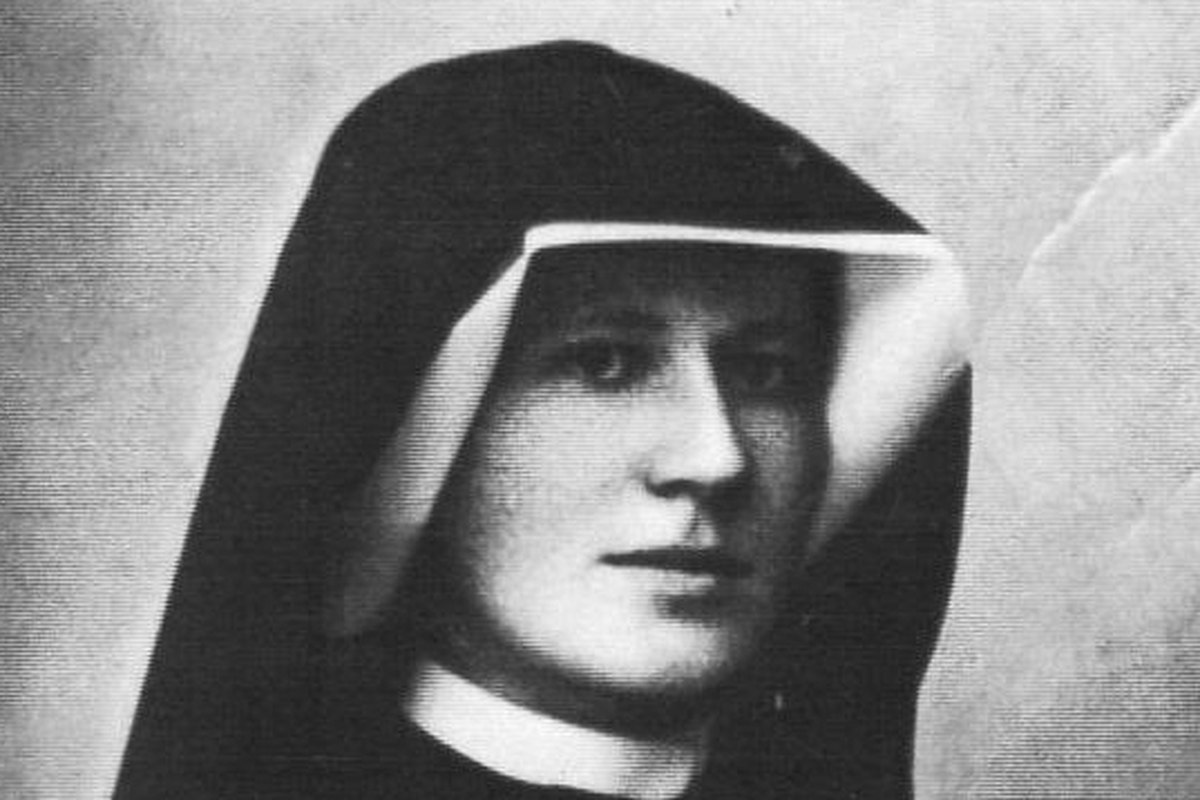
Saint Faustina Kowalska, a young member of the Congregation of the Sisters of Our Lady of Mercy in Poland, recorded a series of mystical experiences in the diary she kept throughout the 1930s under obedience to her spiritual directors. Among the earliest and most consequential, dated to February 1931 while she was living at her congregation's convent in Płock, was a vision of Christ standing before her, dressed in a white garment, one hand raised in blessing and the other touching the area near his heart, from which two rays of light extended outward — one pale, one red. According to her account, an instruction accompanied the vision: that an image be painted according to what she had seen, bearing the inscription "Jesus, I trust in You," and that the image be venerated first in her own convent chapel and eventually throughout the world.
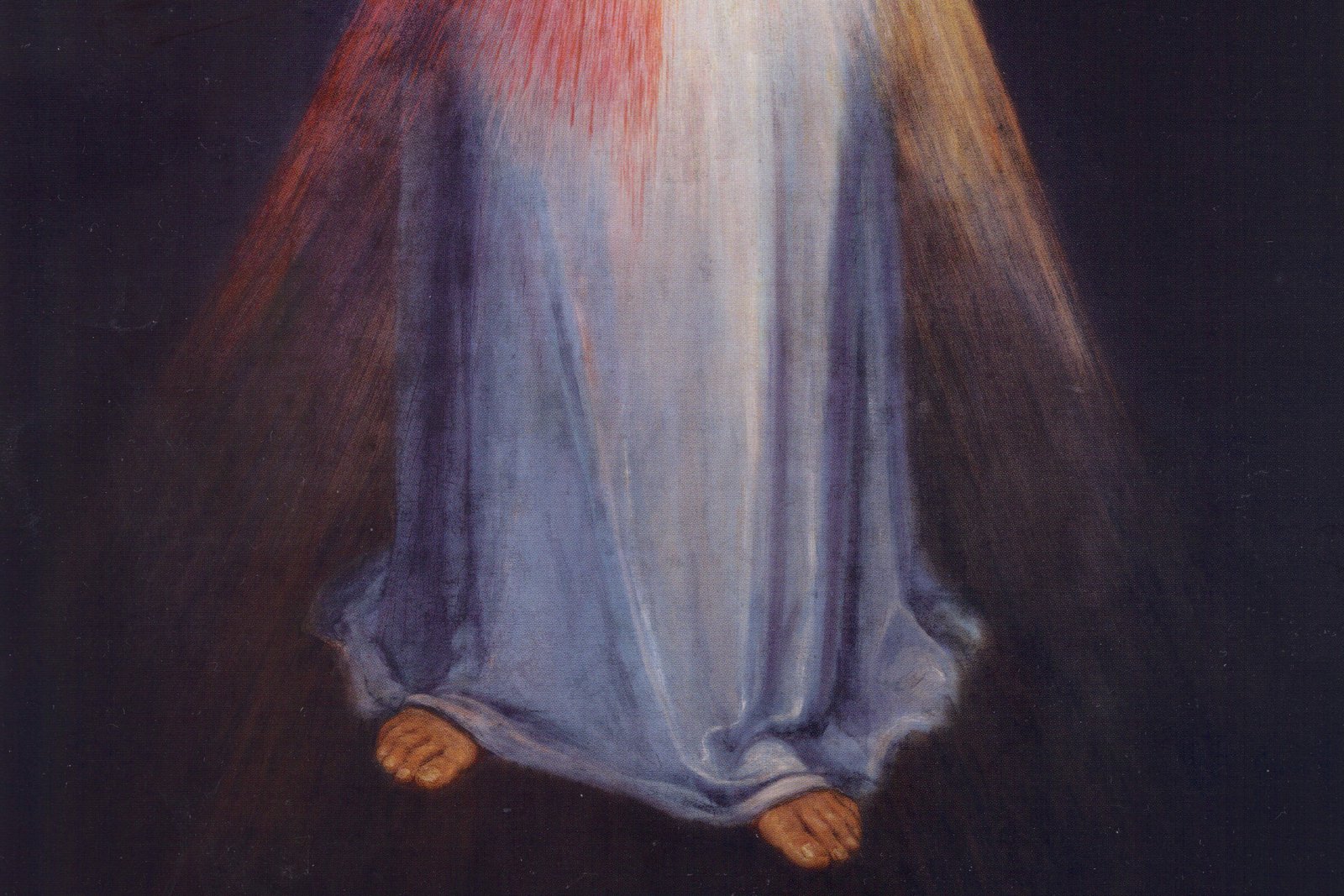
Eugeniusz Kazimirowski, Divine Mercy, 1934, Church of the Holy Spirit, Vilnius — public domain.
Faustina, without artistic training of her own, needed help translating the vision into a finished painting, and the effort to do so would take several years and involve at least two different painters working under very different circumstances, producing two visually distinct images that both circulate today under the same title.
The first painting, made in Vilnius
The first attempt to fulfill the instruction came in 1934, after Faustina had been transferred to her congregation's convent in Vilnius, where she came under the spiritual direction of Father Michael Sopoćko, a priest who would become one of the most important promoters of the devotion she described. Sopoćko commissioned Eugeniusz Kazimirowski, a Polish painter with no particular reputation for religious art, to execute the painting, working over roughly six months under close supervision from both Sopoćko and, by most accounts, Faustina herself, who was reportedly unsatisfied at various points with how closely the emerging image matched what she said she had actually seen.
Kazimirowski's finished 1934 painting depicts Christ in a fairly severe, somewhat formal style typical of academic religious painting of the period, the red and pale rays rendered as distinct, clearly separated streams of light. This original painting remains today enshrined in the Divine Mercy Sanctuary at the Church of the Holy Spirit in Vilnius, Lithuania, where it continues to draw pilgrims, though for much of the twentieth century it remained relatively obscure outside Lithuania and Poland, its wider fame overtaken by a second, later version.
A second version becomes the familiar one
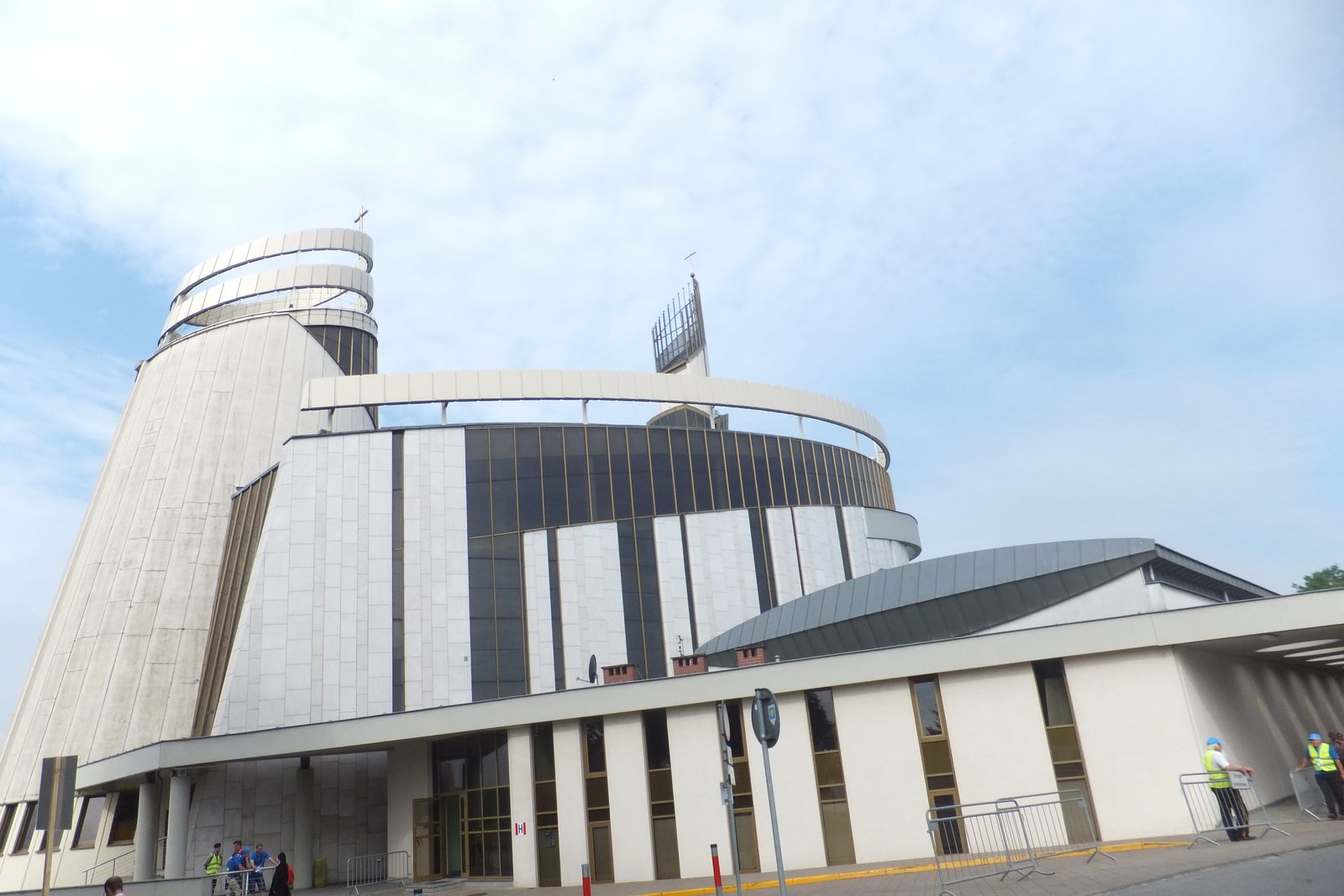
In 1943, several years after Faustina's death, a different painter named Adolf Hyła created another version of the Divine Mercy image, this one for the chapel of the convent in Kraków-Łagiewniki where Faustina had lived and died and where her remains would eventually be enshrined. Hyła's version, softer in style and more overtly emotional in Christ's expression than Kazimirowski's more formal original, became the image reproduced far more widely in prints, holy cards, and statuary distributed as the devotion spread internationally in the decades following the Second World War. For most Catholics today who picture the Divine Mercy image, it is Hyła's 1943 version, not Kazimirowski's original 1934 painting, that comes to mind — a reversal of the two paintings' original relative importance that reflects how reproduction and distribution, rather than strict historical priority, often determine which version of a devotional image becomes the culturally dominant one.
The symbolism explained in Faustina's own account
Faustina recorded in her diary a specific explanation for the two rays of light, attributed to Christ himself within the vision: that the pale ray represents the water that, according to the Gospel of John, flowed from Christ's pierced side at the crucifixion, symbolizing the sacrament of Baptism and the soul's justification, while the red ray represents the blood that flowed alongside it, symbolizing the Eucharist and the life of the soul. Together, the two rays were explained as representing the totality of divine mercy poured out through the sacramental life of the Church, offered to every soul regardless of the weight of what it needed forgiven.
The devotion associated with the image gained enormous institutional support under Pope John Paul II, himself Polish and well acquainted with the tradition surrounding Faustina's visions from his years as Archbishop of Kraków. He canonized Faustina in 2000 and formally established the Sunday after Easter as Divine Mercy Sunday for the universal Church, cementing both the feast and the image associated with it as a fixture of the modern Catholic liturgical calendar, carrying forward, through two different painters working a decade apart, an instruction one young nun said she had received to make an image and trust that people, over time, would come to it.
Faustina herself died in 1938, three years before the Vilnius painting was finally installed publicly for veneration, and did not live to see the devotion spread beyond a small circle of clergy and sisters who had known her personally. The scale of what followed — a feast day observed across the universal Church, an image reproduced by the millions, and a nun canonized within a century of her death — stands in sharp contrast to how modest and uncertain the whole undertaking looked at the outset, when a young sister with no artistic training of her own was simply trying to get a single painting made correctly.
Trivia
Who reported the original vision behind the Divine Mercy image?
Who painted the first Divine Mercy image?
Why are there different-looking versions of the Divine Mercy image?
What do the red and pale rays in the image represent?
What words appear at the bottom of most versions of the image?
Related Reading