Correggio's Assumption: The Dome That Made Heaven Feel Close

A painter who redefined what a ceiling could do
Antonio Allegri, known to art history simply as Correggio after his birthplace in northern Italy, spent much of his relatively short career working in the region around Parma, where he developed a highly personal painting style marked by soft, atmospheric light, sensuous figural modeling, and an increasingly bold interest in illusionistic spatial effects. His dome fresco for Parma Cathedral, executed roughly between 1526 and 1530, represents the culmination of that interest, transforming the physical architecture of the cathedral's dome into what appears, from the floor, to be an actual aperture opening directly onto a vision of heaven itself. It was among the most technically ambitious painting projects of its era, requiring Correggio to solve complex problems of perspective and proportion specific to painting a curved surface intended to be viewed from a fixed, distant vantage point far below.
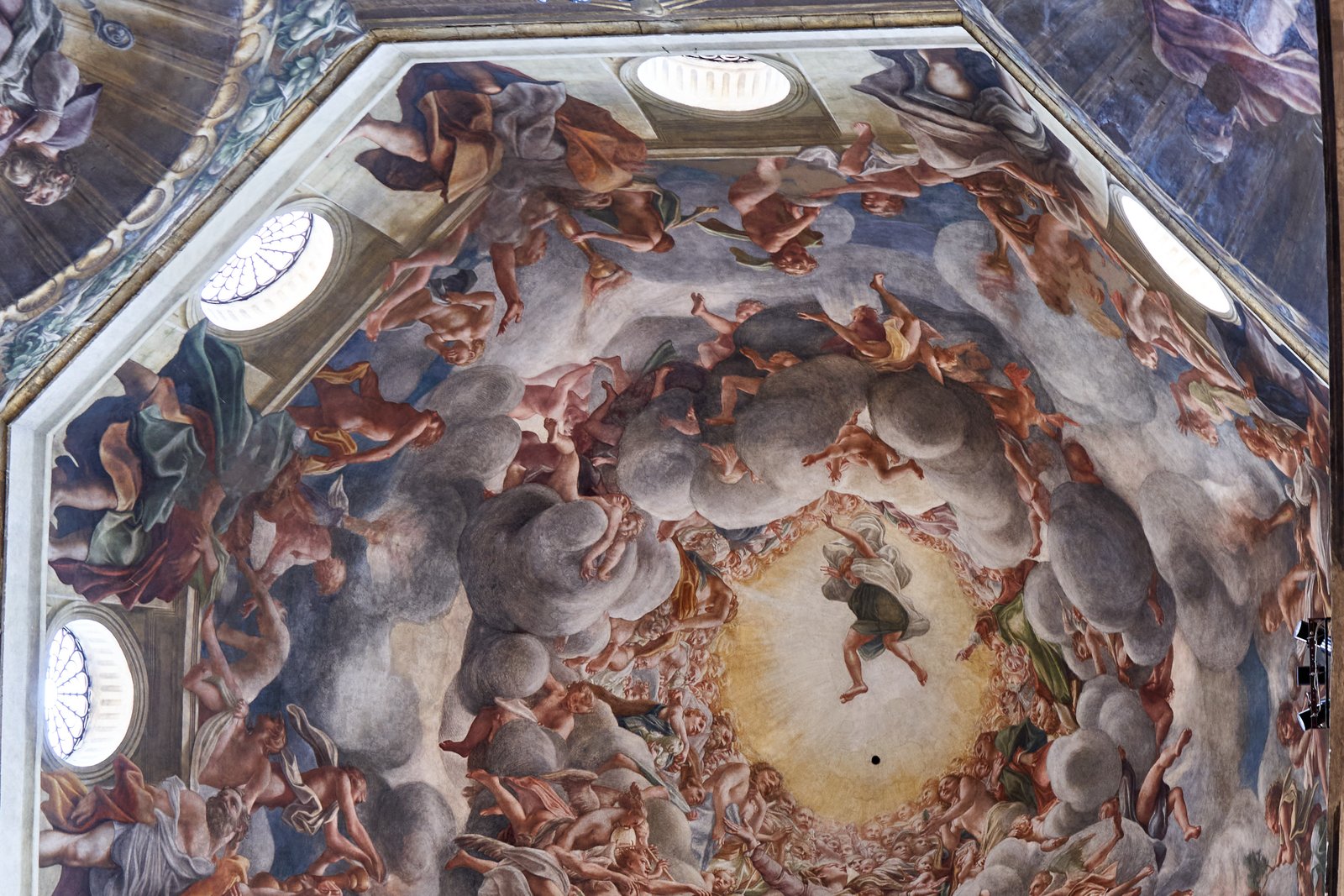
Antonio da Correggio, "Assumption of the Virgin," dome fresco, 1526-1530, Parma Cathedral. Photo by Jean-Christophe Benoist, CC BY 4.0 (Wikimedia Commons).
Painting for a viewer who never sees it straight on
The central technical challenge of any dome or ceiling fresco is that viewers never encounter the image face-on, the way they would a framed panel painting or a wall fresco at eye level. Correggio addressed this by calculating his entire composition according to the principle later termed di sotto in su, literally "from below upward," deliberately distorting and exaggerating the proportions of individual figures so that, seen from the cathedral floor at a steep upward angle and considerable distance, they would resolve into convincing, naturally proportioned forms. This required him to essentially paint against his own eye's instinct for correct anatomy, trusting mathematical calculation of the viewing angle over immediate visual judgment — a technically demanding approach that few painters before him had attempted with such ambition on this scale.
A stew of frogs, or a vision of heaven
The fresco's radical illusionism did not win universal immediate approval. A frequently repeated, if not fully documented, anecdote holds that a contemporary observer compared the dense tangle of foreshortened legs and swirling drapery to a stew of frogs, a comment reflecting how disorienting the effect could appear to eyes unaccustomed to such extreme perspectival distortion. Yet this same radical quality is precisely what later generations of artists and critics came to admire most, recognizing that Correggio had pushed illusionistic ceiling painting into genuinely new territory, sacrificing conventional figural clarity in service of an overwhelming, immersive spatial effect that dissolved the boundary between painted surface and open sky far more completely than earlier ceiling decoration had attempted.
The Assumption as Marian devotion
Beyond its technical innovation, the fresco engages directly with one of the central themes of Marian devotion within Catholic tradition: the belief that Mary, at the close of her earthly life, was taken up body and soul into heavenly glory, a belief with deep roots in Christian tradition that would later be formally defined as dogma by Pope Pius XII in 1950, though it was already a well-established subject of devotion and artistic representation centuries before that formal declaration. Correggio's treatment emphasizes the sheer scale and dynamism of the event, surrounding Mary with a vast, spiraling host of angels and saints rather than a small, contained group, visually reinforcing the cosmic significance of the moment. Readers interested in how other artists have approached the same Marian theme may enjoy our related piece on the rose in Marian art, exploring another recurring visual language used to honor the Virgin.
Influence on a century of church ceilings
Correggio's dome would go on to exert outsized influence over the following century of Italian church decoration. Baroque painters tasked with decorating the domes and ceilings of grand new churches built during the Counter-Reformation drew directly on the illusionistic techniques Correggio had pioneered in Parma, developing them further into the even more spectacular, dramatically theatrical ceiling frescoes that became a defining feature of Baroque religious architecture across Italy and beyond. What had struck some 16th-century viewers as disorienting became, within a hundred years, the standard aspiration for any ambitious church ceiling commission.
A dome still worth the neck strain
Nearly five centuries after its completion, Correggio's Assumption remains a required stop for visitors to Parma Cathedral, who still crane their necks upward to take in a composition designed specifically for that uncomfortable, awestruck vantage point. Few works of Renaissance painting demonstrate so clearly how thoroughly an artist could rethink not just subject matter but the entire physical relationship between a painting, its architectural setting, and the body of the person standing beneath it.
Restoration campaigns over the centuries have periodically cleaned and stabilized the fresco's surface, which suffers, like most large-scale dome paintings, from the ordinary hazards of humidity, candle smoke, and structural settling in the building beneath it. Each restoration has tended to reaffirm rather than diminish Correggio's reputation, revealing passages of color and detail obscured by centuries of accumulated grime and confirming the sophistication of his original planning. For a painter who died relatively young, not yet fifty, and left behind a comparatively modest body of large-scale work, the Parma dome stands as disproportionate evidence of just how far he had pushed the technical and imaginative possibilities of religious painting before his career was cut short.
Trivia
What does Correggio's Assumption of the Virgin depict?
Where is Correggio's Assumption located?
What painting technique makes the dome so visually striking?
Was the fresco well received when it was completed?
How did Correggio's dome influence later art?
Related Reading