Saint Valentine's Relics: The Flower-Crowned Skull of Rome


A skull crowned with flowers
Tourists visiting the Basilica of Santa Maria in Cosmedin in Rome come overwhelmingly for one thing: the Bocca della Verità, the ancient stone mask set into the church's portico, famous from a scene in Roman Holiday and from centuries of legend claiming it will bite off the hand of a liar. Far fewer realize that a few steps further inside the same medieval church sits a considerably more solemn object — a human skull, encircled by a wreath of dried flowers, displayed as the relic of Saint Valentine, the martyr whose name has become shorthand worldwide for romantic devotion. The contrast, tourist curiosity at the door and quiet veneration just inside, says something about how thoroughly Valentine's story has split into two almost unrelated threads: the commercial holiday, and the obscure 3rd-century martyr it claims, with real uncertainty, as its namesake.
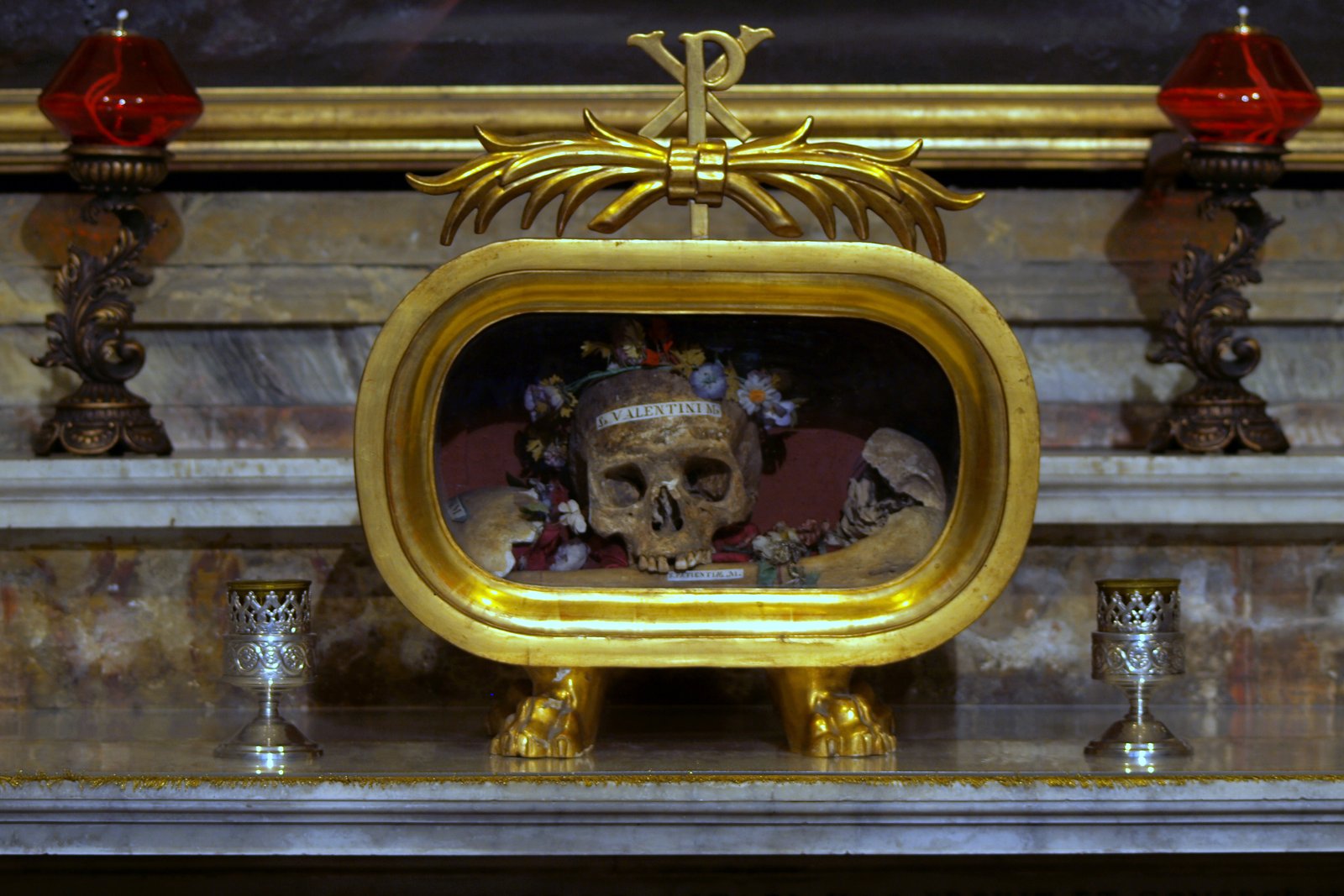
Photo by Alfvan Beem (2012), via Wikimedia Commons, CC0 / public domain.
What the earliest records actually say
Here the Church's own honesty is worth stating plainly, because it runs against how confidently Valentine's story usually gets told in February. Surviving historical records from the 3rd century concerning Valentine are genuinely thin, and Catholic scholarship has long acknowledged that the popular figure may actually represent two, or even three, distinct martyrs whose separate stories were gradually merged into a single popular saint over the centuries. The most commonly cited candidates are a priest martyred in Rome and a bishop of Terni (ancient Interamna), both reportedly executed during the persecutions of the 3rd century, both associated with the Via Flaminia outside Rome, and both commemorated on the same date — similarities that made later conflation almost inevitable for medieval compilers working with scattered, incomplete sources.
This uncertainty carried real consequences within the Church's own liturgical practice. When Pope Paul VI's commission revised the General Roman Calendar in 1969, Saint Valentine's feast was among those removed from the universal, mandatory calendar, specifically because of how little could be reliably established about his historical acts. He was not erased from the Church's list of saints — his feast remains on local and optional calendars, and churches and communities with a particular devotion to him, including Santa Maria in Cosmedin and Whitefriar Street in Dublin, continue to keep it. But the 1969 decision is itself a quiet, official acknowledgment that the popular image of Valentine rests on far less documented ground than his later fame would suggest.
How the skull came to Rome, and how a piece of him reached Dublin
The skull displayed at Santa Maria in Cosmedin has been venerated there for a long span of the church's history, though — in keeping with the honest uncertainty running through this whole topic — its chain of custody back to the 3rd century isn't documented with the kind of precision modern historians would prefer. What is far better documented is a much later chapter in the relic's spread: in 1836, Pope Gregory XVI presented a relic identified as belonging to Saint Valentine to an Irish Carmelite priest, Father John Spratt, after Spratt had made a notably strong impression preaching during a visit to Rome. Spratt carried the relic home to Dublin, where it was enshrined at Whitefriar Street Church, a Carmelite community church that still maintains an active shrine to Valentine, drawing devotion particularly, though not exclusively, around February 14 each year.
This 1836 transfer is a clean, well-documented example of a broader pattern common throughout the history of Christian relics — a significant gift, carefully recorded by both the giving and receiving parties, that can be verified through papal and church records even when the relic's much earlier history remains comparatively obscure. Other churches, including sites in Scotland and elsewhere in Europe, likewise claim fragments or relics associated with Valentine, a dispersal pattern similar to what happened with other widely venerated early martyrs whose remains, over centuries, were divided and distributed among multiple churches seeking a connection to a popular saint.
Where the romance actually comes from
If the history of Valentine's relics is murky mainly around the edges, the romantic association is murky at its very core — because it isn't really part of his story at all, at least not in any account of his martyrdom that survives. The oldest material concerning Valentine concerns his arrest, his faith, and his execution; nothing in it describes secret weddings, romantic correspondence, or any of the other legends popularly attached to him today. Most historians trace the actual origin of the romantic association to medieval literature, and especially to the English poet Geoffrey Chaucer, whose 14th-century poem "Parliament of Fowls" links Valentine's feast day to the time when birds were traditionally believed to choose their mates each spring. That literary association, more than anything in Valentine's own documented life, is widely credited as the seed from which centuries of subsequent romantic custom eventually grew into the modern holiday.
A devotion that outlasted its own documentation
None of this historical uncertainty has meaningfully slowed Valentine's popularity. Couples still visit Whitefriar Street Church in Dublin specifically around February 14, often to have rings blessed at the shrine; pilgrims and curious visitors alike still stop before the flower-crowned skull in Rome. The Catechism's general teaching on relics (no. 1674) frames this kind of veneration as a legitimate, encouraged form of popular devotion — one that has never depended on, and was never meant to depend on, a fully documented biography of the person being honored. Whatever combination of one, two, or three martyrs actually lies behind the name, the devotion that has grown up around Saint Valentine reflects something the Church has always been comfortable leaving honestly unresolved: a popular tradition, built partly on legend and partly on genuine historical martyrdom, that continues regardless of how cleanly the two can be separated.
Trivia
Where is Saint Valentine's skull kept today?
Was there really more than one Saint Valentine?
How did a relic of Saint Valentine end up in Dublin?
Why is Saint Valentine associated with romantic love?
Does the Catholic Church still officially recognize Saint Valentine's feast day?
Related Reading