The Chair of Saint Peter: The Relic Inside Bernini's Bronze Masterpiece

A throne meant to be seen from the floor
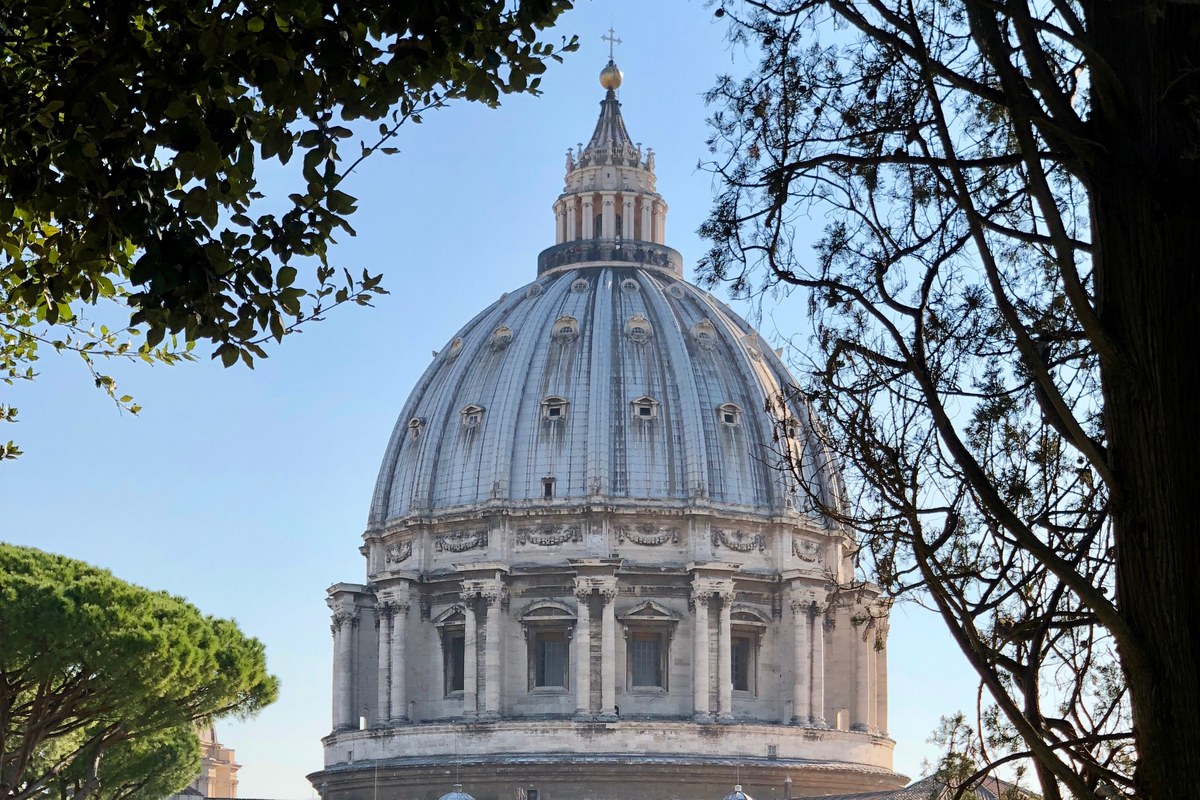
Walk into St. Peter's Basilica, pass the baldachin over the papal altar, and your eye is pulled, almost against your will, toward the far end of the apse. There, more than ninety feet up, four colossal bronze figures — identified as the Doctors of the Church Saints Ambrose, Augustine, Athanasius, and John Chrysostom — appear to strain upward, hoisting an immense bronze throne into the air on clouds and billowing drapery, all of it gilded, all of it lit from behind by a window of golden-amber glass carved into the shape of a dove, the traditional symbol of the Holy Spirit. It is one of the single most theatrical pieces of architecture in a building that is not short on theatrical architecture.
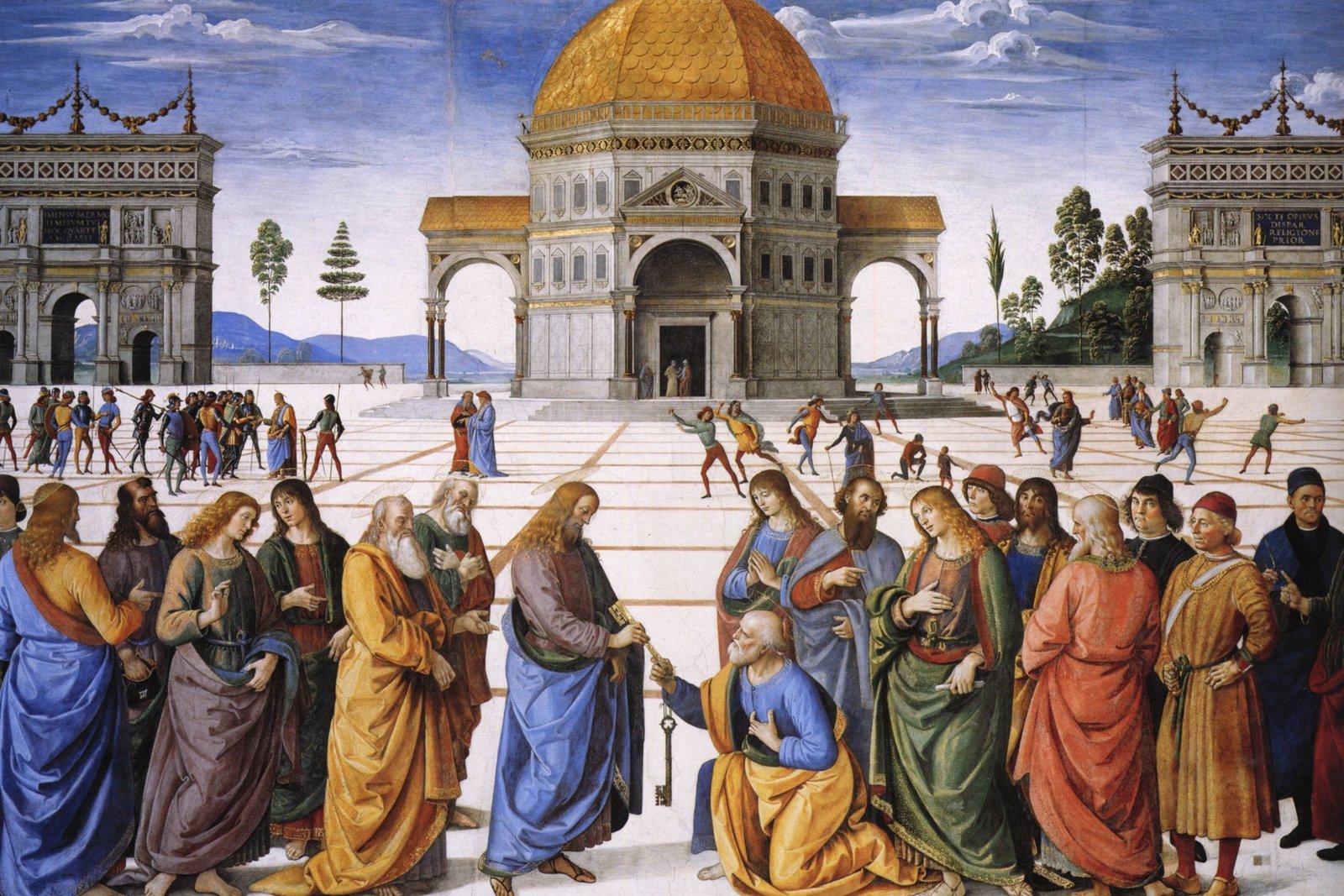
Willem van de Poll, photograph of the Cathedra Petri, December 1937. CC0, via Wikimedia Commons / Nationaal Archief.
This is the Cathedra Petri, finished by the sculptor Gian Lorenzo Bernini in 1666 for Pope Alexander VII. And the detail that tends to surprise people who learn about it for the first time is that the whole soaring bronze apparatus exists to enclose something much smaller and much plainer: an actual wooden chair, sealed inside the bronze casing, invisible to anyone standing in the nave below.
The relic beneath the bronze
The wooden chair itself — the physical object the Church calls the Cathedra Petri, or Chair of Peter — has been venerated at St. Peter's for a very long time. Written references to a chair associated with Peter's teaching authority in Rome go back to at least the 6th century, and the chair was displayed and venerated periodically for centuries before Bernini's commission gave it a permanent architectural home. Tradition held that this was the very seat from which the apostle Peter had taught and presided as bishop of Rome.
What does the chair actually look like underneath the bronze shell? For most of its history nobody outside a small circle of custodians could say with certainty, since it had been sealed from view. That changed in 1867-68, when the relic was examined ahead of celebrations marking the supposed 1800th anniversary of Peter's martyrdom, and again more thoroughly during a 1968 restoration carried out by Vatican conservators. Those examinations found that the chair is a composite object: oak and acacia wood joined together, with ivory carvings decorating its frame, some of which depict the labors of Hercules — an odd detail for a sacred relic, explained by the likelihood that older decorative panels, possibly even ancient ones, were reused when the chair was assembled or repaired.
The core structure of the chair, the 1968 study concluded, is Carolingian — meaning it was built in the 9th century, in the decorative style associated with the court of Charlemagne and his successors, not in first-century Judea. The most widely cited identification is that this chair, or at least its frame, was a gift from the Frankish king Charles the Bald to Pope John VIII around 875 AD, likely presented when Charles traveled to Rome to be crowned Holy Roman Emperor. If that identification is correct, the physical chair inside Bernini's bronze is roughly 1,150 years old — a genuinely ancient and historically significant object in its own right, even though it cannot be the literal chair the historical Peter sat in during his lifetime in the first century. Some older or reused fragments incorporated into the piece may be considerably earlier, but the chair as a complete, datable object belongs to the Carolingian era.
Not the same thing as the February feast
Here it's worth untangling something that trips up a lot of readers: the Feast of the Chair of Saint Peter, celebrated every year on February 22, is not primarily a commemoration of this physical object. The feast's roots in Rome's calendar predate Bernini's sculpture by many centuries and go back to an ancient Roman custom of commemorating the founding of a family or institutional seat — in this case, Peter's establishment of an episcopal "chair," meaning his teaching office, in Rome.
What the feast actually celebrates, according to the Vatican's own description of the basilica's monuments, is Peter's pastoral authority and the teaching office handed down through his successors — the popes — not a date tied to a literal piece of furniture. A "chair," in the ancient and still-current sense the Church uses the word (as in "cathedral," the church that houses a bishop's chair, or "ex cathedra," referring to teaching exercised with the authority of that office) is a symbol of governing and teaching responsibility. The February feast honors that office and its continuity from Peter onward. The wooden relic enshrined in Bernini's bronze is the material, venerable object tradition associates with it, but the two — the feast and the relic — developed along related but separable tracks, and conflating them flattens a more interesting history into a simpler one.
Bernini's argument in bronze
Pope Alexander VII's decision in 1657 to commission a monumental setting for the relic wasn't just decorative ambition. By the mid-17th century, the Catholic Church was deep into the Counter-Reformation, a period in which Rome deliberately used art, architecture, and spectacle to restate Catholic teaching in the most visually persuasive terms possible, partly in response to Protestant reformers who had rejected papal authority and relic veneration alike. Bernini, already responsible for the bronze baldachin over the high altar and much of the basilica's interior sculptural program, took on the challenge of giving this particular relic an architectural argument to go with its devotional one.
The result, completed in 1666, is often counted among the defining achievements of Roman Baroque sculpture: a composition that uses scale, implied movement (the Doctors' robes seem to billow, their postures seem to strain with effort), real light (that amber dove window is positioned to catch the basilica's afternoon sun), and material contrast (gilt bronze against the basilica's white marble and stone) to make a theological claim feel physically inescapable to anyone standing in the nave. The four bronze Doctors supporting the throne — two from the Latin-speaking Western Church, two from the Greek-speaking Eastern Church — were a deliberate choice: the sculpture asserts that both halves of ancient Christianity recognized the authority this chair represents, even as the lived reality of East-West division was, by the 1660s, already centuries old.
What the Church actually teaches the symbol means
Strip away the relic's uncertain dating and the sculpture's spectacle, and what remains is a specific teaching the Catholic Church holds as doctrine, not legend: that Peter was given a unique pastoral responsibility among the apostles, and that this responsibility continues in his successors, the bishops of Rome. The Catechism of the Catholic Church states that Christ made "Simon alone, whom he named Peter, the 'rock' of his Church," giving him "the keys of his Church" and instituting him "shepherd of the whole flock," a pastoral office that "belongs to the Church's very foundation and is continued by the bishops under the primacy of the Pope" (CCC 881). The Second Vatican Council's Lumen Gentium likewise affirms that the Roman Pontiff, as Peter's successor, holds "full, supreme, and universal power over the Church" by virtue of his office, exercised in communion with the college of bishops rather than apart from it.
That teaching about papal primacy stands regardless of how the wooden chair's dating turns out, and regardless of how much Baroque bronze surrounds it. The relic and the monument are, in the end, a physical, visitable argument for something the Church teaches on independent theological grounds — which is, in a sense, exactly what Bernini intended visitors to feel standing beneath it, whether or not they ever learn that the chair sealed inside dates to the court of Charlemagne rather than the age of the apostles.
Trivia
Is the Chair of Saint Peter a real physical object, or just a symbol?
How old is the actual wooden chair inside Bernini's sculpture?
What is the Feast of the Chair of Saint Peter, and is it about the physical chair?
Why did Bernini design such an enormous bronze sculpture around a plain wooden chair?
Can visitors see the actual wooden chair today?
You May Also Like
Related Reading