The Holy House of Loreto: A Nazareth Cottage Enshrined in Italy

A house inside a basilica
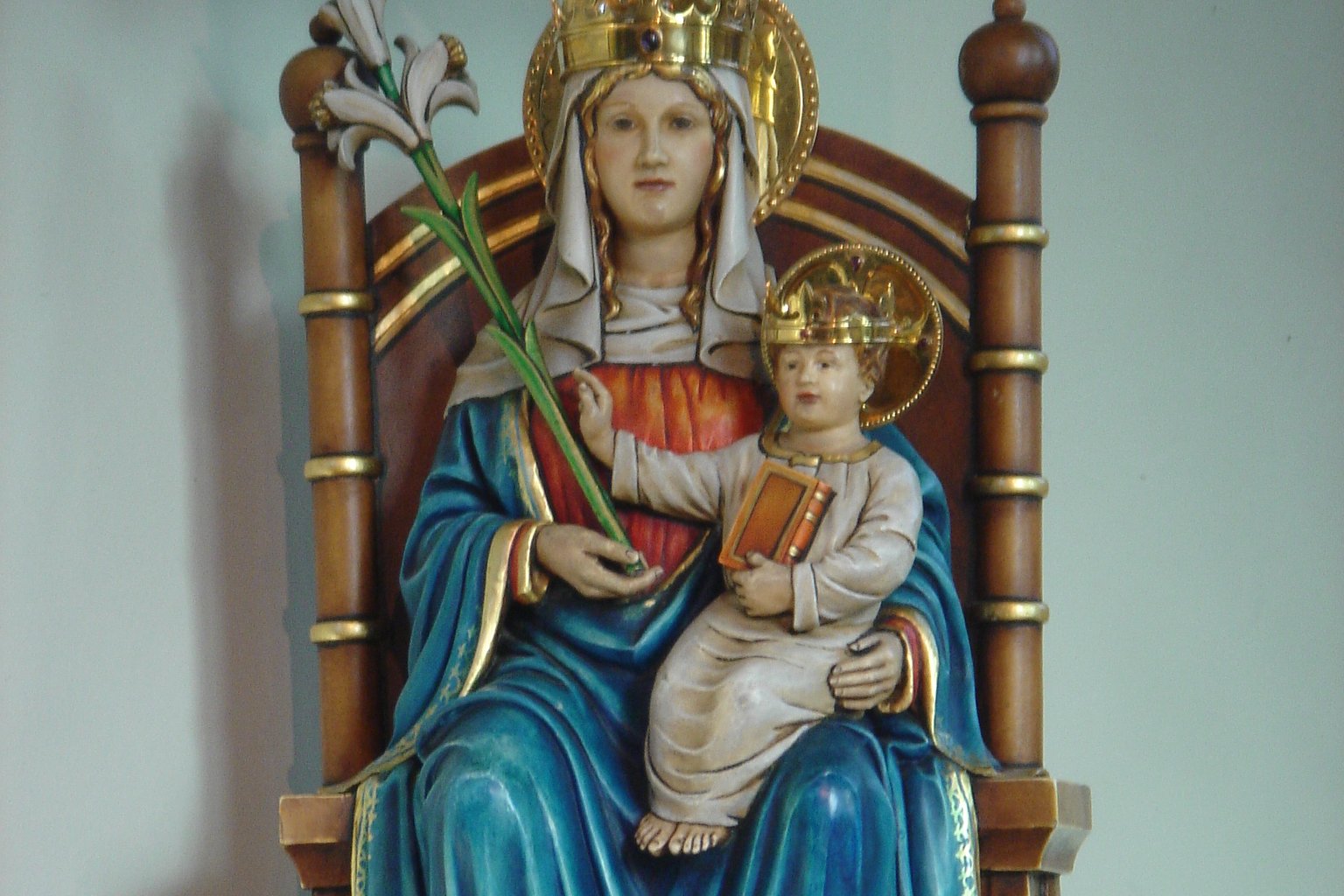
Walk into the Basilica della Santa Casa in Loreto, a hill town a few miles inland from the Adriatic port of Ancona, and the building's real purpose becomes obvious only once you reach the center of the nave. There, beneath the dome, stands another structure entirely: a plain, roughly coursed stone house, its exterior now sheathed for protection in an elaborate marble screen carved by Bramante, Sansovino, and other Renaissance masters, but its interior left essentially bare — measuring, according to the Catholic Encyclopedia's account, about thirty-one feet by thirteen. An altar stands at one end beneath a dark statue of the Virgin and Child. Above it, an inscription in Latin reads Hic Verbum caro factum est — "Here the Word was made flesh."
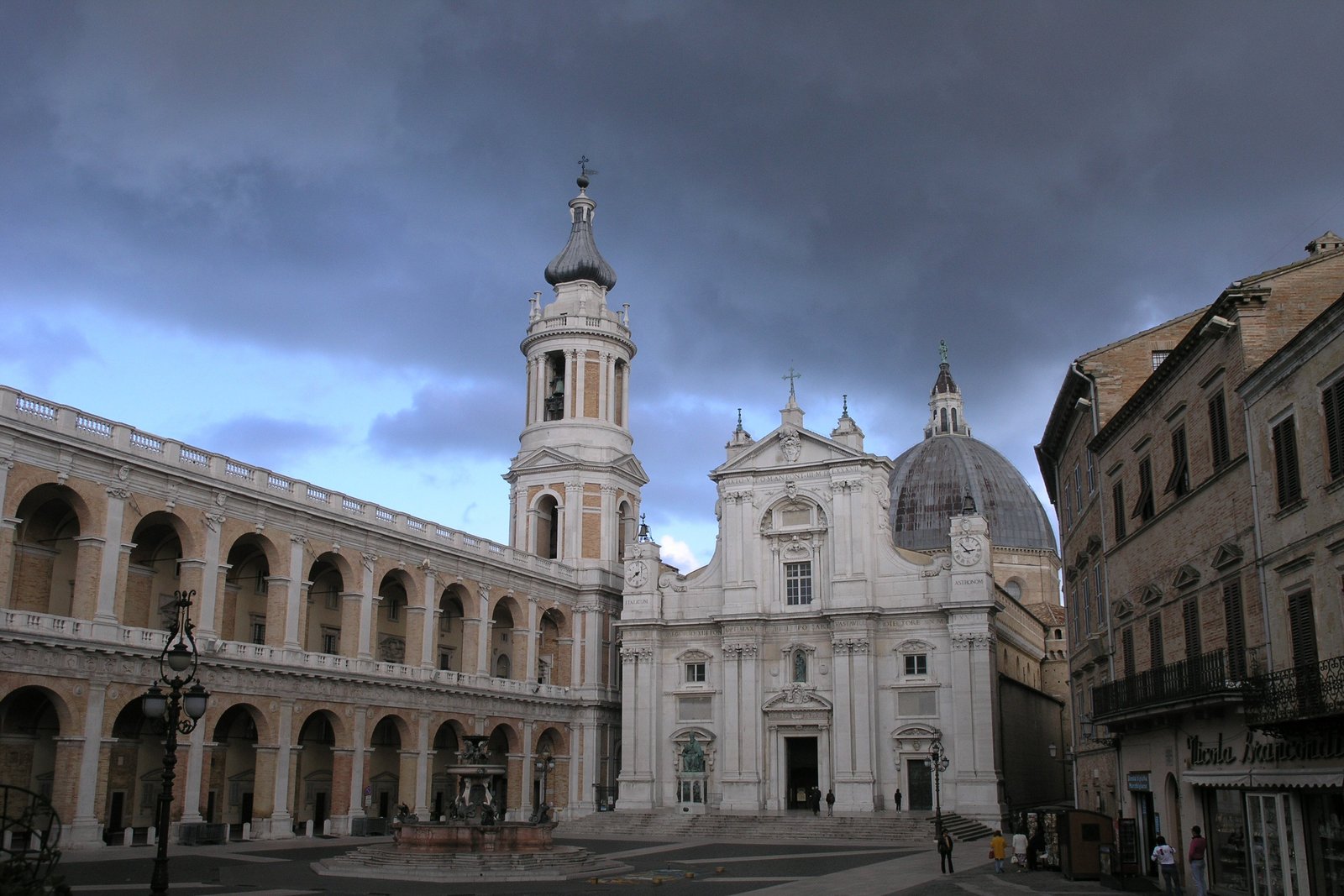
Peter Geymayer, Loreto Basilika (2005). Public domain, via Wikimedia Commons.
That claim is the whole reason the shrine exists. Since at least the fifteenth century, Loreto has been venerated as the enclosure of the actual house of the Holy Family in Nazareth: the home in which, tradition holds, Mary was born, grew up, and received the Angel Gabriel's announcement that she would conceive and bear a son (Luke 1:26-38). The basilica that now surrounds the little house took more than a century to build, drawing contributions and pilgrimages from dozens of popes and a roster of saints that includes Charles Borromeo, Francis de Sales, and Ignatius of Loyola.
The legend: carried by angels
The oldest widely circulated account of how a Nazarene house ended up on an Italian hillside is recorded in a sixteenth-century inscription on the basilica's eastern facade, preserved by the Catholic Encyclopedia: angels, it says, carried the House from Palestine to a town called Tersatto in Illyria (on the Adriatic coast of modern Croatia) in 1291, during the pontificate of Nicholas IV. Three years later, in the time of Boniface VIII, angels moved it again, this time to a wood near Recanati in Italy's Marche region. After shifting location twice more within roughly a year — according to tradition, in response to disputes between local landowners over who should profit from the growing stream of pilgrims — it came to rest permanently on its present site at Loreto.
It is a vivid story, and one taken seriously at the highest levels of the Church for centuries: more than forty popes extended favors or indulgences to the shrine, the tradition was written into the Roman Martyrology in 1669, and a proper liturgical feast and Mass were approved in 1699. Leo XIII, marking the six-hundredth anniversary of the translation in 1894, described the house as having been "miraculously translated to Italy" in a brief granting spiritual favors for the occasion.
What the stones themselves suggest
Quite apart from the inscriptions and papal documents, two physical observations have long been cited in the tradition's favor, and both were formally investigated as early as the eighteenth century, under Pope Benedict XIV. First, the stone and mortar of the house's original walls are reportedly not of a type native to the area around Loreto, but are instead consistent with building materials characteristic of the region around Nazareth — an argument for Nazarene origin that, if the material analysis holds up, is hard to explain by any theory that has the house built locally from the start. Second, and perhaps more striking, the house's lower courses rest on no sunken foundation at all; the walls simply begin at ground level, without the footings a builder would normally dig were they constructing a new structure on that exact spot. Supporters of the tradition read this as consistent with a structure that was assembled somewhere else and then set down, whole, on unprepared ground — rather than built up from bedrock in Loreto in the ordinary way.
Critics of the tradition, led most forcefully by the French scholar Ulysse Chevalier in a widely discussed 1906 study, countered on different ground: the documentary trail. Pilgrim accounts from before 1291 describe nothing at Nazareth resembling a freestanding cottage matching the Santa Casa's dimensions — what earlier pilgrims venerated there was, by several accounts, more a cave or grotto cut into rock than a built house. Chevalier also noted that no surviving writer mentions any miraculous translation before 1472, close to two centuries after the event is supposed to have occurred, and that charters show a church already dedicated to the Virgin existing at Loreto in the twelfth and thirteenth centuries — before the traditional date of the house's arrival. Those are real difficulties, and later defenders of the tradition, including Eschbach, Faloci-Pulignani, and others cited by the Catholic Encyclopedia, have never fully resolved them to the satisfaction of secular historians.
A different kind of answer: the Angeli family
The most historically interesting development came not from either side of that argument but from the archives. Around 1900, the Franciscan historian Girolamo Golubovich, working through Vatican and other archival collections, surfaced a set of documents that reframed the whole question. One, dated 1294, records a marriage dowry: Nikephoros Angelos (rendered in Italian sources as Niceforo Angeli), the Byzantine despot of Epirus, pledged his daughter Itamar's hand to Philip of Taranto and included among her dowry goods "holy stones taken from the House of our Lady the Virgin Mother of God." A coin bearing an Angeli-family mark has also reportedly been found associated with the house's foundation material at Loreto, the kind of token medieval builders sometimes placed to mark who had financed a construction.
Here is where the pieces come together suggestively, if not conclusively: the Angeli were a crusader-era Byzantine noble family with extensive connections across the eastern Mediterranean and the Adriatic in exactly the window the legend describes, and the Italian word for "angels" is, of course, angeli. The resemblance has led a number of historians, popularized in more recent decades by figures such as the physicist-turned-researcher Nanni Monelli and discussed in outlets including Catholic News Agency, to propose that the oldest form of the Loreto story began as a garbled memory of the Angeli family's documented role in moving stones or building materials associated with a Marian shrine from the crusader states westward — a human transaction later recast, as oral tradition layered onto it over two centuries, as a miracle performed by literal angels.
It is worth being precise about what this theory does and does not establish. It does not prove that the stones at Loreto are authentically from first-century Nazareth, nor does it fully resolve Chevalier's documentary objections about what, if anything, stood at Nazareth before 1291. What it offers is a plausible, non-miraculous historical mechanism — a noble family's logistics and patronage, operating in a documented geopolitical context — that could account for how building material reputed to be from a Marian holy site in the crusader East ended up, by means of human ships and human money, on the Italian Adriatic coast. Whether the Angeli transported original Nazarene stones, stones from a shrine already built up around a venerated site, or something else again remains, honestly, an open historical question.
A shrine the Church still honors — without requiring certainty
None of this historical uncertainty has diminished Loreto's standing as one of the great Marian shrines of the Catholic world. The feast of Our Lady of Loreto is kept on December 10, the traditional date of the house's final translation, and it remains an active site of papal pilgrimage; multiple modern popes, including John Paul II, Benedict XVI, and Francis, have visited and prayed there, and Pope Francis in 2019 formally inserted the memorial of Our Lady of Loreto into the General Roman Calendar for the universal Church.
What the Church has consistently declined to do, across more than seven centuries of devotion, is make the mechanism of the house's arrival in Italy — angelic flight, Angeli-family shipping logistics, or some combination neither side has fully documented — a matter of required belief. As with other venerated relics, the Catechism of the Catholic Church frames devotion to shrines and relics as an encouraged practice of popular piety (no. 1674), one that directs the faithful's veneration toward the mysteries a place or object represents — here, the Incarnation itself, commemorated in the inscription above the altar — rather than toward a forensically certified artifact. A pilgrim standing inside that small stone room at Loreto is not required to have settled, first, whether angels or a Byzantine noble family's ships carried its walls across the sea. The tradition has survived, and the popes have continued to honor it, precisely because the house's deeper claim — that here, in some house, the Word was made flesh — does not rise or fall on resolving that question with documentary certainty.
Trivia
What is the Holy House of Loreto?
Did angels really carry the house, according to Catholic teaching?
Is there a more historical explanation than the angel legend?
Is there any physical evidence connecting the house to Nazareth?
What does the Catholic Church teach about venerating relics like this one?
Related Reading