The Holy Lance of Vienna: Relic of the Holy Roman Emperors

A spearhead that outranked most swords
Most relics venerated by the Church earned their place through quiet devotion — a saint's bones, a splinter of wood, a scrap of cloth kept by someone who loved its original owner. The Holy Lance of Vienna took a different road entirely. It became one of the most politically potent objects in medieval Europe not primarily because of who it was said to have touched on Calvary, but because of who carried it into battle and coronation ceremonies centuries later. Understanding it means setting aside, for a moment, the broader legend of the centurion's spear from John's Gospel — our companion article, "The Spear of Longinus," covers that story and Rome's own rival lance in full — and looking instead at how one specific iron blade became bound up with the fate of an empire.
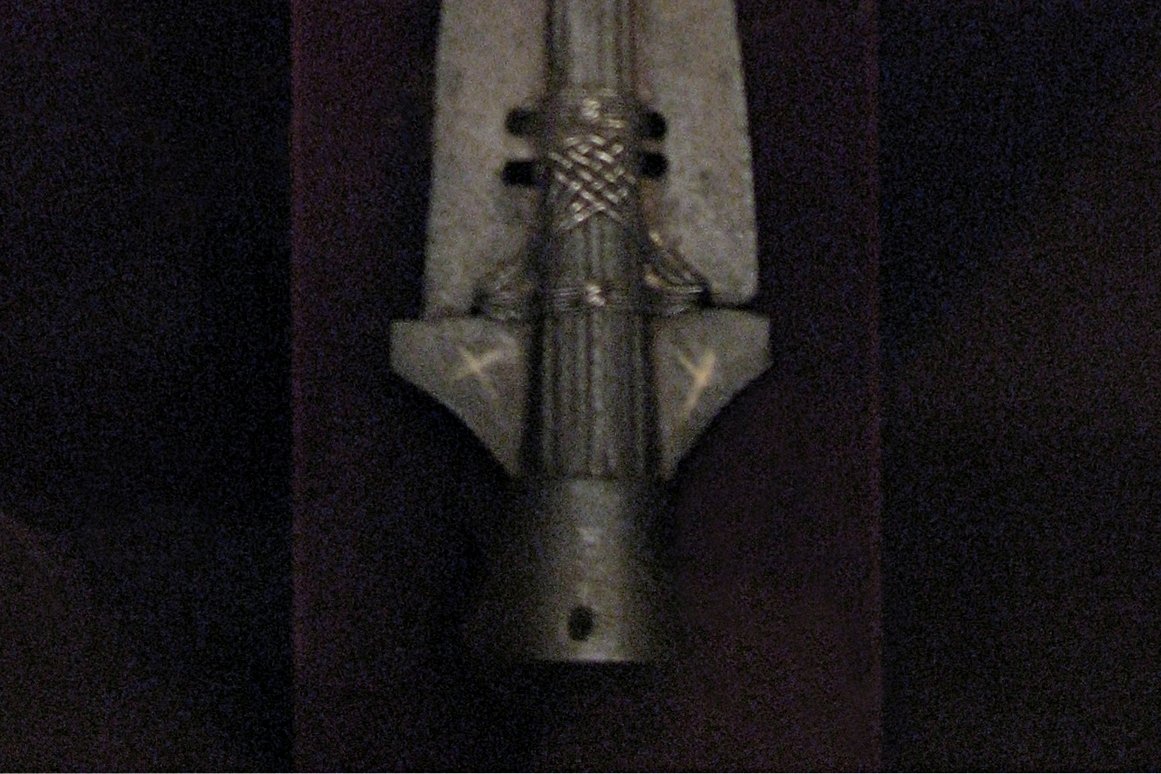
Photo of the Weltliche Schatzkammer, Vienna (2014), via Wikimedia Commons, CC BY-SA 3.0.
From Carolingian battlefield to imperial coronation
The lance now kept in Vienna's Hofburg Treasury surfaces in documented history as part of the Imperial Regalia, the Reichskleinodien, the collected objects — crown, orb, sword, and lance together — that symbolized the legitimate authority of the Holy Roman Emperor. Medieval tradition held that the lance had belonged to Saint Maurice, the Roman military commander venerated as a martyr, which is why it is sometimes still called the Lance of Saint Maurice. By the time it was carried into the coronation ceremonies of the Kings of the Germans at Aachen, the lance was already treated less as a battlefield weapon and more as a piece of sacred regalia: to be invested with it, alongside the crown, was to be visibly marked as God's chosen ruler.
Two of the most formidable rulers in medieval German history anchored their reputations partly to this object. Otto I, crowned emperor in 962, is remembered by tradition as having carried the lance at the decisive Battle of Lechfeld against the Magyars in 955, a victory that cemented his authority across the German kingdoms. Two centuries later, Frederick Barbarossa — the same emperor whose armies sacked Milan and set the relics of the Magi on their way to Cologne Cathedral — is likewise said to have trusted the lance as a guarantee of victory in his own military campaigns. Whether either belief reflects anything more than the kind of battlefield confidence any army draws from a revered symbol is impossible to verify historically; what is certain is that by the high Middle Ages, possessing this particular lance had become inseparable from claiming legitimate imperial rule.
What the blade is actually made of
Strip away the legend and the lance itself is a remarkable, genuinely ancient object in its own right — just not from the century its medieval owners believed. The core is a winged iron spearhead of a design typical of Carolingian-era weaponry, the dynasty founded by Charlemagne that dominated Western Europe from the 8th through 10th centuries. At some point, likely during the reign of the 14th-century emperor Charles IV, a decorative sleeve of gold was added partway down the blade, covering a section near the socket and bearing an inscription claiming that a Holy Nail from the crucifixion itself had been driven into the iron and was now sealed beneath the gold. Fine silver wire, wound in several bands around the blade, further bound the whole object together — as much a piece of devotional reliquary craftsmanship by that point as a weapon.
Modern metallurgical and art-historical examination of the piece — direct scientific study of the object itself, not simply an inference from written legend — has dated the iron blade to roughly the 7th or 8th century. That places its manufacture firmly in the Carolingian period, many centuries after the crucifixion it was popularly believed to memorialize. The finding doesn't disprove the devotional tradition surrounding the embedded nail, since the claim was always about a relic added to an existing blade rather than about the blade's own age — but it does settle, as a matter of established fact, that the spearhead itself cannot be a 1st-century Roman weapon.
Seized for its legend, not its history
The lance's strangest chapter belongs to the 20th century. By the early 1900s, a tangle of nationalist and occult legend had grown up around the object, portraying it as a talisman whose possession conferred mystical power over the fate of nations — a claim with no basis in documented medieval tradition, but one that found a receptive audience in certain currents of early 20th-century German and Austrian nationalism. After Nazi Germany annexed Austria in March 1938, the regime had the Imperial Regalia, lance included, removed from Vienna and transported to Nuremberg, a city the Nazi party had already made central to its own propaganda and mass rallies. The transfer was a documented historical event, carried out for reasons tied to political symbolism rather than any genuine historical claim on the regalia.
The lance, along with the rest of the regalia, remained in Nuremberg through the end of the Second World War. American forces recovered the collection after Germany's defeat, and the Imperial Regalia were returned to Austria in 1946, restored to the Hofburg Treasury in Vienna, where the lance has remained on public display ever since.
What the Church actually says, and what belongs to history
As with the other rival lances discussed in our companion article on Longinus, the Catholic Church has never dogmatically certified that this object, or the nail tradition attached to it, is a genuine relic of the crucifixion. The Catechism of the Catholic Church treats the veneration of relics generally as an encouraged form of popular devotion (no. 1674), but that encouragement has never depended on, nor amounted to, a scientific or doctrinal ruling on any specific artifact's material origin.
What can be said with confidence, and without relying on contested legend, is more interesting in some ways than the relic claim itself: this is a genuinely ancient Carolingian weapon, reworked over centuries into one of the most consequential pieces of political regalia in European history, fought over, carried into coronations, and finally seized by a regime that wanted its myth more than its metal. The gold sleeve, the silver wire, the inscription claiming a hidden nail — all of it tells the story of how badly medieval and even modern Europe wanted its symbols of power to carry something sacred inside them, whether or not the history could actually bear the weight.
Trivia
Where is the Holy Lance of Vienna kept today?
Is the Vienna lance the same relic as the one at St. Peter's Basilica in Rome?
How old is the Vienna Holy Lance, according to modern science?
Why did the Nazi regime take the Holy Lance of Vienna in 1938?
Does the Catholic Church teach that the Vienna lance contains a genuine nail from the crucifixion?
Related Reading