The Spear of Longinus: The Holy Lance That Pierced Christ's Side

A single verse, and an anonymous soldier
Of all the relics associated with Christ's Passion, the Holy Lance rests on the thinnest biblical foundation of any of them. The Gospel of John is the only one of the four Gospels to mention it at all, and it does so in a single, spare sentence describing events after Jesus had already died: "one soldier thrust his lance into his side, and immediately blood and water flowed out" (John 19:34). John goes out of his way to insist this detail comes from an eyewitness — "he knows that he is speaking the truth" (19:35) — and ties the piercing to two Old Testament passages he reads as prophetically fulfilled: that none of Christ's bones would be broken, and that people would "look upon him whom they have pierced" (19:36-37).
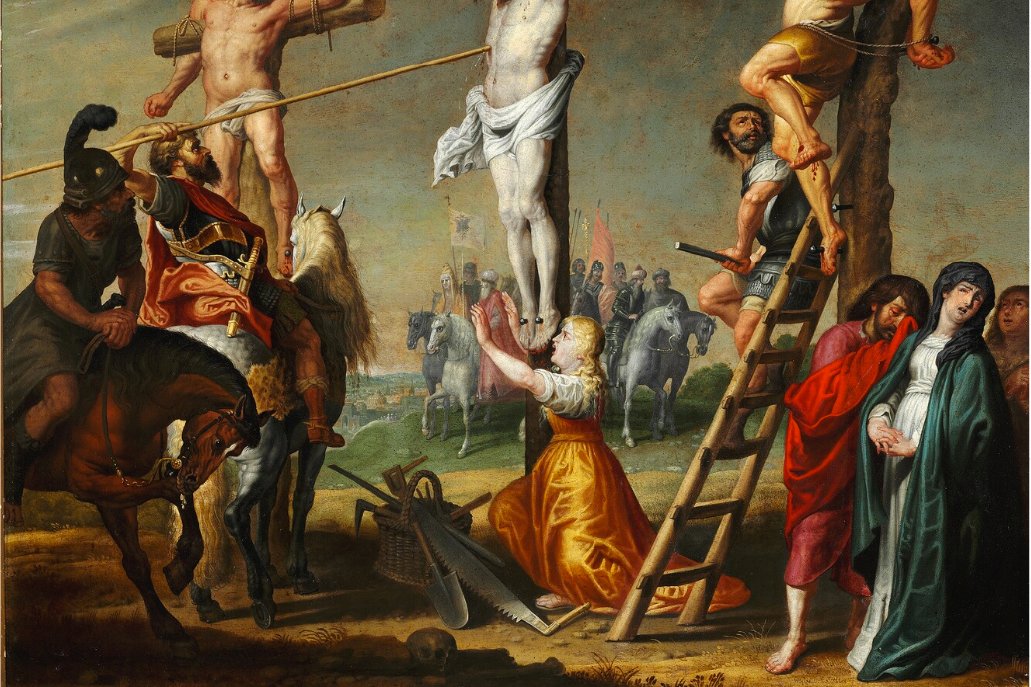
Gerard de la Vallée, Longinus Piercing Christ's Side with a Spear (1626–1667). Public domain, via Wikimedia Commons.
That's the entirety of what Scripture says. No name for the soldier, no description of the weapon beyond the Greek word lonche ("lance" or "spear"), and no indication of what became of it. Everything that follows — the soldier's name, his later life, and the relic's travels across three continents — comes from tradition that developed over the centuries after the Gospel was written.
How an anonymous soldier became Saint Longinus
The name "Longinus" first turns up in a visual source rather than a text: the Rabbula Gospels, a Syriac manuscript illuminated in the year 586 and now held at Florence's Laurentian Library. In one of its miniatures, the soldier thrusting the lance into Christ's side is labeled, in Greek letters, "LOGINOS." Scholars have long noticed the near-pun between that name and logche, the Greek word for the lance itself — raising the possibility that the name grew out of the weapon's own description rather than any historical record of who held it.
Legend filled in the rest. According to the tradition that developed around this figure, the soldier was healed of an eye ailment by a drop of the blood and water that fell on him from the wound, and the miracle led to his conversion. Some versions merge him with the centurion of Mark 15:39, the unnamed soldier who, witnessing the crucifixion, declares "Truly this man was the Son of God!" — though Mark's Gospel gives that centurion no name at all, so the identification is itself a later harmonization rather than anything in the biblical text. Longinus is venerated as a saint in parts of the Church's tradition, with a feast kept on March 15 in some calendars, but this should be read for what it is: a devotional legend built up over centuries around a single unnamed figure in John's Gospel, not a biography resting on independent historical sources.
The relic surfaces in Jerusalem
Whatever became of the physical lance in the decades after the crucifixion, nothing is heard of it in writing for roughly five centuries. The first clear reference comes from Cassiodorus in the mid-6th century and, a little later, from Gregory of Tours, both noting that a lance believed to be the one from Calvary was kept in Jerusalem. The pilgrim Antoninus of Piacenza, visiting around 570, records seeing "the crown of thorns with which Our Lord was crowned and the lance with which He was struck in the side" displayed together in the basilica on Mount Sion — placing the Passion relics as a matched set from very early on, the same pairing that would travel through later history with the Crown of Thorns.
That stability didn't last. In 615, Jerusalem fell to a Persian army under a lieutenant of King Chosroes, and the city's relics of the Passion were seized along with everything else. According to the Byzantine chronicle known as the Chronicon Paschale, the tip of the lance had broken off at some point and was given that same year to a man named Nicetas, who carried it to Constantinople and placed it in the Hagia Sophia. Centuries later, in 1244, that fragment was presented by Baldwin II of Constantinople to King Louis IX of France (Saint Louis) and enshrined in the Sainte-Chapelle alongside the Crown of Thorns — only to disappear during the chaos of the French Revolution, when France's revolutionary government seized and dispersed royal and ecclesiastical treasures; unlike the Crown, this fragment was never recovered.
From Jerusalem to Rome: the lance at St. Peter's
The larger portion of the lance — the main blade, minus its broken tip — stayed behind in Jerusalem, where the pilgrim Arculf reported seeing it around 670, apparently restored to the city by the emperor Heraclius after his recovery of Jerusalem from the Persians. After that, Western pilgrim accounts of a lance in Jerusalem thin out noticeably; notably, Saint Willibald, who visited in 715, says nothing about it. Historians such as Herbert Thurston, writing the Catholic Encyclopedia's account of the relic, have inferred from this silence that the larger fragment was likely transferred to Constantinople sometime before the 10th century, quite possibly alongside the Crown of Thorns.
Byzantine sources, especially Russian pilgrim accounts, attest to a lance relic circulating among Constantinople's churches over the following centuries. In 1492, with the city long since fallen to the Ottomans, Sultan Bayezid II sent what he described as this relic to Pope Innocent VIII, as a diplomatic gesture meant to secure the pope's continued custody over the sultan's rival brother and political prisoner, Cem (Zizim). The gift never left Rome again. It is preserved to this day beneath the dome of St. Peter's Basilica, one of four relics traditionally honored there alongside Saint Peter's own associated items. In the 18th century, Pope Benedict XIV compared a drawing of the Paris fragment's shape against the Roman lance-head and concluded the two pieces had originally belonged to the same blade — though, as with so much of this history, that is a historical argument rather than a formally defined Church teaching.
The rival lance of the Holy Roman Empire
While Rome's lance traces a path from Jerusalem through Constantinople, an entirely separate relic — now known as the Holy Lance of Vienna, or the Lance of Saint Maurice — developed its own, very different career in the West. Documented as part of the imperial regalia at least since 1273, when it was used in the coronation of the King of the Germans (and future Holy Roman Emperor) at Aachen, this lance became bound up with the political legitimacy of imperial rule itself: to hold the regalia, including the lance, was to visibly hold the sanctioned authority of empire. It traveled to Nuremberg in 1424 with the rest of the imperial treasure and today is kept in Vienna's Hofburg Palace, among the Habsburg dynasty's imperial treasury.
Medieval tradition also associated this particular lance with the emperor Constantine, believing it enshrined a nail — or a fragment of one — from the crucifixion itself, driven into the blade. That detail, layering one relic of the Passion inside another, is itself a sign of how urgently medieval Europe wanted its most important political symbols to carry unmistakable sacred authority. Separately, a lance said to have been found at Antioch in 1098 during the First Crusade, following visions reported by a soldier named Peter Bartholomew, generated enormous excitement among the crusading army at the time — but its later history is murky, and Herbert Thurston's research for the Catholic Encyclopedia suggests it may be identical with yet another relic entirely: the one still kept at Etchmiadzin.
The Armenian lance at Etchmiadzin
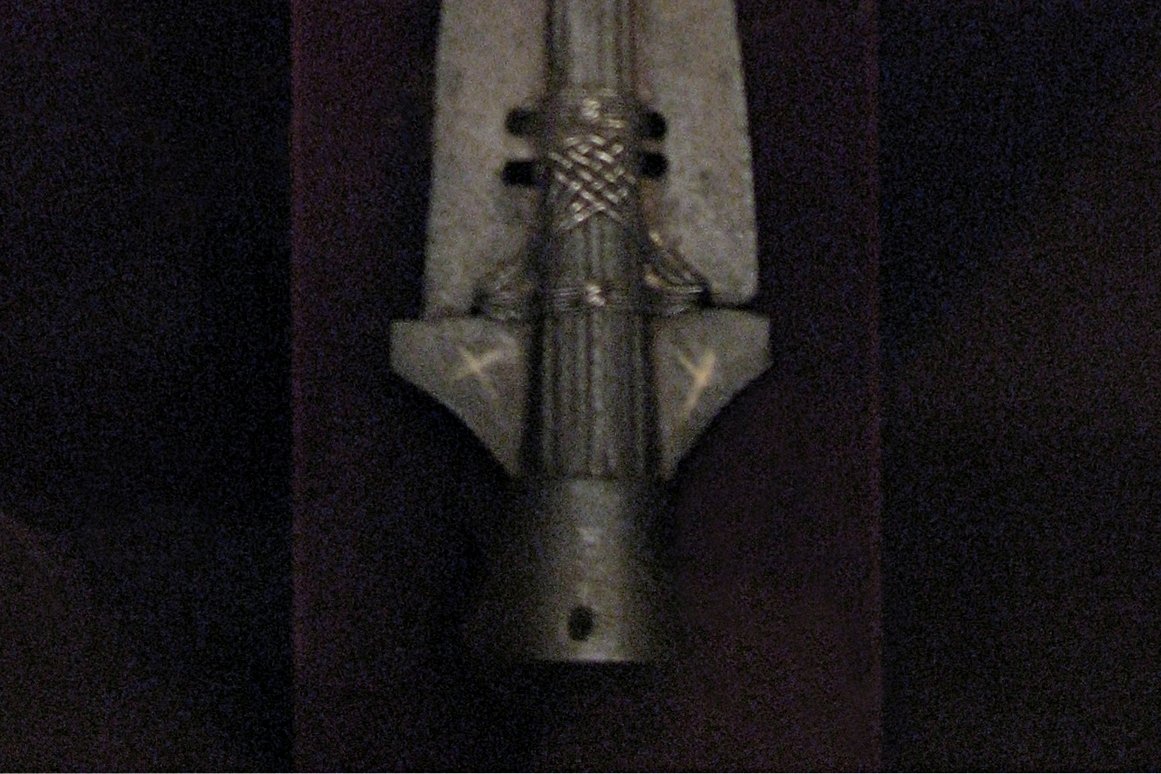
The Armenian Apostolic Church's cathedral at Etchmiadzin, the church's spiritual headquarters, preserves its own relic venerated as the Holy Lance, known locally as the Geghard (meaning "spear" in Armenian) — a name also given to a monastery built specifically to house it. Scholarly investigation into its physical form, summarized by Thurston, concluded that this object was likely never a lance blade at all in origin, but rather the head of a military standard. One line of tradition associated with it ties the relic instead to a later, separate legend: Jewish residents of Beirut striking a crucifix with a spear, provoking a reported miraculous flow of blood from the image. Whatever its true origin, the relic has been venerated by Armenian Christians for centuries and remains one of the most important treasures of Armenian Christianity, held at the same complex that anchors the Armenian Church's historic identity.
A fifth lance, claimed at Kraków in Poland and said to have rested there for roughly eight centuries, rounds out the list of relics bearing this name — though, as with the others, its documented history only reaches back so far before the trail goes cold.
Four lances, one tradition, and what the Church actually asks
Lined up against each other, these four or five lances can't all be the literal weapon described in John 19:34 — a plain physical fact that competing custodians have occasionally sparred over across the centuries, from the doubts raised in Rome in 1492 (when officials already knew of rival lances at Nuremberg and Paris) to later debates among historians trying to trace each fragment's chain of custody. The Catholic Church has never tried to resolve that contest by dogmatic decree. As with the True Cross and the Crown of Thorns, the Church's actual teaching on relics, reflected in the Catechism of the Catholic Church (no. 1674), encourages the practice of veneration without requiring certainty about any specific object's material origin — honor given to a relic, per the ancient teaching of the Second Council of Nicaea, passes through the object to what it represents, not to the artifact considered as a thing of power in itself.
That distinction matters more here than with almost any other relic of the Passion, precisely because the lance's history is so tangled with worldly power — imperial coronations, diplomatic gifts between a sultan and a pope, a crusading army's morale. Strip away the politics, and what's left is simply a soldier's unthinking gesture, recorded in a single verse, that Christian tradition has spent fifteen centuries trying to hold onto in physical form. Whichever blade, if any, actually touched Christ's side, the devotion that grew up around all of them points back to the same moment: blood and water flowing from a wound meant to confirm, beyond doubt, that this was truly a death — and, for believers, the beginning of everything that followed it.
Trivia
Where in the Bible is the piercing of Christ's side mentioned?
Was the soldier who pierced Christ's side really named Longinus?
How many relics claim to be the Holy Lance?
Why was the Vienna Holy Lance politically important?
Does the Catholic Church teach that any of these lances is the authentic relic from Calvary?
Related Reading