The Relics of Saint Mark in Venice: A Theft That Built a Basilica

A Gospel writer, a city in Egypt, and an unlikely patron
Mark's own appearance in the New Testament is modest. He is traditionally identified with the "John Mark" of the Acts of the Apostles, a companion of Paul and Barnabas and, later, of Peter, and Christian tradition since the second century has credited him with writing the Gospel that bears his name — the shortest and, most scholars agree, the earliest of the four. Its final command, addressed to the eleven apostles, is blunt and expansive at once: "He said to them, 'Go into the whole world and proclaim the gospel to every creature'" (Mark 16:15, NABRE). Later tradition, recorded by early Church writers such as Eusebius of Caesarea, holds that Mark carried that commission to Alexandria, Egypt, founding a Christian community there and serving as its first bishop before dying a martyr — accounts that belong to the earliest strand of Church tradition about him rather than to the Gospel text itself.
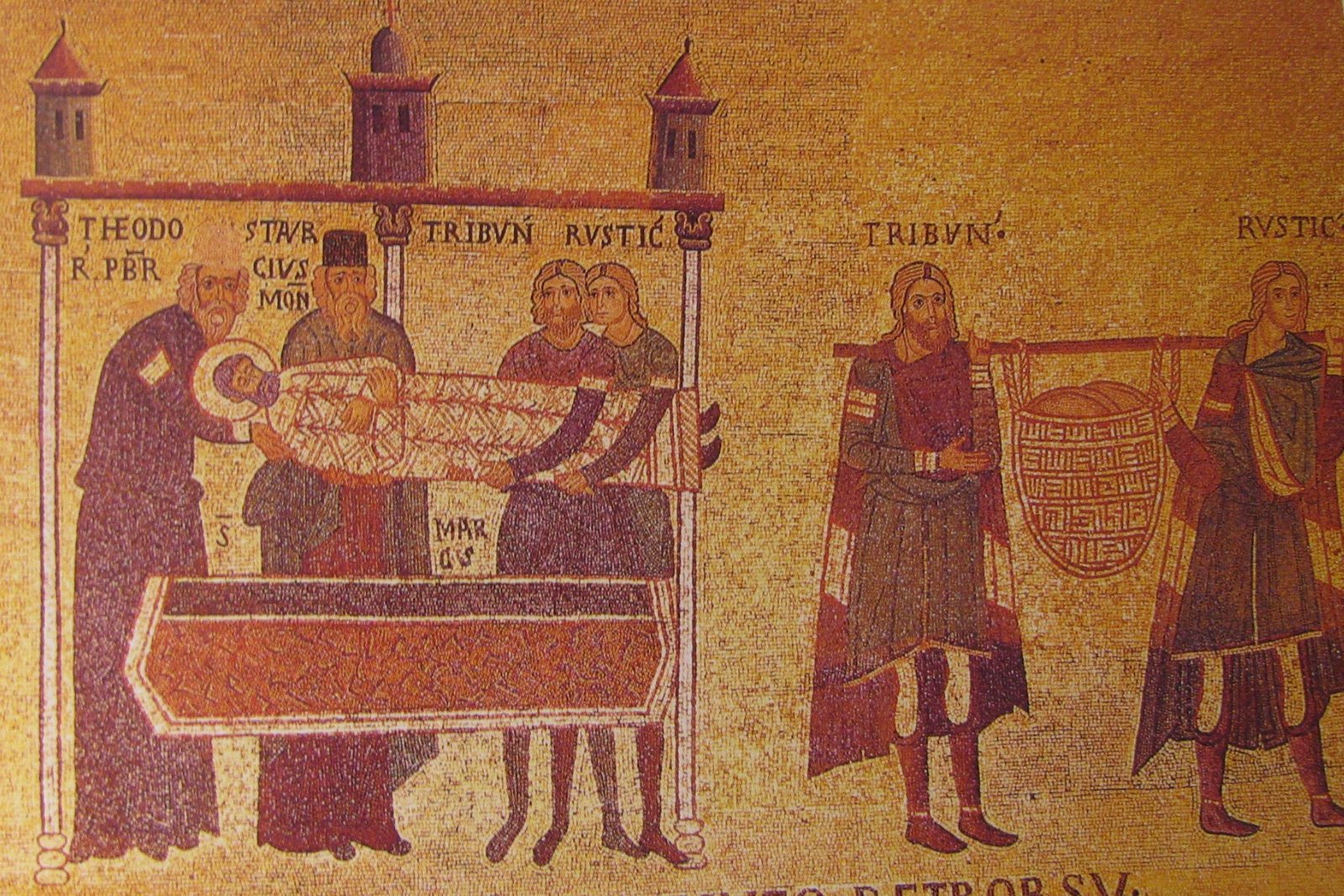
Anonymous, 11th-century mosaic, St. Mark's Basilica, Venice, via Wikimedia Commons, public domain.
By the ninth century, Mark's tomb in Alexandria was a venerated Christian site inside a city that had been under Muslim rule since the 7th-century Arab conquest of Egypt — a political reality that, Venetian chroniclers later claimed, put the relics at risk of destruction as local authorities repurposed or demolished churches for building material.
The merchants, the crate, and the smell of pork
The story Venice tells about what happened next is one of its oldest civic legends, recorded in medieval accounts collectively known as the Translatio Sancti Marci — the "translation," or ceremonial transfer, of Saint Mark. According to that tradition, in 828 AD two Venetian merchants, traditionally named Buono da Malamocco and Rustico da Torcello, arranged with Alexandrian monks anxious about the relics' safety to remove Mark's body from its tomb and carry it out of Egypt. The famous detail — that they packed the relics into a chest, covered them with layers of pork and cabbage leaves, and labeled the whole thing "pork" to get it past Muslim customs officials who would not touch unclean meat — comes down through this same chronicle tradition. It is one of the most vivid relic-smuggling stories in medieval Christendom, and whether every detail happened exactly as told, it reflects a widely accepted and still-celebrated piece of Venice's own foundational memory, commemorated to this day in a mosaic on the basilica's facade.
The ship reportedly reached Venice in 828 or early 829. The Doge, Giustiniano Participazio, who is said to have had a premonition of the relics' arrival, received them and ordered a chapel built specifically to house them beside the ducal palace — a building that would grow, through later rebuilding, into the basilica that still dominates St. Mark's Square. The original church was consecrated in 832.
From Saint Theodore to the winged lion
Before Mark's arrival, Venice's patron had been Saint Theodore, a soldier-martyr venerated across the Byzantine world, whose statue still stands atop one of the two great columns in the Piazzetta facing the lagoon. Possessing an evangelist's relics, though, carried far greater prestige than a secondary military saint, and Venice moved decisively to make Mark its own: a replacement patron, a replacement civic identity, and — most visibly — a replacement emblem. Mark's traditional symbol, the winged lion, drawn from the four symbolic creatures associated with the Gospel writers in Christian art since at least the early medieval period, became Venice's own. It appears on the Republic's flags and coinage for the next thousand years, atop the second great column in the Piazzetta (installed, tradition says, not long after the relics' arrival), and on buildings and monuments across the Venetian trading empire, from Dalmatia to Crete. To this day, the winged lion of Saint Mark remains one of the most recognizable visual shorthand for Venice itself.
Lost, then found again: the 1094 rediscovery
Venice's relationship with its relics took one more dramatic turn before the story settled into its familiar form. A fire damaged the original basilica in 976, during a period of civic unrest, and construction of the present, far grander church — the one still standing — began in 1063. According to tradition recorded by later Venetian chroniclers, however, the exact location of Mark's relics within the building was lost, whether through the fire, the long rebuilding, or simple institutional memory lapsing over the decades. Venice is said to have genuinely worried that its most prized possession was gone.
The resolution, as later tradition tells it, came in 1094. During a solemn Mass held to pray for the relics' recovery, in the presence of Doge Vitale Falier, one of the basilica's pillars reportedly cracked open, revealing an arm — and, within it, the relics themselves, miraculously restored to the community. Venice still commemorates this event, known as the apparitio, each June, and the basilica identifies a specific pillar near the high altar as the traditional site of that 1094 rediscovery. As with the original 828 translation, the apparitio belongs to pious tradition and communal memory passed down through the centuries rather than to a verifiable contemporary record, but it occupies a permanent place in how Venice understands its own basilica and its patron.
What the basilica actually holds
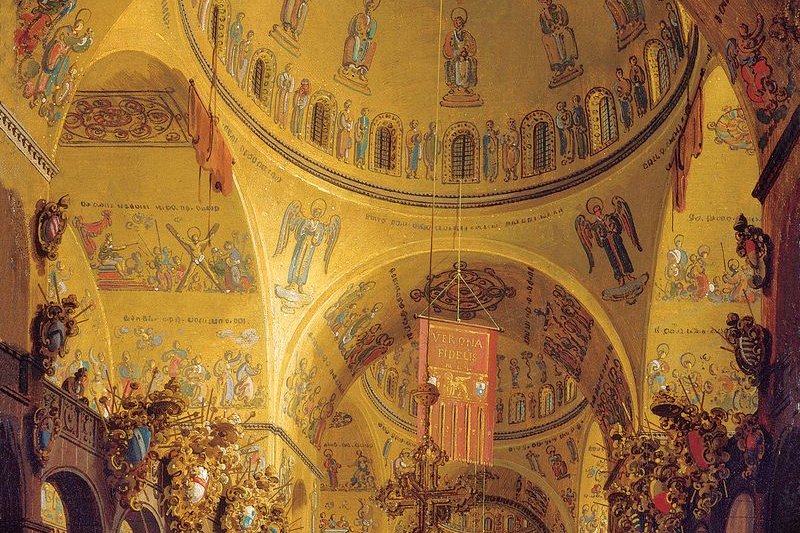
St. Mark's Basilica has housed relics venerated as the evangelist's remains beneath its high altar continuously since the medieval rebuilding, inside a structure whose Byzantine-influenced mosaics, golden domes, and ground plan were shaped, in significant part, specifically to honor what lay inside it — much as other great medieval basilicas were built or expanded around a single, prestigious relic. The basilica's own facade carries mosaic scenes narrating the Translatio story directly to visitors entering the square, making the relics' arrival part of the building's visual program as much as its history.
As with so many medieval relic traditions, it is worth being precise about where documented history gives way to pious legend. The 828-829 removal from Alexandria and arrival in Venice is recorded in Venetian chronicle tradition close enough to the events to count as a genuine, long-standing historical claim about the relics' custody, even without independent corroboration from Alexandrian sources. The vivid specifics — the exact smuggling method, the merchants' precise motives, the 1094 column miracle — belong more clearly to the realm of tradition and civic memory, told and embellished across centuries of retelling. The Catholic Church has never dogmatically certified the physical identity of the remains beneath the altar, and does not need to: as the Catechism notes regarding relics in general, their veneration is an encouraged expression of popular piety (no. 1674) whose real object is not the bone itself but the life and witness it represents — in Mark's case, a Gospel writer's command to carry a message "into the whole world," which one ninth-century shipment of merchants, by their own city's telling, took rather literally.
Trivia
Who was Saint Mark, and why does Venice claim him as patron?
Is the story of the relics hidden under pork actually true?
What happened to the relics after they arrived in Venice?
Why is the Lion of Saint Mark on Venice's flag?
Does the Catholic Church certify that the remains in St. Mark's Basilica are authentic?
Related Reading