The Scala Sancta: The Holy Stairs Pilgrims Still Climb on Their Knees

A stairway kept behind wood and glass
Walk into the small sanctuary building standing apart from the great bulk of St. John Lateran, Rome's cathedral, and you'll find a scene that hasn't changed in its essentials for centuries: a central flight of steps, roped off from ordinary foot traffic, where a steady trickle of pilgrims make their way upward on their knees. Two side staircases, open for walking, flank the central one — most visitors use those to come back down, since descending the holy stairs on one's knees was never part of the custom.
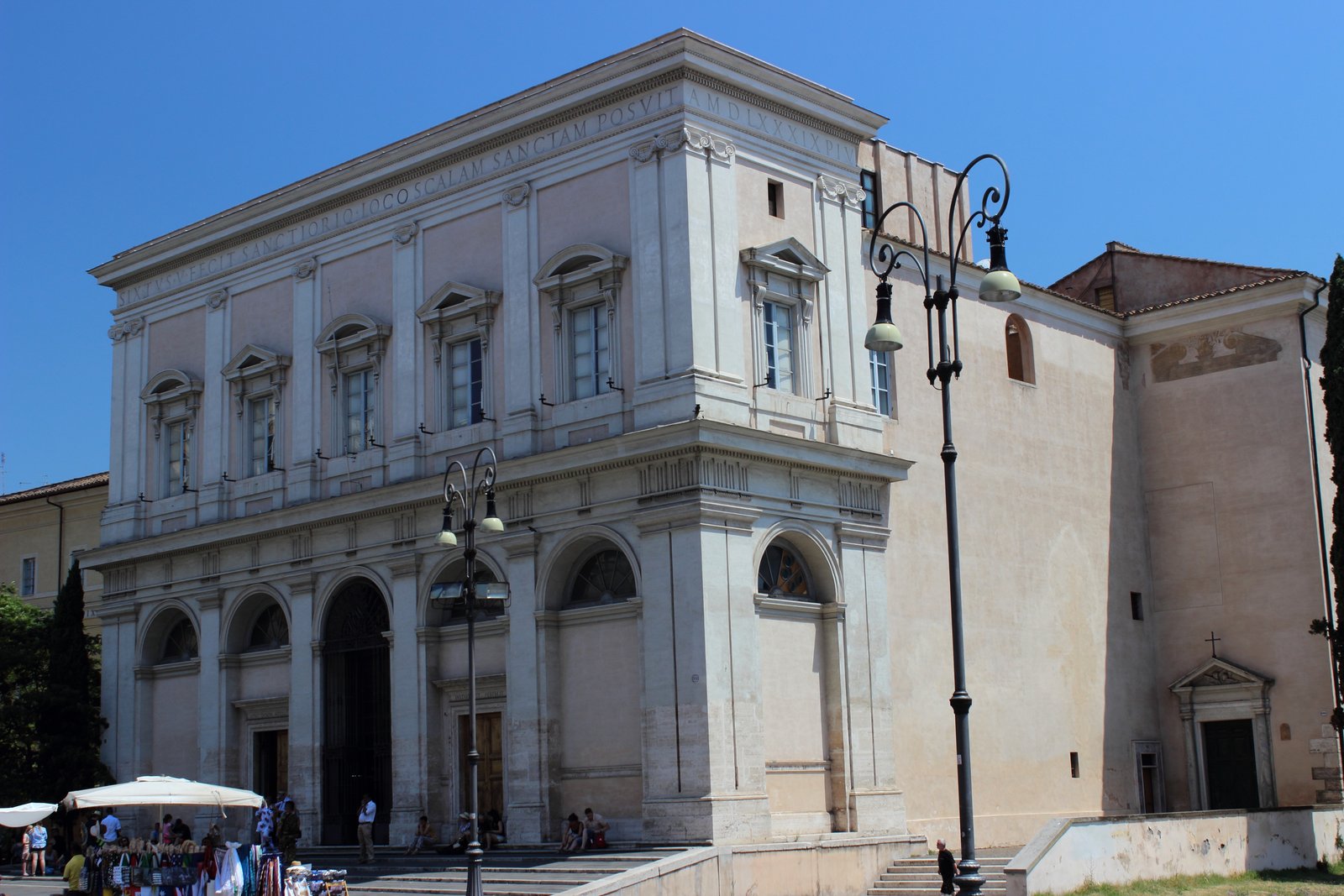
Miguel Hermoso Cuesta, Exterior Scala Santa Roma 01 (2015). CC BY-SA 4.0, via Wikimedia Commons.
The steps themselves are no longer bare stone. What pilgrims' knees actually touch today is a protective covering of walnut wood, installed over the marble to shield it from the wear of centuries of devotion — repairs and replacements of this wooden casing are generally dated to the 18th century, under Pope Pius IX's era of restorations at the sanctuary and earlier work before him, though the exact dating of each intervention is a matter for specialists rather than a single clean date. Cut into several of the wooden treads are small glass-covered openings, deliberately placed so that visitors can look down and see fragments of the original marble surface beneath — worn, discolored in places, and, tradition holds, marked by what some early pilgrims described as bloodstains, a detail embedded deep in the devotional literature surrounding the stairs but impossible to verify by any means beyond legend.
The tradition: steps from Pilate's praetorium
The claim behind the Scala Sancta is a striking one. According to the tradition venerated at the sanctuary, these 28 marble steps are the very stairway that led up to the praetorium — the Roman governor's residence and judgment hall — in Jerusalem, where Pontius Pilate conducted the trial of Jesus before his crucifixion. The Gospel of John records that Jesus was led to Pilate's praetorium early in the morning following his arrest (John 18:28), and it is this scene — Christ ascending under guard to face judgment — that the devotion at the Holy Stairs is built around. Climbing on one's knees, pausing to pray at each step, is meant as a physical, embodied way of entering into that moment: retracing, however imperfectly, the path tradition says Christ himself walked toward his condemnation.
It's worth being precise about what kind of claim this is. Unlike the discovery of the True Cross, which the Catholic Encyclopedia and contemporary 4th-century witnesses like Saint Cyril of Jerusalem describe within living memory of the event, the written record connecting this particular stairway to Pilate's praetorium, and to its transfer to Rome, develops later and more thinly. The tradition holds that Saint Helena, Constantine's mother, had the stairs brought to Rome from Jerusalem in the 4th century — the same broad era, and the same impulse, that produced her far better-attested recovery of relics of the Cross. But the documentary chain for the stairs specifically is considerably less firm, and later medieval and early modern sources carry more of the weight of the claim than contemporary ones. That doesn't mean the tradition is baseless; it means it belongs, honestly, in the category of long-held pious tradition rather than settled historical fact — the same category the Church itself places most relic claims in, including the True Cross fragments venerated a short walk away.
From the Lateran Palace to Sixtus V's new chapel
Whatever their origin, the stairs have a much better-documented history once they arrive in Rome. For centuries they stood at the old Lateran Palace, the residence of the popes before the papacy's long Avignon exile and its eventual move to the Vatican, leading up to a chapel known as the Sancta Sanctorum ("Holy of Holies") — the popes' own private chapel, famed for its own collection of ancient relics and images.
The palace itself, however, had fallen into serious disrepair by the late 16th century. Pope Sixtus V, an energetic builder who reshaped large parts of papal Rome during his short pontificate (1585–1590), ordered the old medieval Lateran Palace largely demolished to make way for a new one, designed by the architect Domenico Fontana. Rather than lose the stairway in the process, Sixtus V had the Scala Sancta carefully dismantled and moved to its own newly built sanctuary structure, positioned so that the stairs still lead, as they always had, directly up to the door of the Sancta Sanctorum chapel. That relocation, carried out in the 1580s, is the arrangement pilgrims still encounter today: the Holy Stairs housed in a purpose-built sanctuary of their own, physically separate from the cathedral itself but standing only steps away from it.
A devotion that has outlasted five centuries of scrutiny
The practice of climbing the stairs on one's knees is not, and has never been, a formal requirement of the Church for visiting the sanctuary — pilgrims are free to use the side stairs and skip the custom entirely. But it has persisted as a voluntary act of popular piety for centuries, drawing ordinary visitors, religious pilgrims, and occasionally public figures within the Church itself. It remains, today, one of the more visible and continuously observed devotional customs connected to a Passion relic anywhere in Rome — a practice that long predates, and has outlasted, the kind of skepticism any claimed relic eventually attracts.
As with the True Cross, the Crown of Thorns, and the other relics of Christ's Passion venerated across Rome's churches, the Catholic Church does not require — and has never offered — certainty that the Scala Sancta's marble was quarried for a 1st-century Roman governor's residence in Jerusalem. The Catechism's teaching on the veneration of relics (no. 1674) frames the practice as an encouraged form of popular devotion, not a claim resting on forensic proof. What the stairs offer pilgrims, climbing one step and one prayer at a time, is less a certified artifact than a physical way of dwelling, bodily, inside a single moment of the Gospel story — whether or not the stone beneath the walnut casing ever actually stood in Jerusalem at all.
Trivia
What are the Scala Sancta, and where are they located?
Why do pilgrims climb the stairs on their knees?
Are the original marble steps still visible?
How did the stairs come to Rome?
Does the Catholic Church teach that these are certainly the historical steps from Pilate's praetorium?
Related Reading