The Shrine of the Three Kings: Cologne's Golden Reliquary of the Magi

A star, a journey, and three unnamed visitors
The Gospel of Matthew gives the story almost no names and no numbers. "When Jesus was born in Bethlehem of Judea, in the days of King Herod, behold, magi from the east arrived in Jerusalem," the account begins, asking where they might find "the newborn king of the Jews," whose star they had seen "at its rising" (Matthew 2:1-2, NABRE). Herod, troubled, sends them on to Bethlehem, where the star stops over the house; they find the child "with Mary his mother," and there, Matthew writes, "they opened their treasures and offered him gifts of gold, frankincense, and myrrh" (Matthew 2:11, NABRE). Then, warned in a dream, "they departed for their country by another way" (Matthew 2:12, NABRE) — and vanish from Scripture entirely.
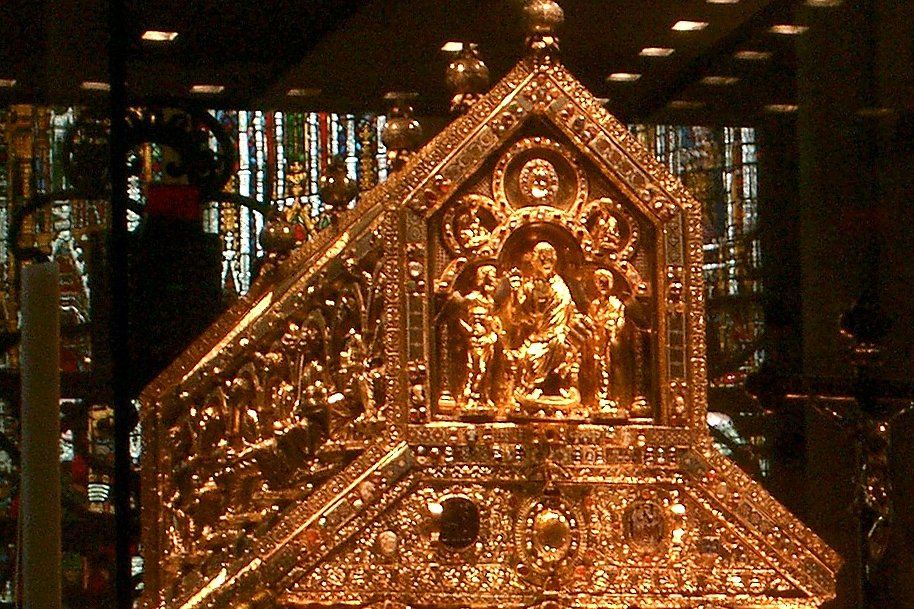
Photo by Beckstet (2005), via Wikimedia Commons, CC BY-SA 3.0.
Everything else — that there were exactly three of them, that they were kings, that their names were Melchior, Caspar, and Balthasar — developed over the following centuries, as Christian tradition filled in a story the Gospel had deliberately left open. By the time Cologne Cathedral's great golden shrine was built in the 12th and 13th centuries, that tradition was centuries old and widely believed, and it is the engine behind one of the most elaborate reliquaries ever constructed.
From Milan to Cologne, by way of a war
The legendary chain of custody, as later medieval writers told it, traces the relics first to Saint Helena, mother of the emperor Constantine, who is said to have located them in the 4th century and brought them to Constantinople. From there, tradition holds, the bones were later given to the bishop of Milan and installed in that city, where they remained for several centuries, venerated in what became the Basilica of Sant'Eustorgio.
That earlier chain rests on tradition rather than verified medieval documentation. What is historically documented, and much better attested, is the 1164 transfer that actually brought the relics north. That year, the army of the Holy Roman Emperor Frederick Barbarossa conquered and sacked Milan during his long conflict with the northern Italian city-states. Barbarossa's chancellor and close ally, Rainald von Dassel, who was also the Archbishop of Cologne, had the relics of the Magi removed from Milan and carried back to his own cathedral city as part of the spoils of that campaign — a straightforward act of medieval war plunder that nonetheless transformed Cologne overnight into the custodian of one of Christendom's most celebrated relics.
Nicholas of Verdun's masterpiece
The relics arrived in Cologne housed in a comparatively modest container. Within a few decades, the cathedral chapter commissioned something far grander: a reliquary shrine large enough and magnificent enough to match the prestige of what it held. Around 1190, the goldsmith Nicholas of Verdun — already renowned for earlier work including the Klosterneuburg Altar — began what would become his masterwork and one of the supreme achievements of medieval Mosan goldsmithing, a tradition named for the Meuse river valley spanning parts of modern Belgium, the Netherlands, and Germany, prized for its enameled and gilded metalwork.
The finished shrine is shaped like a miniature triple-aisled basilica, its gilded silver surface over an oak core worked into row upon row of figures: prophets and apostles in relief, enthroned emperors, and biblical scenes rendered in gold relief and translucent enamel, the whole surface further studded with engraved gems, antique cameos, and filigree work. At roughly two meters long, it remains, by most measures, the largest reliquary surviving anywhere in the Western world — a scale that was itself a form of theological argument, declaring through sheer material splendor the importance of what lay inside. The project outlived Nicholas of Verdun himself, continuing under other craftsmen into the 13th century before its completion.
Why a reliquary built a cathedral
Possessing the shrine changed Cologne's fortunes. Pilgrims from across Europe began arriving to venerate relics connected to the Magi — figures whose Gospel appearance, brief as it is, carried enormous symbolic weight as the first gentiles to recognize and worship Christ, making them patrons, in medieval eyes, of travelers, of kings, and of the universal reach of the Christian message itself. The scale of that pilgrim traffic, combined with the relics' prestige, is widely credited by architectural historians as a major reason Cologne's archbishops decided, in 1248, to tear down their existing Romanesque cathedral and begin construction of the vast Gothic structure that stands today — a building so ambitious that its twin spires weren't actually finished until 1880, more than six centuries after the first stone was laid. The shrine itself has occupied a place of honor behind the high altar since the choir's completion in the 14th century, and it remains there now, still an active pilgrimage destination and a centerpiece of Cologne's identity as a cathedral city.
What the tradition can and cannot claim
It's worth being plain about where documented history ends and pious tradition begins. The 1164 transfer from Milan to Cologne is a real, recorded historical event — war plunder, openly described as such in contemporary and near-contemporary chronicles. Everything earlier than that — Helena's discovery, the centuries in Constantinople and then Milan, and above all the identification of the remains inside with the specific individuals described, unnamed, in Matthew's Gospel — rests on a tradition that crystallized long after the biblical events themselves, without the kind of documentary trail that would let historians verify it independently.
The Catholic Church has never dogmatically certified that the bones inside the Dreikönigenschrein are the actual remains of the Magi described by Matthew, and it doesn't need to in order to justify the shrine's long devotional history. As the Catechism notes regarding relics generally, their veneration is an encouraged form of popular piety (no. 1674), but the honor such practices extend ultimately reaches past the physical object toward the event and the faith it represents — in this case, the Gospel's account of gentile wise men, guided by a star, kneeling before a child in Bethlehem. Whatever is physically inside Nicholas of Verdun's golden basilica, that is the story eight centuries of pilgrims have actually come to Cologne to remember.
Trivia
What relics does the Shrine of the Three Kings claim to hold?
How did the relics of the Magi end up in Cologne?
Who built the Shrine of the Three Kings, and when?
Is the Shrine of the Three Kings why Cologne Cathedral is so large?
Does the Catholic Church teach that these are certainly the Magi's actual remains?
Related Reading