The Stone of Unction in the Church of the Holy Sepulchre

The first thing a pilgrim meets
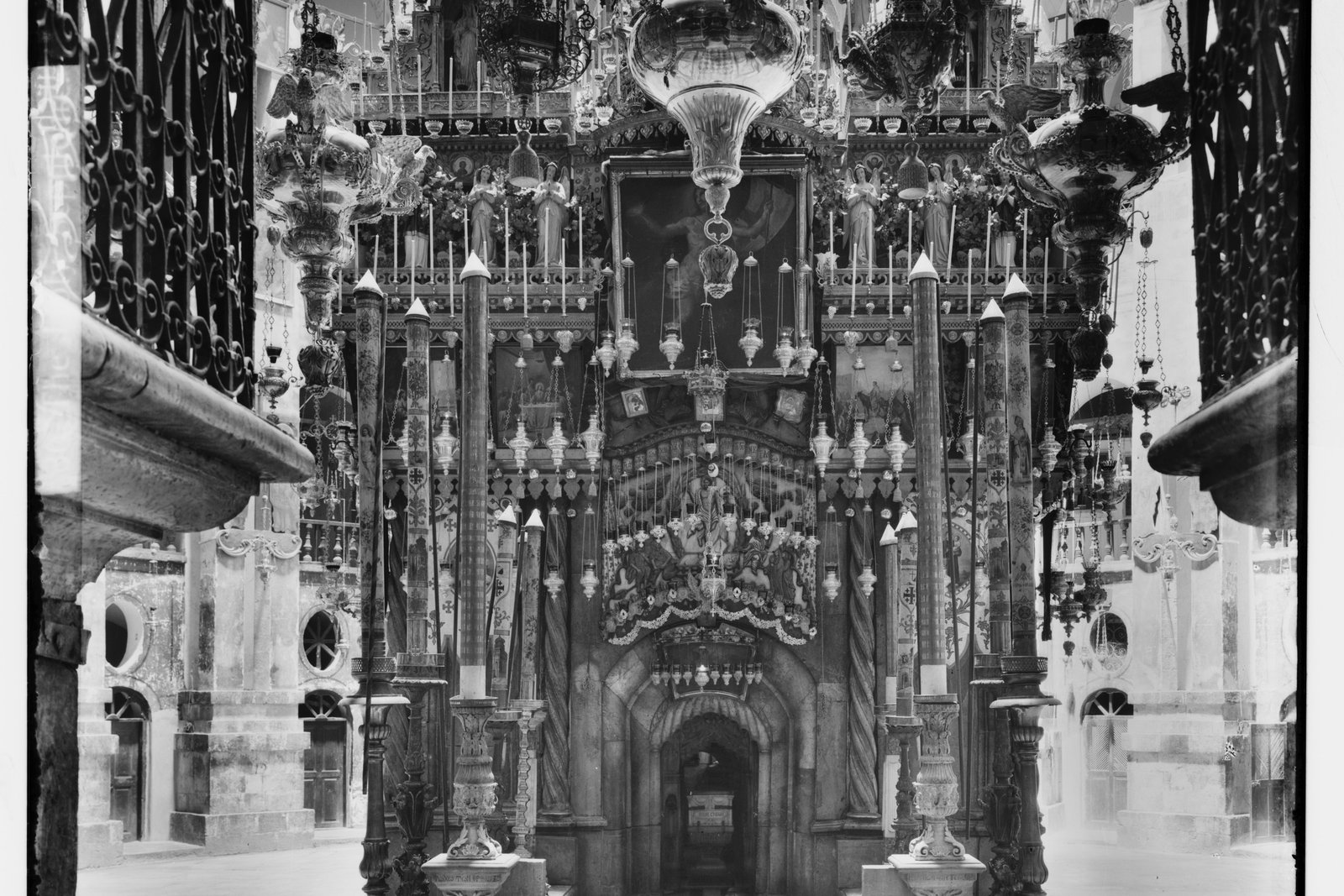
Step through the main entrance of the Church of the Holy Sepulchre in Jerusalem's Old City, and before any pilgrim reaches the chapel marking Golgotha or the tomb itself, they meet this: a long, low slab of pinkish limestone, usually surrounded by kneeling figures and ringed by hanging lamps donated by different Christian communities. This is the Stone of Unction, sometimes called the Stone of Anointing, and it is often the very first thing a visitor to the holiest site in Christianity physically touches.
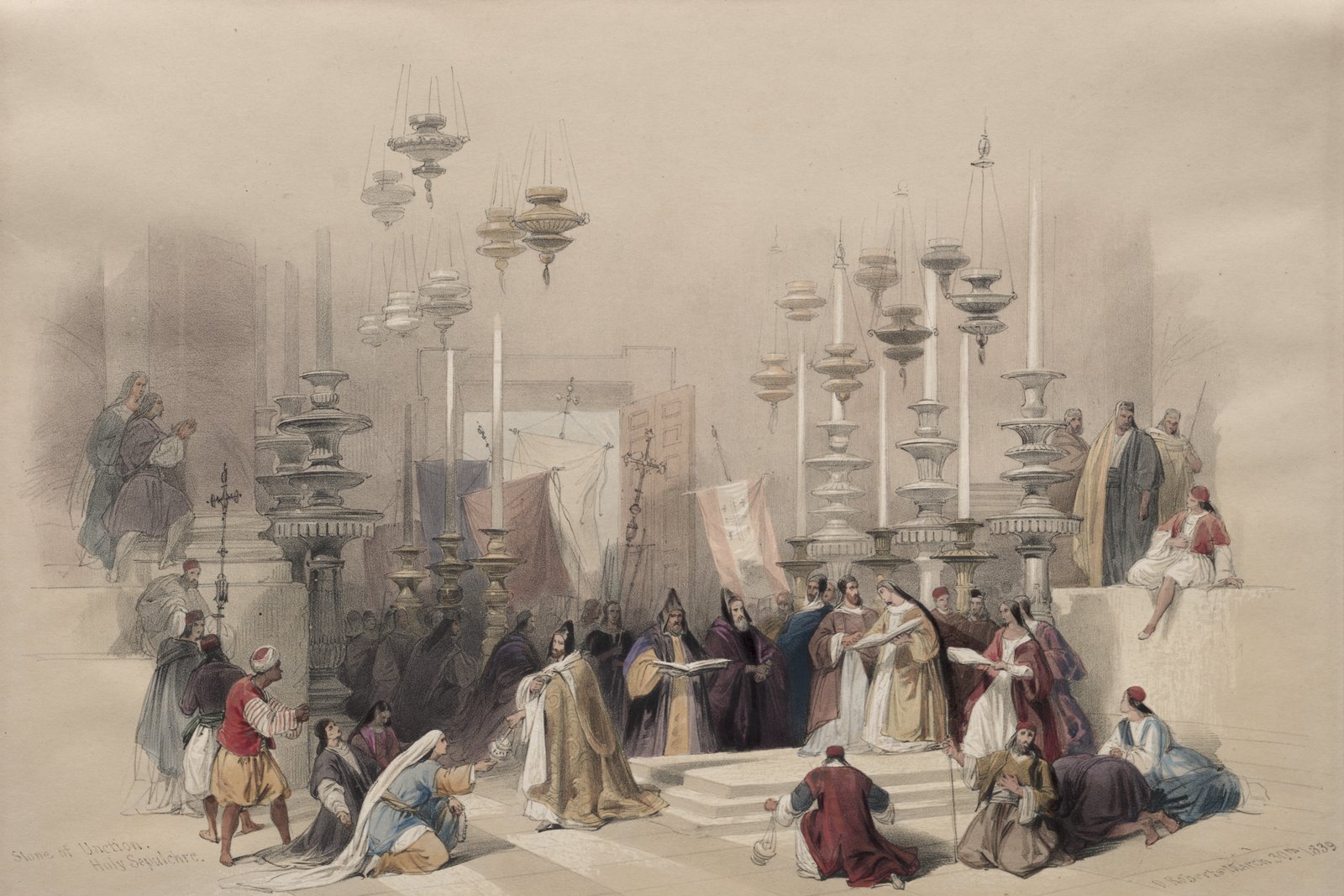
David Roberts, Stone of Unction, Holy Sepulchre, 1839. Public domain, Cleveland Museum of Art, via Wikimedia Commons.
What the Gospel actually says
The devotion attached to this spot traces back to a specific moment described in the Gospel of John, immediately following the crucifixion. After Jesus's death, Nicodemus — the same Pharisee who had earlier come to Jesus by night seeking instruction — arrived "bringing a mixture of myrrh and aloes weighing about one hundred pounds," and together with Joseph of Arimathea, "they took the body of Jesus and bound it with burial cloths along with the spices, according to the Jewish burial custom" (NABRE, John 19:39-40). The Gospel does not specify an exact stone or table used for this preparation; the tradition of a specific physical location for it developed over the following centuries, as Christian pilgrimage to Jerusalem's holy sites became organized and the general area of the crucifixion and burial was progressively marked with permanent structures and markers.
A 19th-century stone with older roots beneath it
Here the article needs to be direct about something many visitors don't realize, and the shrine's own custodians have never tried to hide: the stone pilgrims kneel before today is not ancient. It was installed in 1810, during a substantial restoration of the church carried out after a major fire had damaged significant portions of the building the previous year. The pink stone set down then replaced an earlier marker that had stood at the same traditional spot.
That doesn't make the location itself a 19th-century invention — the general site has been continuously venerated for vastly longer than the current stone has existed. The church standing today is substantially a Crusader-era building, constructed in the 12th century over the same traditional footprint, which itself replaced earlier Byzantine structures reaching back to the 4th century, when Emperor Constantine's mother, Helena, and the bishop Macarius are traditionally credited with identifying and enshrining the sites of Christ's crucifixion and burial not long after Constantine legalized Christianity across the Roman Empire. Fires, earthquakes, conquests, and repeated reconstructions across those sixteen centuries mean that almost nothing visible in the church today is a direct, unbroken physical survival from the 1st century — a fact that applies to most of the building's venerated furnishings, not just this particular stone.
How pilgrims venerate it
The custom at the Stone of Unction follows a pattern common to venerated relics and holy sites throughout the Christian world: pilgrims kneel, touch the stone directly with their hands, and often kiss its surface. Many also press personal devotional objects against it — rosaries, small icons, prayer cards, and photographs of family members or loved ones who are sick or have died — in the belief that contact with the stone at this particular location carries a form of blessing through to the object touched. Rose water or oil is sometimes poured over the stone's surface by the clergy who maintain it, which pilgrims then collect on cloths to take home, a practice with parallels at other major Christian shrines.
Why the Status Quo matters here
Part of why the stone's precise history has never been subjected to the kind of modern archaeological reinvestigation a secular historic site might receive lies in the unusual governance of the building that houses it. The Church of the Holy Sepulchre operates under an arrangement known as the Status Quo, formalized in the 19th century under Ottoman rule and still in effect today, which divides custodianship, physical space, and authority over the building among several Christian communities: principally the Greek Orthodox Patriarchate, the Roman Catholic Custody of the Holy Land (administered by Franciscan friars), and the Armenian Apostolic Patriarchate, with the Coptic, Syriac Orthodox, and Ethiopian Orthodox churches holding smaller, more limited rights within the complex.
The Status Quo was designed to freeze existing arrangements in place precisely because disputes among these communities over space, maintenance, and ritual precedence have historically run deep enough to require outside enforcement to prevent them from boiling over. That same arrangement makes any unilateral decision to alter, relocate, or formally re-investigate a shared object like the Stone of Unction a genuinely delicate undertaking, since any change touches the interests of multiple custodial communities at once. It is one practical reason, among others, why an object's documented history can sit publicly acknowledged as a 19th-century replacement without anyone pursuing further verification of exactly what came before it, layer by layer, back to the 1st century — the physical act of investigating would itself require a level of inter-communal agreement that is simply hard to come by.
A stone that doesn't need to be ancient
None of this historical plainness seems to have dampened the stone's pull on pilgrims. If anything, the willingness of the church's custodians to be straightforward about the 1810 restoration — rather than quietly let visitors assume otherwise — reflects something true about Catholic devotion to relics and holy places more broadly: the spiritual value of venerating a specific location doesn't depend on every physical marker at that location being the original one. The ground itself, the long unbroken chain of Christian memory attached to it since Constantine's era, and the Gospel event it points pilgrims back toward are what the devotion is actually built on. The stone is simply where that memory currently rests.
Trivia
What is the Stone of Unction supposed to commemorate?
Is the current stone slab actually ancient?
Does the exact spot have an older history, even if the stone itself doesn't?
What do pilgrims typically do at the stone?
Why hasn't anyone 're-verified' the stone's history more precisely?
Related Reading