The Holy Sepulchre's Edicule: The Shrine Over Christ's Tomb

A tomb beneath a temple beneath a church
The Church of the Holy Sepulchre's overall history — its two holy sites under one roof, its destruction and rebuilding across the centuries, and the Status Quo arrangement that governs it today — is covered in full in this site's article on the Church of the Holy Sepulchre. This article narrows in on one specific structure inside that church: the Edicule, the small shrine built directly over the site tradition identifies as Christ's actual tomb.
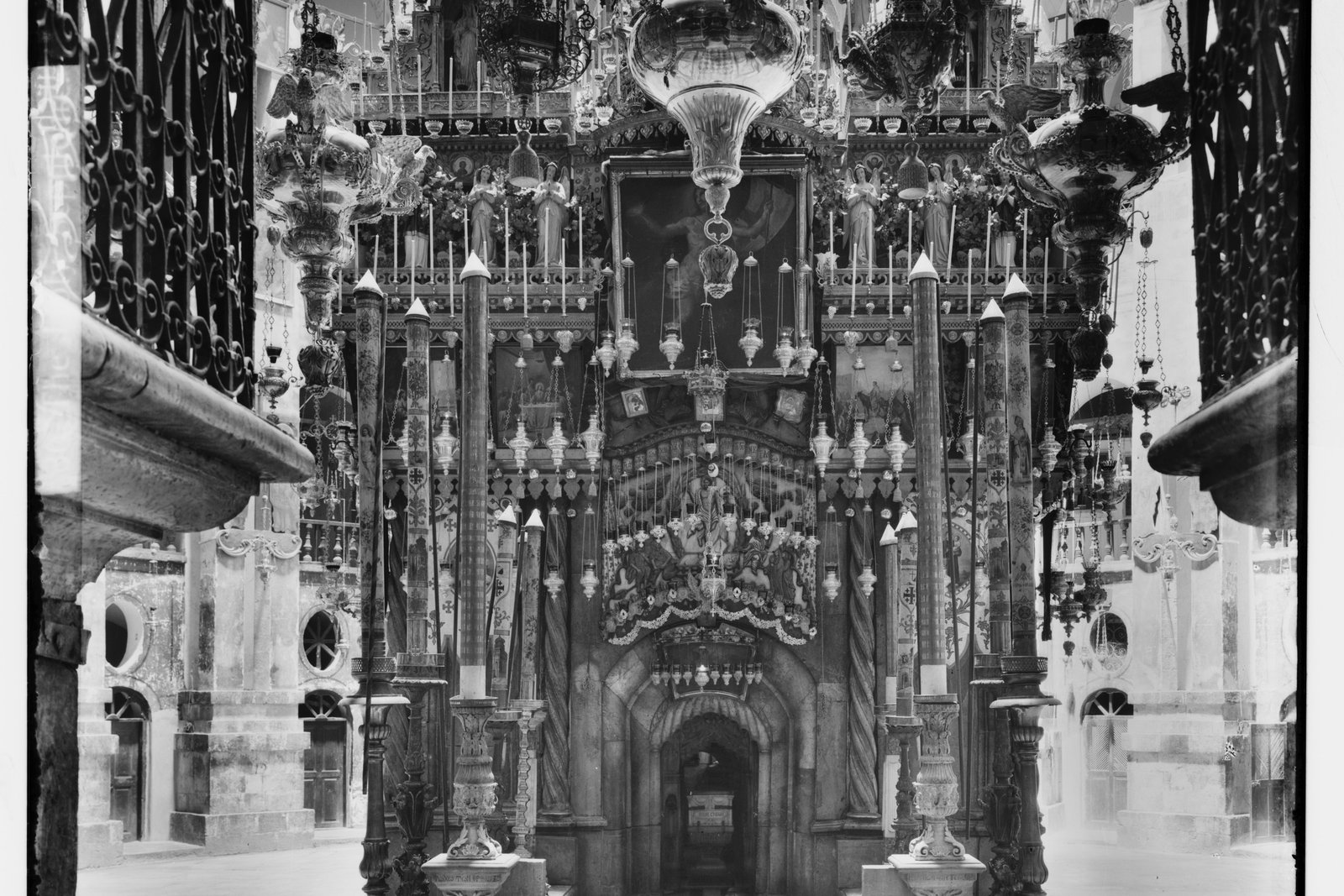
Matson Photograph Collection, Library of Congress, Holy Sepulchre (the Edicule), between 1898 and 1946. Public domain.
The case for that identification rests on a specific, documented sequence of events rather than guesswork. According to Christian tradition and the historical record as it survives, the Roman emperor Hadrian had a temple built over the site in the 2nd century, reportedly as a deliberate move to suppress the Christian veneration already taking place there. That detail matters more than it might first appear: a temple built specifically to cover and discourage worship at a site is itself a kind of indirect evidence that Christians were already venerating that exact spot well before Hadrian's time, since there would otherwise have been little reason to build over it at all. When Emperor Constantine's mother's generation of Christians gained imperial favor in the 4th century, Bishop Macarius of Jerusalem directed excavations that removed Hadrian's temple and uncovered a rock-cut tomb beneath it — the tomb Constantine then enclosed within the basilica that became the Church of the Holy Sepulchre. Many historians consider this sequence — a pagan temple deliberately built over, then later removed from, a specific site — reasonably credible circumstantial support for the tradition, even though no documentary proof survives that could satisfy a strict modern archaeological standard.
A structure rebuilt again and again
The small shrine standing over that tomb today, the Edicule, is not the original structure from Constantine's era — it has been damaged, destroyed, and rebuilt multiple times across the centuries, following the same pattern of destruction and restoration that shaped the larger church around it. The version pilgrims see today dates mostly to an 1810 rebuilding, undertaken after a serious fire had damaged the earlier structure.
The 20th century brought further crisis. An earthquake in 1927 left the Edicule's structural integrity badly compromised, and in 1947, British authorities administering Jerusalem at the time installed a crude iron scaffolding cage around the entire shrine simply to keep it from collapsing. That cage remained in place, visibly ugly and strikingly out of keeping with the sacred space around it, for seventy years — not because no one wanted it gone, but because removing it required a restoration project that the church's divided custodianship made extraordinarily difficult to approve.
Why fixing it took seventy years
The Church of the Holy Sepulchre operates under an arrangement called the Status Quo, a body of customs formalized under Ottoman decree in the 18th and 19th centuries that freezes exactly which Christian community controls which space and requires agreement among all parties before anything shared can be altered. The Edicule sits at the absolute center of that shared space, claimed in different ways by the Greek Orthodox, Roman Catholic (through the Franciscan Custody of the Holy Land), and Armenian Apostolic communities alike — which meant that any structural intervention serious enough to actually fix the shrine required a level of three-way consensus the communities had rarely managed to reach on anything.
That consensus finally came together in 2015 and early 2016, when the Greek Orthodox Patriarchate of Jerusalem, with the agreement of the Catholic and Armenian communities, invited the National Technical University of Athens to study and restore the structure. It was, by most informed accounts, a genuinely rare moment of practical cooperation inside a building otherwise defined by jealously guarded boundaries.
Sixty hours inside the tomb
Restoration work began in May 2016 under the leadership of chief scientific supervisor Antonia Moropoulou, and the most significant single moment of the entire project came that October. To prevent structural grout from flowing into the burial chamber during stabilization work, the conservation team temporarily removed the marble slab covering the burial shelf inside the Edicule — a slab that, according to the restoration team's own findings, had covered the surface beneath it since at least the year 1555, and quite possibly longer. For roughly sixty hours, researchers had direct access to look beneath it, and what they documented was the original limestone surface of the burial shelf itself, carved into the side of the limestone cave that the earliest Christian tradition identifies as Christ's tomb — a surface no living person had seen exposed before that moment, and one unlikely to be exposed again for a very long time.
The full restoration concluded in March 2017, roughly on schedule with the Easter deadline the participating communities had agreed to, and the Edicule reopened to the public without its decades-old iron cage for the first time since 1947.
What the restoration settled, and what it didn't
The 2016-2017 project answered real structural and archaeological questions: it confirmed the age and placement of the stone surface long associated with the tomb tradition, and it finally stabilized a building that had genuinely been at risk of serious damage. What it could not do, and never claimed to do, was offer forensic proof that the specific tomb beneath the marble is the exact site of Christ's burial and resurrection as recorded in the Gospels. That identification remains, as it always has, a matter of a continuous, early, and historically plausible Christian tradition — not a claim the Church asks anyone to accept on scientific grounds. For the millions of pilgrims who still wait in line, sometimes for hours, to duck through the Edicule's low doorway and kneel for a moment at that shelf, the distinction has rarely seemed to matter as much as simply being there.
Trivia
What is the Edicule at the Church of the Holy Sepulchre?
How was the tomb site identified as genuine?
What happened during the 2016-2017 restoration of the Edicule?
Why did it take so long to restore the Edicule?
Does the Catholic Church teach with certainty that this is the actual tomb of Christ?
Related Reading