The Tilma of Guadalupe as a Scientific Mystery

A cloth that was never supposed to last
For the full story of the apparitions themselves — Juan Diego, the four meetings on Tepeyac Hill, the roses gathered in December — see Our Lady of Guadalupe and Saint Juan Diego. This article asks a narrower question: what happens when the physical object those stories center on — the cloak itself — gets handed to scientists instead of theologians?
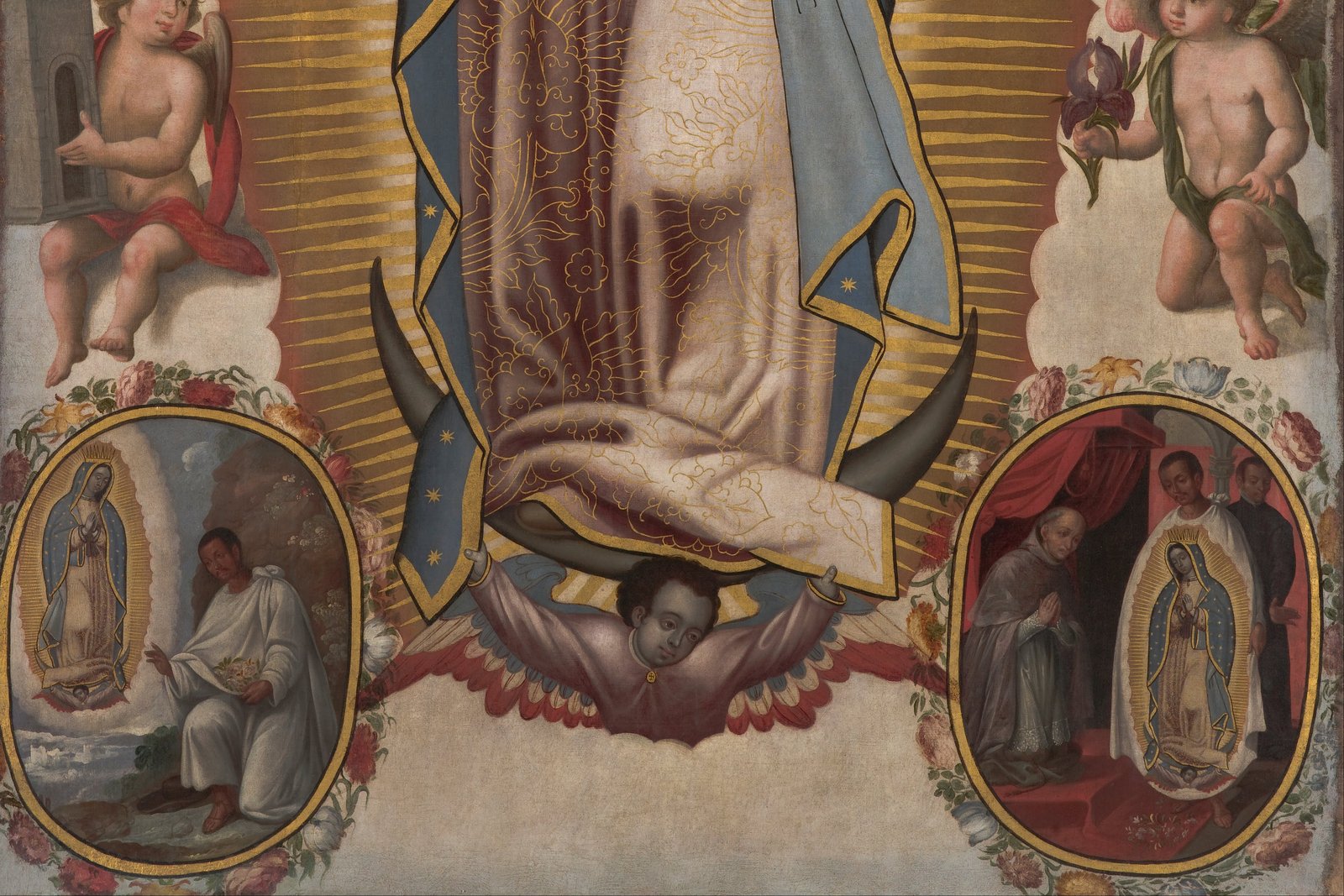
Virgin of Guadalupe, Google Art Project reproduction of the tilma image, Basílica de Guadalupe, Mexico City. Public domain, via Wikimedia Commons.
The tilma is woven from ayate, a rough fabric made from maguey (agave cactus) fiber, the same material 16th-century Indigenous Mexicans used for everyday cloaks and sacks. Textile conservators generally agree that cloth of this kind, kept in ordinary conditions, degrades within a few decades — the fibers dry, crack, and disintegrate well within a human lifetime. The tilma has instead survived for nearly five hundred years, for much of that time displayed without the glass case and climate controls it has today, exposed to candle soot, incense, humidity, and the touch of countless pilgrims. That durability is the first fact that draws researchers to the object at all, independent of any claim about the image painted — or not painted — on its surface.
What the 1979 infrared study actually found
The most frequently cited scientific examination of the tilma is the work of Philip Serna Callahan, a biophysicist with the United States Department of Agriculture, who was permitted to photograph the image using infrared film over several hours on the night of May 7, 1979. Infrared photography is a standard tool in art conservation: because underdrawing, sketch lines, and varnish layers often reflect infrared light differently than the paint layers above them, the technique can reveal a painting's preparatory stages even when they're invisible to the naked eye.
Callahan reported that the original figure — Mary's face, hands, robe, and mantle — showed no detectable underdrawing and no visible brushstroke texture, details that in his assessment were difficult to reconcile with known 16th-century painting methods, which typically involved sketching the composition first and applying paint with visible brush texture. It's worth being precise about what Callahan did and didn't conclude, though: he also found that several major elements of the image we see today — the crescent moon, the supporting angel, the gold sunburst rays, and the stars on the mantle — were added later, probably over the following century, using ordinary materials and technique. His own study, in other words, describes a composite object: a core image he found scientifically puzzling, overlaid with later, conventionally painted additions. Reviews of his decades-old examination have not concluded that the underlying material is of unexplainable or non-material origin — that stronger claim, often attached to Callahan's name in devotional retellings, goes beyond what his published findings actually assert.
Where the pigment debate stands
Callahan's findings aren't the only word on the subject, and it would misrepresent the evidence to treat them as settled science. In 1982, a Spanish documentary team arranged for an independent art restorer, José Sol Rosales, to examine the cloth directly. Sol Rosales reported finding a priming layer of calcium sulfate beneath the image and pigments consistent with ordinary period painting materials — a direct contradiction of the "no human materials" framing that has circulated in some popular accounts. Around the same period, skeptical researchers Joe Nickell and Joseph Fischer published their own analysis arguing that the image is explainable as a competent, conventional 16th-century painting, consistent with an artistic tradition already present in colonial Mexico.
Neither side of this dispute has produced a single, independently repeated, peer-reviewed laboratory study that definitively settles the question. What exists instead is a genuinely contested record: researchers sympathetic to the apparition account point to Callahan's reported absence of underdrawing and brushstroke texture in the central figure; skeptical researchers point to Sol Rosales's priming layer and ordinary pigments, and argue the "no brushstrokes" claim has never been verified by an independent, disinterested laboratory with full access to the cloth. Both claims can be fairly reported as claims. Neither should be reported here as proven fact.
The eyes, and why that claim stays unsettled
A separate, often-repeated claim concerns the Virgin's eyes. Beginning with an informal observation by ophthalmologist Rafael Torrija Lavoignet in 1929, and expanded by later researchers using digital image magnification, some investigators have reported that tiny human figures appear reflected in the corneas of both eyes — and that the reflections differ slightly between the left and right eye in a way some describe as consistent with the Purkinje-Sanson principle governing how a living eye reflects nearby objects.
This claim deserves the same caution as the pigment debate, for a simple reason: it depends on digital enlargement of an extremely small, centuries-old, and partially worn area of cloth, at magnifications (some reports cite figures in the thousands of times) well beyond what the unaided eye can perceive. No controlled study using this technique has been replicated and accepted across the broader scientific community, and skeptics have raised reasonable questions about how much is pattern-matching in noisy, heavily magnified image data rather than a genuine, intentional feature of the original image. The honest summary is that the corneal-reflection claim is real in the sense that researchers have published it and continue to discuss it — not in the sense that it has been scientifically established.
It's also worth naming a myth directly: claims that NASA scientists examined the tilma and declared the image biologically "alive" or otherwise confirmed it as supernatural are not supported by any NASA statement or published NASA research; that specific framing has been traced to popular devotional retellings rather than to the space agency itself.
Why the Church doesn't lean on any of this
None of this scientific back-and-forth is something the Catholic Church treats as doctrinally load-bearing. Devotion to Our Lady of Guadalupe, like all Marian apparitions, falls under what the Church calls private revelation — something the faithful are free to believe, and which the Church has approved and encouraged, but which no Catholic is required to accept as an article of faith (Catechism of the Catholic Church, no. 67). That framework means the tilma's scientific standing — contested pigment analysis, unreplicated eye-reflection claims, a cloth that has simply lasted longer than expected — functions as supporting circumstantial interest for believers, not as proof the Church's teaching depends on.
Standing before it today
Whatever conclusion a given visitor reaches about the physical evidence, the tilma itself is easy enough to find: it hangs above the main altar of the modern Basilica of Our Lady of Guadalupe in Mexico City, completed in 1976 specifically to manage the millions of pilgrims who travel there each year, sealed behind glass and climate control, viewed from a slow-moving walkway built so that no single visitor can linger too long in front of an image so many people want to see. The debates over brushstrokes and corneal reflections continue in journals and documentaries; the basilica itself simply keeps the cloth on display, open to anyone willing to look and draw their own conclusions.
Trivia
What is the Tilma of Guadalupe made of?
Did a 1979 infrared study prove the image is miraculous?
Do mainstream conservators agree the image can't be explained by painting?
What are the claims about figures reflected in the Virgin's eyes?
Where is the Tilma of Guadalupe kept today?
Related Reading