The Veil of Veronica: The Legend, the Relic, and the Face at Manoppello

A face with no name attached to it
For most of Christian history, pilgrims arriving in Rome made a point of seeing one particular object kept inside St. Peter's Basilica: a small cloth, folded behind glass and gold, said to bear the actual face of Christ. It wasn't a painting. It wasn't an icon in the usual sense — no artist had signed it, and no one claimed to have made it. According to the tradition that grew up around it, the image appeared the moment a compassionate woman pressed a towel to Jesus's face as He struggled toward Calvary under the weight of the cross. The cloth is known today as the Veil of Veronica, and its story sits at an unusual crossroads of devotion, legend, and a name that may never have belonged to a real person at all.
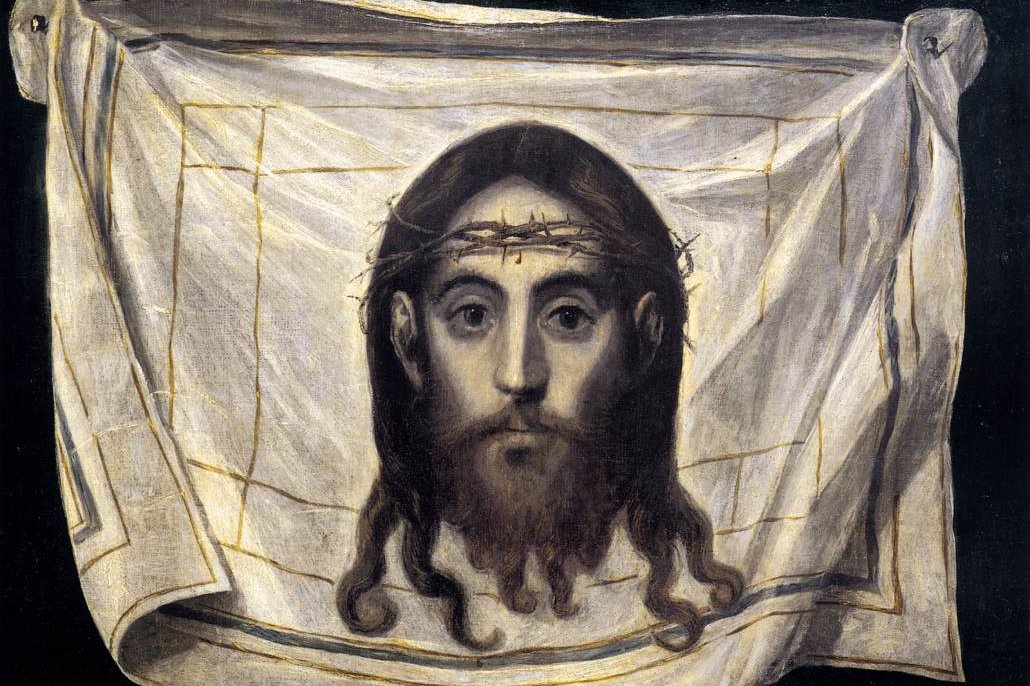
El Greco, The Veil of St Veronica (c. 1580). Public domain, via Wikimedia Commons.
The story the Gospels never tell
Here is the strange part: nowhere in Matthew, Mark, Luke, or John does a woman named Veronica appear. The Gospel of Luke does describe a crowd of mourning women following Jesus on the way to His crucifixion, whom Jesus addresses directly (Luke 23:27-28), but none of the four Gospel accounts of the Passion mention anyone wiping His face or any image being left behind on cloth.
The Veronica story instead developed later, outside the New Testament, and eventually found a fixed place in one of the most widespread devotional practices in the Catholic world: the Stations of the Cross, the sequence of meditations tracing Christ's final journey to Calvary. The traditional Sixth Station carries the title "Veronica wipes the face of Jesus," and it is through this devotion — repeated in parish churches every Lent for centuries — that the moment became as familiar to ordinary Catholics as anything actually recorded in Scripture, even though its origin lies in later legend rather than the Gospel text itself.
Where the name "Veronica" actually comes from
The 1912 Catholic Encyclopedia's entry on the subject makes an argument worth taking seriously: that "Veronica" almost certainly began life not as a woman's name but as a label for the image itself. The Latin word vera ("true") combined with the Greek icon ("image") to form vera icon — "true image" — the term used in Rome to distinguish this particular image of Christ's face from others in circulation. Ordinary speech, over time, contracted that phrase into a single word, and that word was eventually mistaken for a person's name. "By degrees," the encyclopedia notes, "popular imagination mistook this word for the name of a person and attached thereto several legends which vary according to the country."
That variation is itself revealing. In the Italian version of the legend, Veronica travels to Rome and cures the Emperor Tiberius by having him touch the sacred image, later bequeathing it to Pope Clement. In French traditions, she is given in marriage to Zacchaeus — the tax collector Jesus calls down from a sycamore tree in Luke's Gospel — and the pair's story gets tangled up with the founding legend of Rocamadour. Other regional versions merge her with the woman cured of a hemorrhage by touching Jesus's cloak (Matthew 9:20-22), or with a companion of St. Martial preaching near Bordeaux. A figure with this many mutually incompatible biographies, spread across different countries, looks far more like folklore accumulating around a famous relic than a single remembered life — which is exactly the conclusion the Catholic Encyclopedia itself draws, while still allowing that "there is no reason why the belief that such an act of compassion did occur should not find expression in the veneration paid to one called Veronica."
The relic kept at St. Peter's
Whatever its origins, devotion to an image called the Veronica took firm, documented root in Rome by the early medieval period. A cloth bearing this name was kept at St. Peter's Basilica, eventually given its own dedicated chapel, and treated as one of the basilica's three great relics — displayed alongside the lance said to have pierced Christ's side and a fragment of the True Cross. In 1208, Pope Innocent III instituted a solemn annual procession carrying the Veronica from St. Peter's to the Church of the Holy Spirit, a public devotion that continued for generations and that cemented the image's place in Roman religious life.
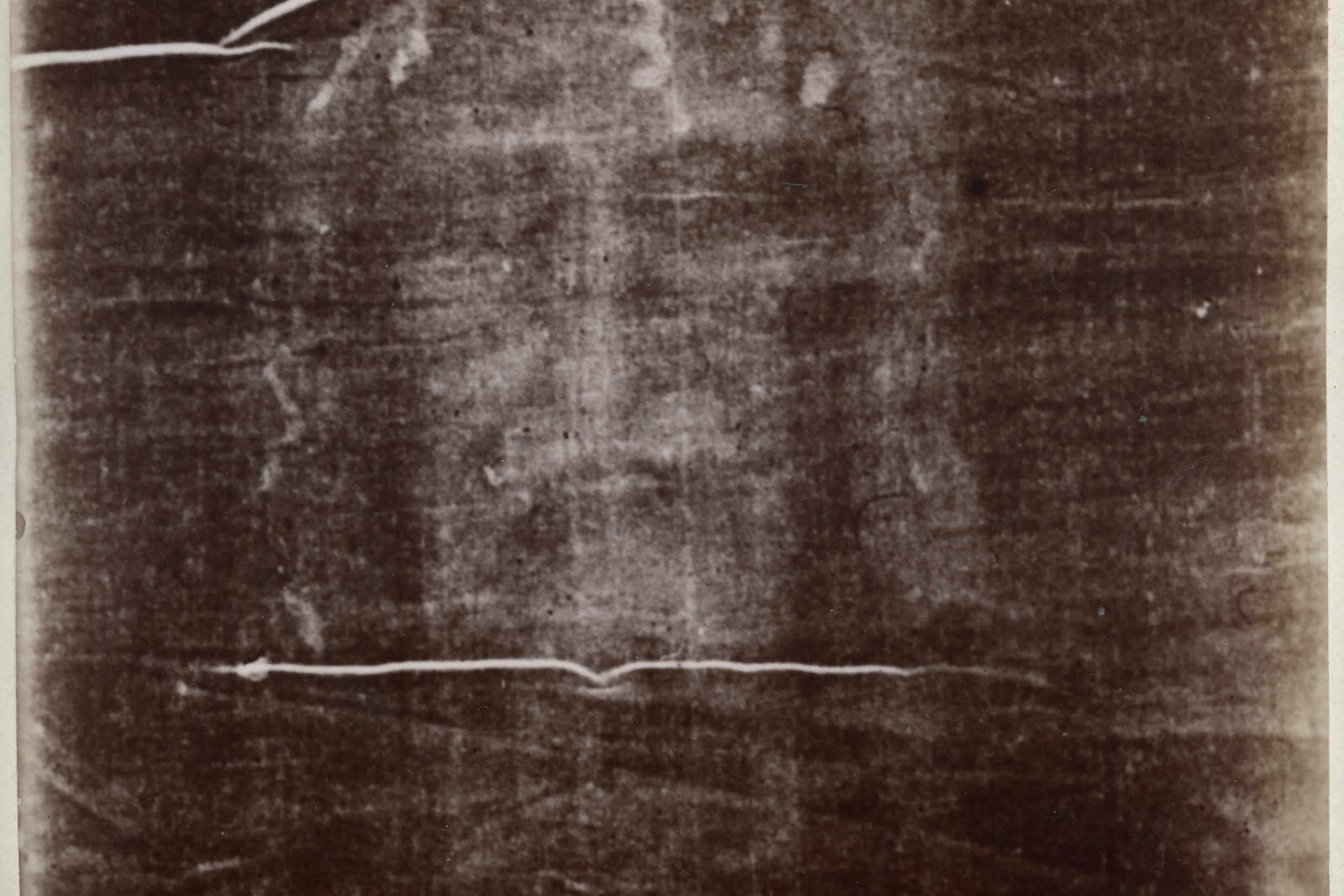
Unlike the Shroud of Turin, however, the Veronica housed at St. Peter's has never been put through the kind of sustained public exposition or scientific examination the Shroud underwent in the 20th century. It is shown only rarely, and no equivalent of the 1988 carbon-dating controversy exists for it — partly a matter of the Vatican's own caution with the object, and partly simply because far less modern documentation survives describing its physical condition in detail.
A second face, hidden in Manoppello
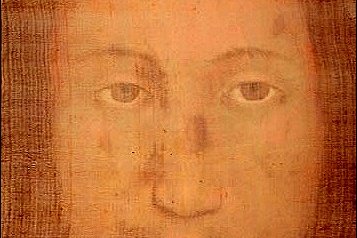
The story gets another twist roughly eight centuries later, in a small town in Italy's Abruzzo region. According to local tradition there, in 1506 an unidentified pilgrim arrived in Manoppello carrying a wrapped cloth, which he left with a local doctor, Giacomo Antonio Leonelli, before disappearing. The cloth bore a faint image of a bearded man's face, and it eventually passed into the keeping of the Capuchin friars of Manoppello in 1638, where it remains today in a shrine now raised to the status of a papal basilica.
Some devotees and researchers have proposed that the Manoppello Image is the very Veronica relic that once hung in St. Peter's, suggesting it may have left Rome unrecorded at some point in its history — a claim that remains a matter of ongoing argument rather than established fact, since no continuous documentary trail connects the two objects. What is better documented is Pope Benedict XVI's visit to the Manoppello shrine on September 1, 2006 — reportedly the first journey inside Italy he chose entirely on his own initiative as pope — where he venerated the image without making any formal declaration about its identity or authenticity.
What the Church actually says
As with the Shroud of Turin, the Catholic Church has never dogmatically pronounced on whether any surviving cloth — the one in Rome, the one in Manoppello, or any other claimant — is the literal relic described in the Veronica legend. No pope has required belief in its authenticity, and none has ruled it out. What the Church has consistently done is treat the image as worthy of devotion regardless of the unresolved historical question, in exactly the same spirit that governs reverence for the Shroud: an aid to contemplating the suffering of Christ's Passion, valuable for that purpose whether or not its precise material history can ever be fully traced.
That restraint reflects something true about how Catholic devotion to relics and sacred images generally works. The Sixth Station of the Cross doesn't ask worshippers to first settle a historical debate about a first-century Jerusalem woman before meditating on an act of simple human compassion offered to a suffering man. Whether "Veronica" began as a real person's gesture, a later legend built around a title meaning "true image," or some blend of both, the devotion it produced has outlasted every argument about its origins — which may be the most honest thing that can be said about a relic whose very name is also, quite possibly, its own origin story.
Trivia
Who was Veronica, and is she a real historical person?
What does the legend say happened on the road to Calvary?
Where is the Veil of Veronica kept today?
How is the Veil of Veronica different from the Shroud of Turin and the Manoppello Image?
Has the Catholic Church declared the Veil of Veronica authentic?
You May Also Like
Related Reading