The Manoppello Image: The Holy Face Cloth and the Veronica Theory

A stranger, a cloth, and a doctor's house
The documented story of the Manoppello Image begins abruptly, almost like the opening of a folktale. In 1506, a pilgrim no one in the town recognized arrived carrying a wrapped bundle. He gave it to a local physician, Giacomo Antonio Leonelli, and then disappeared — no name recorded, no explanation given, no trail left for anyone to follow afterward. Inside the bundle was a cloth bearing the faint image of a bearded man's face.

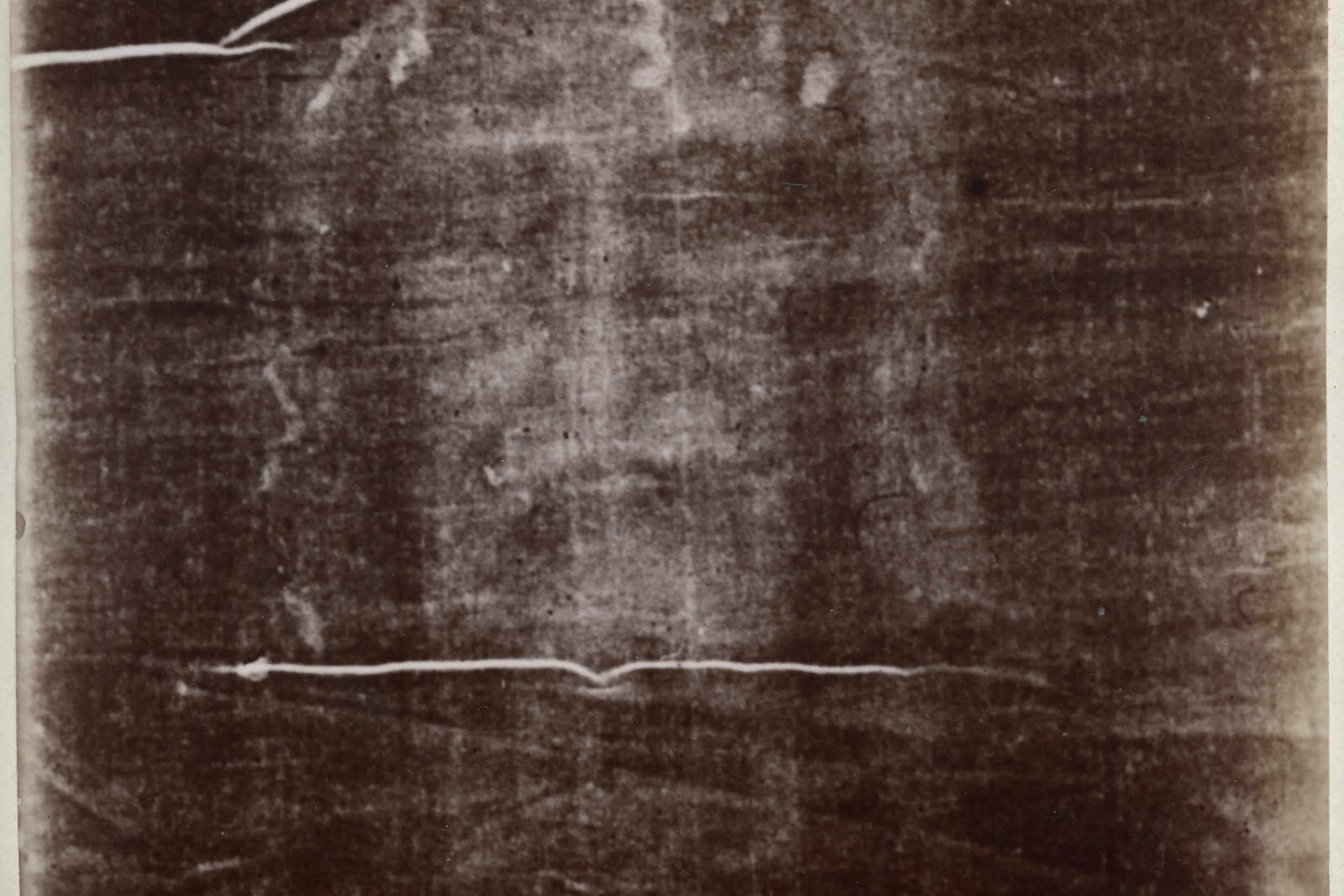
Volto Santo di Manoppello, anonymous, photograph via Wikimedia Commons. Public domain.
For more than a century, the cloth stayed within the Leonelli family before eventually passing, in 1638, into the keeping of the Capuchin friars who had settled in Manoppello. It has remained with them ever since, now housed in a basilica built specifically around it — the Shrine of the Holy Face, raised to that status by the Church in recognition of how significant the devotion to the image had become. That continuous custodial record, running from 1506 to today, is the one part of the Manoppello story that isn't in dispute. What came before 1506 is where the real argument begins.
If you want the broader history of the related legend — the woman traditionally called Veronica, the cloth long kept at St. Peter's Basilica in Rome, and how the two traditions intersect — the companion article on the Veil of Veronica covers that ground. This article goes deeper into Manoppello itself: the cloth's unusual material, the specific researchers who built the case connecting it to Rome, and why that case remains contested rather than settled.
A cloth unlike a painting
What drew serious attention to the Manoppello Image, beyond its curious arrival story, is the physical object itself. Visitors and researchers who have studied the cloth closely describe it as remarkably fine and nearly see-through when held up to light — a texture unlike ordinary linen or cotton. Some researchers identify the material as byssus, an extremely rare and historically prized fabric sometimes called sea-silk, traditionally associated in the ancient world with luxury textiles rather than everyday use.
The more striking claim concerns the image itself. According to researchers who have examined it, the face is visible on both sides of the cloth, with no detectable pigment, paint, or dye forming it — a characteristic that, if accurate, would be difficult to reconcile with how an artist working in oil, tempera, or any other conventional medium of the period would have produced an image. It's worth being direct about the limits of this claim: it rests primarily on examinations conducted by advocates of the relic's special status, and it has not undergone the kind of broad, independent, peer-reviewed material analysis that would let outside scientists confirm or challenge it on equal footing. The comparison that researchers and journalists alike reach for is the Shroud of Turin, which has been scientifically tested far more extensively (including the contested 1988 carbon-dating study) precisely because the Church has permitted broader outside access to it over the decades. Manoppello has not received a comparable level of open scientific scrutiny.
The theory connecting Manoppello to Rome
The specific argument tying the Manoppello Image to the historic Veronica relic once venerated at St. Peter's Basilica is most closely associated with two researchers: Sister Blandina Paschalis Schlömer, a German Trappistine nun who studied the cloth's physical properties and image characteristics, and Father Heinrich Pfeiffer, a Jesuit art historian who argued the case publicly and drew wider attention to it in the 1990s and 2000s. Their shared claim is that the Manoppello cloth is the same Veronica relic that had been kept in Rome for centuries and that largely vanished from clear documentary record after the Renaissance period — and that it somehow made its way out of Rome and eventually into the hands of the unnamed pilgrim who appeared in Manoppello in 1506.
It's an intriguing theory, and it has earned genuine attention, including scholarly conferences and books devoted to examining it. But it remains exactly that: a theory, not an established historical fact. No continuous paper trail — no sale record, no transport document, no contemporary account — connects the Roman relic's last documented sighting to the cloth's sudden appearance in Manoppello. Historians who have looked at the proposed connection from outside the circle of its original proponents have generally found the case suggestive rather than conclusive, and no consensus exists among scholars that the identification is correct. The Catholic Church, for its part, has never issued any formal statement affirming that the Manoppello Image is the historic Veronica relic, or indeed making any dogmatic ruling on the cloth's origin at all.
Benedict XVI's visit
Whatever the unresolved historical questions, the Manoppello shrine's standing within Catholic devotional life took a visible step forward on September 1, 2006, when Pope Benedict XVI traveled there in person to venerate the image. The visit drew particular notice because it was reportedly the first journey inside Italy that Benedict chose entirely on his own initiative since becoming pope the previous year — not a stop arranged as part of a broader diplomatic or pastoral itinerary, but a destination he picked himself.
Consistent with the Church's general caution around unverified relics, Benedict did not use the occasion to make any formal declaration about the cloth's identity, origin, or authenticity. He venerated the image as an aid to prayer and reflection on the face of Christ, in the same spirit that governs how the Church treats the Shroud of Turin and the Roman Veronica tradition: devotion is encouraged independent of whether the underlying historical claims can ever be conclusively proven.
What can honestly be said
It is worth being plain about where the evidence actually stands. What is documented beyond dispute: a cloth bearing a face image has been continuously present in Manoppello since 1506, has been in the Capuchin friars' care since 1638, and is now housed in a basilica dedicated to it. What is credibly reported but not independently, broadly verified: the cloth's unusual material and the image's reported visibility from both sides without pigment. What remains an open, debated theory rather than an established fact: that this is the same object as the historic Veronica relic once kept in Rome.
That layered uncertainty is not a weakness unique to Manoppello — it is the same posture the Church takes toward the Shroud of Turin and the Roman Veronica tradition alike, as the companion Veil of Veronica article discusses in more depth. None of these objects carry a dogmatic ruling on authenticity, and Catholic teaching has never required belief in any of them as a condition of faith. What devotion to the Holy Face of Manoppello does offer, regardless of how its origin question is eventually resolved, is the same thing pilgrims have sought there since an unnamed stranger first walked into town five centuries ago: a face to look at while praying, and a tangible place to bring that prayer to.
Trivia
What is the Manoppello Image, and where is it kept?
Is the Manoppello Image the same as the Veil of Veronica?
What makes the cloth itself unusual?
Did Pope Benedict XVI visit Manoppello?
Has the Church or science confirmed what the image is or how it was made?
Related Reading