Saint Jude Thaddaeus

A question none of the others thought to ask
At the Last Supper, as Jesus speaks about revealing himself after his death, it's Jude who interrupts with a question the others apparently hadn't considered: "Master, [then] what happened that you will reveal yourself to us and not to the world?" (John 14:22, RSV-CE). It is one of the few moments in the Gospels where an apostle other than Peter, John, or Thomas speaks up directly, and the question itself is a practical one — Jude seems to expect, like most of his contemporaries, that the Messiah's return would be a public, unmistakable event, and he wants to understand why Jesus is instead describing something quieter and more intimate. John's Gospel is careful to specify which Jude is asking — "Judas (not Judas Iscariot)" — a small clarification that turns out to matter far more than it seems at the time, since the two men shared the same common Jewish name (a variant of Judah) and were easily confused even by their contemporaries.
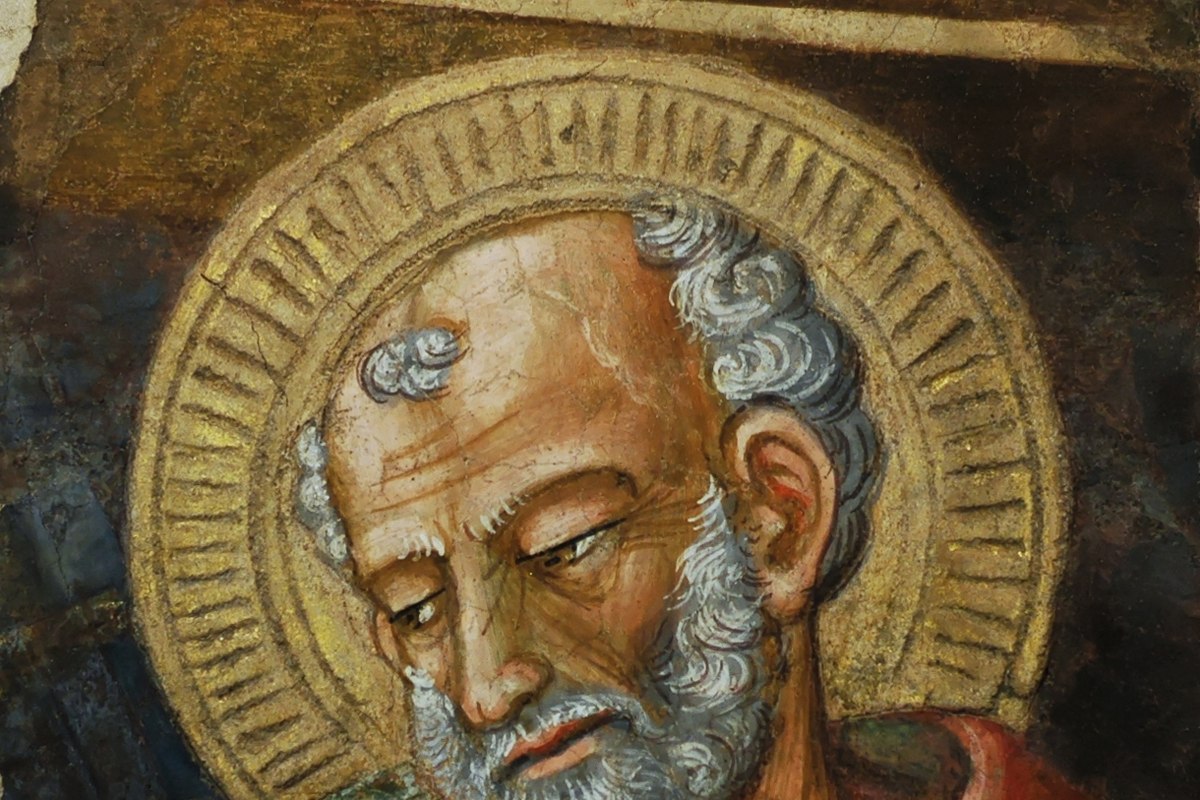
Bicci di Lorenzo, "Saint Jude Thaddaeus," c. 1440, Opera di Santa Maria del Fiore, Florence — public domain.
A name that worked against him for centuries
That distinction — not Judas Iscariot — followed Jude for nearly two thousand years. According to long-standing tradition, the resemblance between his name and that of Christ's betrayer made many believers reluctant to invoke him in prayer, worried about the confusion or, less charitably, the association with the apostle who had handed Jesus over to be crucified. The result, as popular devotion tells it, was an apostle largely bypassed for centuries — genuinely capable of helping, but rarely asked, even as devotion flourished around most of the other apostles, including figures like Saint Bartholomew, whose own feast and cult developed much more prominently across the medieval Church.
The overlooked apostle becomes the last resort
That very obscurity is what eventually built Jude's most distinctive reputation. Because so few people turned to him, tradition holds he became especially responsive to those who did — particularly people facing situations everyone else considered hopeless. That's the origin most often given for his enduring title, "patron saint of hopeless causes": not a grand miracle or a dramatic biblical episode, but a saint whose neglect, ironically, became the very reason people now turn to him first when nothing else has worked. Devotion to Jude under this title grew rapidly in the twentieth century, particularly in the United States, where novenas (nine-day cycles of prayer) to Saint Jude became widely popular during the Great Depression and the difficult years that followed, as people facing desperate financial and medical circumstances sought him out by name.
Jude's letter, and a small epistle with a sharp warning
Jude is also traditionally credited as the author of the shortest book in the New Testament, the Epistle of Jude, a brief but forceful letter warning early Christian communities against false teachers who had, in his words, "crept in unnoticed" among the faithful. Scholars debate how directly the apostle himself composed the letter versus how much it reflects later editing by his community, a common question for several New Testament epistles, but the Church has long included it among the canonical books of Scripture regardless of the precise authorship question. The letter's brevity has made it one of the lesser-known books of the Bible, yet it contains one of the New Testament's most quoted doxologies, a closing prayer of praise still used in Christian liturgy today.
A ministry that stretched from Mesopotamia to a Roman crypt
After the resurrection, tradition holds that Jude traveled and preached widely — through Mesopotamia, Libya, and Persia, often alongside the apostle Simon, sometimes called Simon the Zealot — before eventually being martyred for his faith, according to tradition by being struck with a club and beheaded. His relics were later brought to Rome and placed in a crypt beneath St. Peter's Basilica, alongside those of Simon, where pilgrims have continued visiting for centuries, carrying the same kinds of urgent, difficult petitions that built his reputation in the first place. His feast day, shared with Simon, falls on October 28 in the Western Church calendar.
A devotion carried across the world by immigrants
Devotion to Saint Jude as patron of hopeless causes spread well beyond Europe in the twentieth century, carried in large part by immigrant Catholic communities in the Americas facing genuine hardship: economic depression, war, and the uncertainty of building new lives far from home. Shrines dedicated to him, including the National Shrine of St. Jude in Chicago, founded in the 1920s, became major centers of prayer and correspondence, with thousands of letters arriving each year from people asking that petitions be placed before his relics or read during novena services on their behalf. That grassroots, largely working-class character of his cult distinguishes it from the more formal, hierarchical devotion surrounding some other apostles, and mirrors the very pattern that built his reputation in the first place: an apostle overlooked by the powerful becoming, in practice, one of the most personally invoked saints among ordinary people facing circumstances they cannot control.
Trivia
What did Jude ask Jesus at the Last Supper?
Why is Jude sometimes called Thaddaeus?
Why did Jude become the patron saint of hopeless causes?
What happened to Jude after the resurrection?
Related Reading