Saint Andrew the Apostle

Called first, on an ordinary working day
Andrew's story begins on the water, doing the same job he'd likely done his whole life. Matthew records the moment plainly: "As he was walking by the Sea of Galilee, he saw two brothers, Simon who is called Peter, and his brother Andrew, casting a net into the sea; they were fishermen. He said to them, “Come after me, and I will make you fishers of men.” At once they left their nets and followed him." (Matthew 4:18-20, RSV-CE). According to John's Gospel, Andrew was in fact the very first person Jesus called to follow him — before Peter, before James, before anyone.
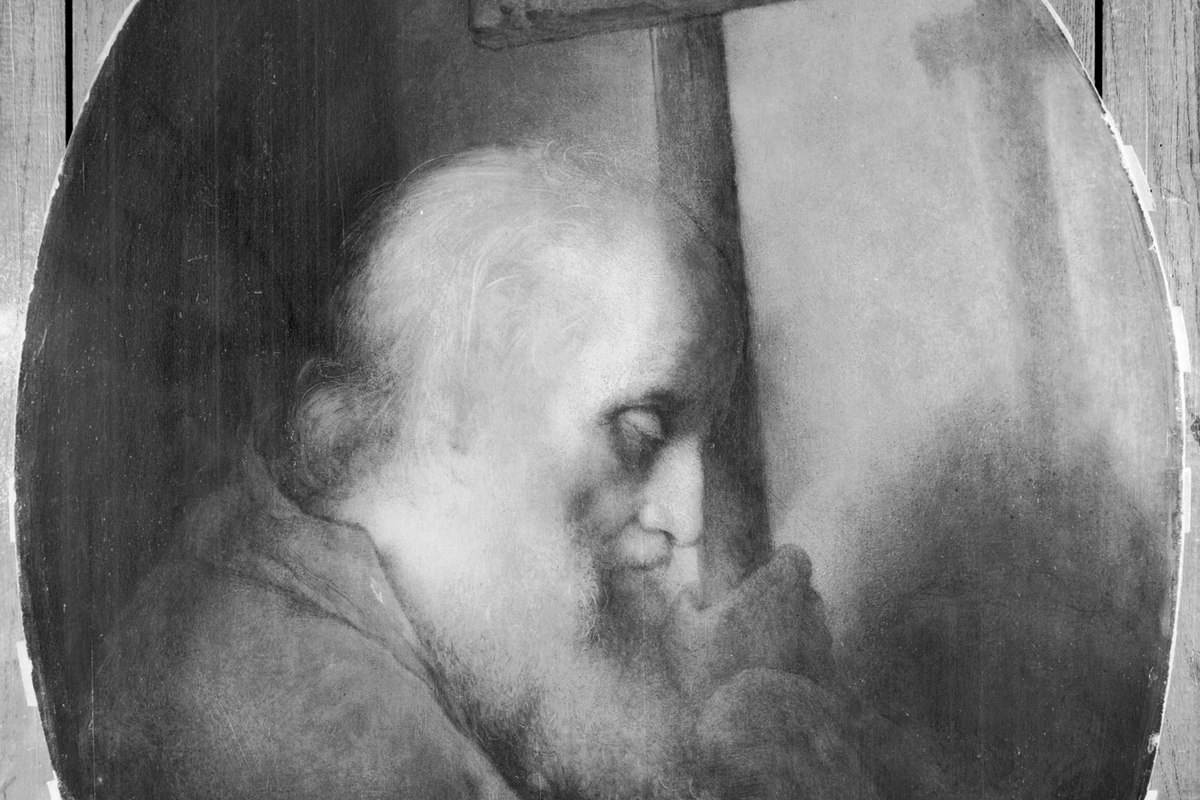
Christoph Paudiss, "Saint Andrew the Apostle," c. 1665 — public domain.
John's account fills in a detail Matthew leaves out: Andrew had already been a disciple of John the Baptist before he ever met Jesus. He was standing with John near the Jordan when the Baptist pointed Jesus out and said, "Behold, the Lamb of God!" — and Andrew, along with another unnamed disciple, simply left and went to see where Jesus was staying, spending the rest of that day with him. Only afterward does Andrew go back to his nets, so that the calling by the Sea of Galilee reads less like a stranger's sudden summons and more like the confirmation of something Andrew had already begun to suspect. It's a small but telling detail: before he was known as "first called," he was already someone actively searching.
The brother who brought his brother
What Andrew does with that calling says as much about him as the calling itself: rather than keeping the moment to himself, he goes and finds Simon Peter and brings him to Jesus. It's a small act with an outsized consequence — the apostle who would become the Church's foundational "rock" was introduced to Jesus by his quieter, less-celebrated brother. Andrew never becomes the center of the story that follows, but the story wouldn't have Peter in it at all without him.
That pattern of quietly connecting other people to Jesus shows up again later in the Gospels. It's Andrew who points out the boy with five barley loaves and two fish before the feeding of the five thousand, even while admitting how little the offering seemed to matter — "but what good are these for so many?" (John 6:9, NABRE). And when a group of Greek pilgrims in Jerusalem wanted an audience with Jesus during Holy Week, they approached Philip, who wasn't sure how to proceed and brought the request to Andrew instead, who then took it to Jesus. Across all three episodes — his brother, the boy with the loaves, and the Greek visitors — Andrew appears as a kind of connector, someone whose role in the Gospels is consistently to bring other people toward Jesus rather than to stand at the center of events himself.
Decades of quiet missionary work before Patras
Between his calling by the Sea of Galilee and his death, tradition and early Church writers trace Andrew across a wide and often remote missionary territory. Various accounts, none of them part of Scripture itself, place him preaching along the Black Sea coast, through Byzantium (the city that would later become Constantinople), and into Scythia — the region north of the Black Sea that Greek and Roman writers associated with present-day Ukraine and southern Russia. This tradition is part of why the Eastern Orthodox Church, alongside the Catholic Church, venerates Andrew as a founding apostle of Constantinople, honoring him with the title "Protokletos," Greek for "the first-called" — the same distinction tied to his calling in John's Gospel. Little of this missionary period is verifiable in the way the Gospel accounts are, but the geographic reach attributed to Andrew, extending far to the north and east of the other apostles' recorded travels, has shaped his veneration in Eastern Christianity for centuries.
A death chosen on his own terms
Tradition holds that Andrew was martyred by crucifixion at Patras, in Achaea, around 60 AD — and that he specifically requested a cross different from the one Jesus died on, considering himself unworthy of an identical death. The result, according to that same tradition, was a crux decussata — an X-shaped cross, or saltire, now known simply as Saint Andrew's Cross. Some later accounts add that Andrew was bound to the cross with rope rather than nailed to it, in order to prolong his suffering, and that he continued preaching to the crowd gathered to watch for two full days before he died. None of these details come from the earliest layers of tradition, and the Church is careful to treat them as pious legend rather than established historical fact — but they help explain why later Christian art so often depicts Andrew bound, rather than nailed, to his cross.
From a Greek fishing town to Scotland's flag
That same X-shaped cross eventually traveled a long way from Patras. A later legend held that a cloud formation resembling the saltire appeared over a Scottish battlefield, leading King Óengus to adopt Andrew as Scotland's patron saint — and the white saltire against blue that became the design of Scotland's flag traces directly back to the shape of the cross Andrew is said to have chosen for himself, out of humility, nearly two thousand years earlier.
How Andrew's relics ended up connected to Scotland at all is its own tangle of legend. One tradition credits a monk named Saint Regulus (also called Rule) with bringing some of Andrew's bones from Patras to the Scottish coast in the 4th century, founding the settlement that became the town of St Andrews — still home to Scotland's oldest university and one of the world's most famous golf courses, both named for the apostle. A separate set of relics reached Amalfi, Italy, in the 13th century during the Fourth Crusade, and remain enshrined there today. Centuries later, in 1964, Pope Paul VI returned a portion of Andrew's relics from Rome to the Orthodox Church in Patras as a gesture of reconciliation between the Catholic and Orthodox traditions — a fitting gesture for a saint venerated jointly, and about as equally, by both.
A patronage far wider than one country
Scotland is the best-known of Andrew's patronages, but far from the only one. He's also honored as patron saint of Greece, Romania, Russia, and Ukraine, along with fishermen, fishmongers, and rope-makers — trades that echo his own original occupation on the Sea of Galilee. His feast day, November 30, falls near the start of Advent in the Western liturgical calendar and is marked with particular solemnity in Scotland, where it remains an official bank holiday, and throughout the Orthodox world, where the Patriarchate of Constantinople still traces its own founding back to Andrew's missionary work in the city nearly two thousand years ago.
Trivia
Was Andrew really the first apostle Jesus called?
What did Andrew do immediately after being called?
What was Andrew's original occupation?
Why is Andrew associated with an X-shaped cross?
Related Reading