Saint Thomas the Apostle

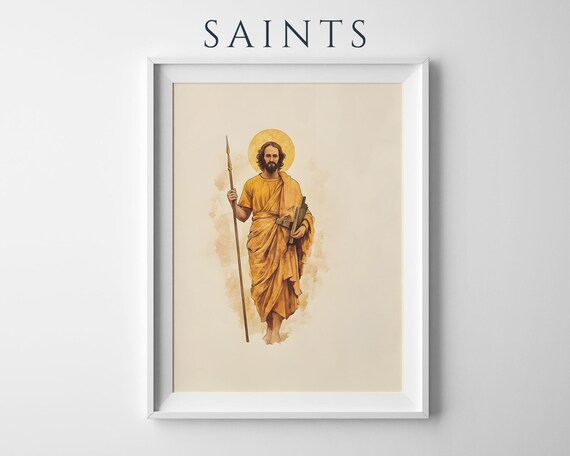
Refusing to take anyone's word for it
By the time the risen Jesus first appears to the disciples, Thomas isn't in the room — and when the others tell him afterward, he doesn't soften the terms of his disbelief at all: "Unless I see the mark of the nails in his hands and put my finger into the nailmarks and put my hand into his side, I will not believe." (John 20:25, RSV-CE). It's a strikingly specific demand, not vague skepticism — Thomas names exactly what would satisfy him, and nothing less.
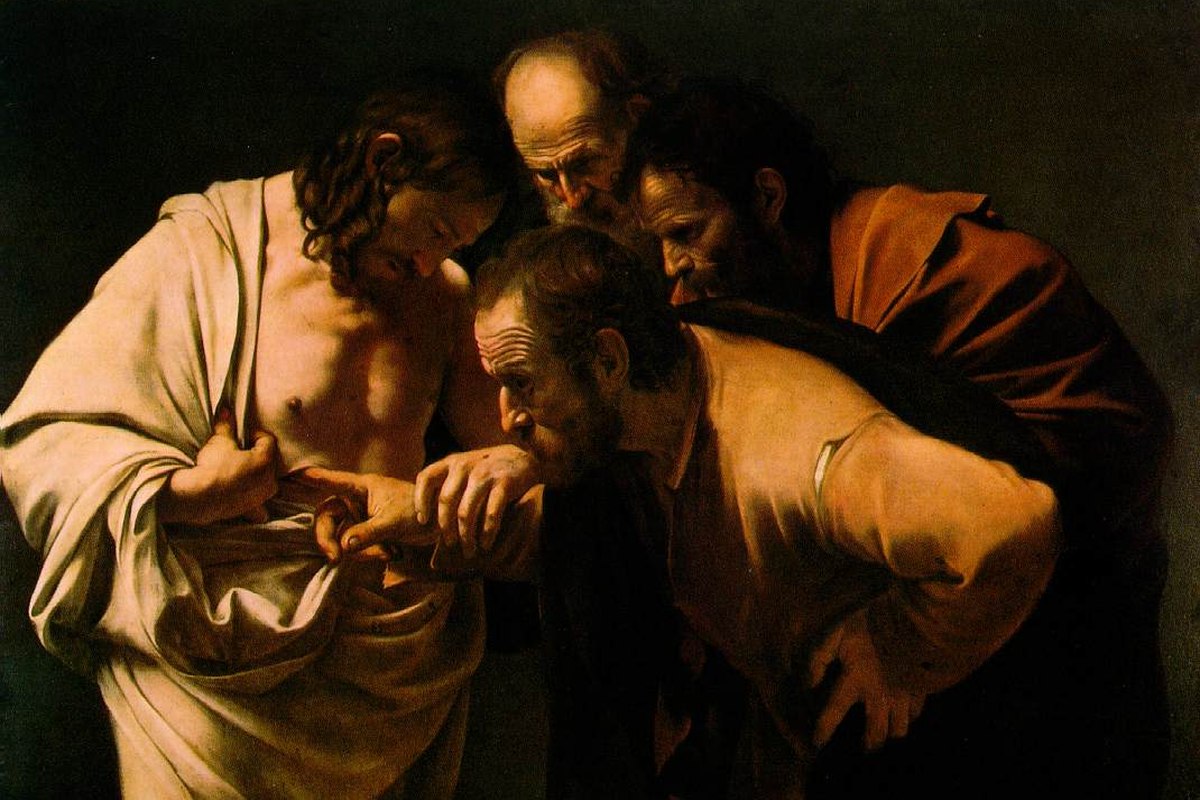
Caravaggio, "The Incredulity of Saint Thomas," c. 1601-1602 — public domain.
This isn't the only moment in John's Gospel where Thomas speaks up in a way that reveals a particular kind of honesty. Earlier, when Jesus announces he's returning to Judea to visit the dying Lazarus, despite the very real danger of stoning there, it's Thomas who says to the other disciples, "Let us also go to die with him." (John 11:16, RSV-CE) — a statement of loyalty shadowed by real fear, rather than naive bravado. And at the Last Supper, when Jesus tells the disciples they know the way to where he is going, it's Thomas again who admits what the others may have been thinking but didn't say aloud: "Master, we do not know where you are going; how can we know the way?" (John 14:5, RSV-CE) — a question that prompts one of Jesus's best-known replies, "I am the way, and the truth, and the life" (John 14:6, RSV-CE). Across all three episodes, Thomas emerges as a disciple defined less by doubt for its own sake than by a consistent refusal to pretend he understands or believes more than he actually does.
Met exactly where he stood
A week later, Jesus appears again, and this time Thomas is present. What happens next isn't a rebuke. Jesus goes straight to the condition Thomas had set: "Put your finger here and see my hands, and bring your hand and put it into my side, and do not be unbelieving, but believe." (John 20:27, RSV-CE). There's no recorded scolding for the doubt itself — only an invitation to exactly the proof Thomas had asked for.
The clearest declaration in the Gospels
Thomas's response is immediate and total: "My Lord and my God!" (John 20:28, RSV-CE). It's one of the most direct, unqualified statements of Jesus's divinity spoken by anyone in the Gospels — and it comes, almost paradoxically, from the disciple who had just insisted he wouldn't believe without physical proof. Jesus's reply looks past Thomas to everyone who would come after him: "Have you come to believe because you have seen me? Blessed are those who have not seen and have believed." (John 20:29, RSV-CE).
That closing line is often read as a gentle correction of Thomas, and in a sense it is — but it's worth noticing what Jesus doesn't say. He never tells Thomas his demand for proof was wrong, or refuses to meet it. He simply widens the frame: Thomas's faith, hard-won through direct physical evidence, was real and valid, but every generation after the apostles would need a different kind of faith, one built on testimony rather than touch. In that sense, Thomas's story becomes a kind of bridge in John's Gospel — the last of the apostles to see the risen Christ in the flesh, and the first person addressed, even indirectly, as a representative of everyone who would come to believe without that same direct encounter.
The apostle who went farthest
What happened to Thomas afterward is harder to pin down with certainty, but a long, well-preserved tradition holds that he traveled farther than any other apostle — all the way to India. The Saint Thomas Christians of Kerala maintain an unbroken tradition that he landed at Muziris in 52 AD and founded several of the region's earliest Christian communities, making the man remembered for demanding proof also the one credited with carrying the faith to one of its most distant early frontiers.
According to that same tradition, Thomas founded seven churches along the Malabar Coast of southwestern India before traveling further to what is now the city of Chennai, on India's eastern coast, where he was martyred, reportedly speared to death, around 72 AD at a hill still known today as St. Thomas Mount. The community he is said to have founded survived in continuous, if isolated, existence for nearly two thousand years — a Christian population that developed its own distinctive liturgy, largely cut off from the churches of the Mediterranean world, and that identifies itself to this day, with considerable pride, as the direct spiritual descendants of the apostle who once refused to believe without touching the wounds himself. Modern archaeological and historical research can't confirm every detail of this tradition with certainty, but the trade routes connecting the Roman world to the Malabar Coast in the 1st century were well established and active, meaning the core claim — that a Mediterranean traveler reached India by sea in this period — is entirely plausible on its own terms, whatever the full truth of Thomas's specific journey.
A name still carried by an ancient community
The label "Doubting Thomas" has outlived nearly everything else about him in popular memory, becoming a common English phrase for any habitual skeptic — a slightly unfair legacy for an apostle whose Gospel appearances actually show a man defined by candor and loyalty as much as by doubt. Alongside the Twelve Apostles at a Glance, Thomas remains one of the few besides Peter and John whose personality comes through so distinctly in the Gospel text itself, rather than being reconstructed almost entirely from later tradition. His feast day, July 3, is celebrated with particular devotion among the Saint Thomas Christians of India, whose churches trace an unbroken line of worship back to the same apostle who once said he would believe nothing without seeing it for himself.
Trivia
Why is Thomas remembered as 'doubting Thomas'?
What happened when Jesus actually appeared to Thomas?
What did Thomas say once his doubt broke?
Where did Thomas go after Jesus's ascension?
What is Saint Thomas the patron saint of, and when is his feast day?
Related Reading