Saint Kevin of Glendalough

A prince's grandson who wanted solitude
Kevin — in Irish, Coemgen, meaning "fair-begotten" — was born around 498, reportedly of noble stock, into a Leinster family with the connections to have secured him a comfortable, visible life. Early hagiographers insist he wanted none of it. As a boy he was sent to be educated by monks, and whatever happened during those years convinced him that the monastic life, not the world his family had planned for him, was where he belonged. By the time he was a young man he had already begun looking for somewhere remote enough to be left alone with it.
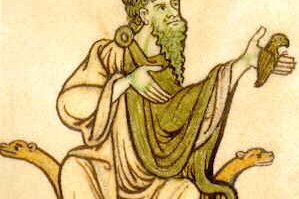
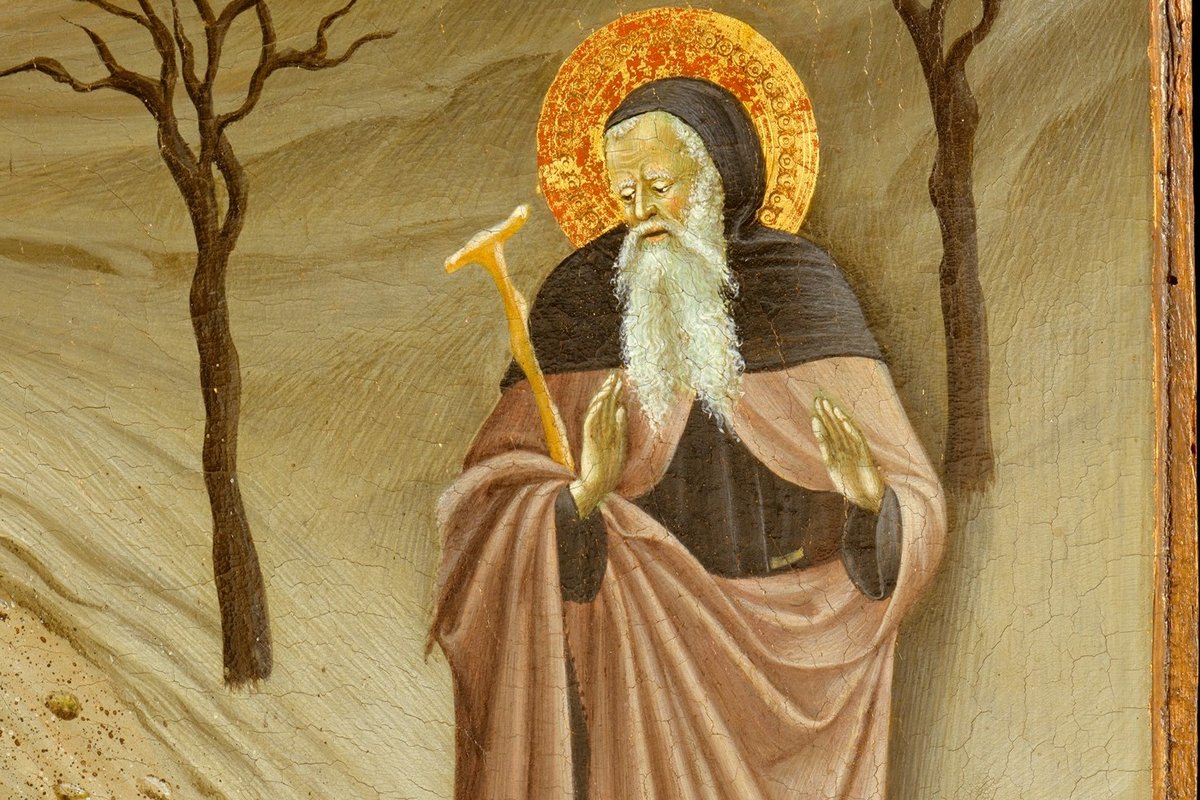
Anonymous, 10th-century Irish manuscript miniature of Saint Kevin — public domain.
He found that place in a valley in the Wicklow Mountains called Gleann Dá Loch — the valley of the two lakes — a landscape of steep wooded slopes, a river, and two dark glacial lakes that made it nearly inaccessible by the standards of sixth-century Ireland. Kevin settled first in a cave above the upper lake, a spot still shown to visitors today as "Saint Kevin's Bed," and lived there for years as a solitary ascetic: minimal food, minimal shelter, and by every account a level of physical hardship that his own community later treated as the defining fact of his sanctity.
From hermit to reluctant abbot
Solitude, in early Irish monasticism, had a way of attracting exactly the crowd it was meant to escape. Word of Kevin's holiness spread, and other men seeking the same kind of disciplined, isolated life began arriving at Glendalough hoping to live near him or under his direction. According to the Catholic Encyclopedia's account, Kevin eventually organized these followers into a proper monastic community — then, once it was established and functioning, retired back into solitude for four more years, apparently uninterested in running the institution he had inadvertently founded. Only the persistent pleading of his own monks brought him back to lead it.
That reluctance is worth pausing on, because it cuts against the tidier image of the confident founder-saint. Kevin's story, as it comes down to us, is of a man who kept being pulled back into community life against his own preference for silence — and who apparently never fully stopped preferring the cave to the abbot's chair. The monastery he led anyway grew rapidly. Within a few generations of his death, Glendalough had become one of the great monastic schools of early medieval Ireland, drawing students and pilgrims from well beyond Leinster, and its scriptorium and community endured — surviving Viking raids that devastated many other Irish monastic sites — for centuries afterward.
The blackbird, and Kevin's reputation for kinship with animals
The blackbird story is the single detail most people know about Kevin, and it isn't isolated — medieval Irish hagiography returns again and again to the theme of saints living in a kind of restored harmony with wild creatures, as though holiness rolled back a small piece of the alienation between humans and the rest of creation. Otters are said to have brought Kevin fish. A wild boar reportedly led hunters to his hermitage without harming him. None of this is verifiable history in the way a modern biography would require, and the Catholic Encyclopedia itself treats these episodes as pious legend rather than documented fact — but they were never meant to function as forensic reporting. They were meant to illustrate, vividly and memorably, what several centuries of Irish monks believed extreme humility and patience could look like in practice.
The blackbird legend in particular has had an unusually long afterlife. It resurfaces in modern literature — most famously in Seamus Heaney's poem "St Kevin and the Blackbird," which imagines Kevin's interior struggle between the ache of holding still and the deeper stillness that comes once he stops fighting it. That a fifth-century hermit's small, quiet act of forbearance could still be inspiring poetry fifteen centuries later says something about how durable the story's core image really is.
Glendalough as a place, not just a legend
Unlike many early Irish saints whose associated sites have vanished or been reduced to a placename, Glendalough survives as a physical place you can walk through today, and that matters for understanding Kevin's legacy. The valley still holds the remains of what's called the "Seven Churches" — a cluster of stone chapels built across several centuries of the monastery's active life, not all at once — along with a well-preserved round tower over 30 meters tall, one of the finest surviving examples of the tower type Irish monasteries built partly as lookout posts and partly as secure storage for relics and manuscripts during Viking raids. St. Kevin's Bed, the cave above the upper lake where he is said to have lived as a hermit, is still pointed out to visitors, cut into a cliff face accessible only by a narrow ledge — a detail that does a lot to explain why isolation, rather than performance, was the actual point of the place he chose.
A patron of a landscape as much as a person
Kevin's feast falls on June 3, and devotion to him has remained strongest exactly where you'd expect — in Ireland, and specifically in Leinster, where Glendalough still functions as a pilgrimage destination alongside its role as a heavily visited historical site. What distinguishes his cult from many saints of the same era is how thoroughly it's tied to one specific, still-visitable landscape rather than to relics that were scattered, lost, or moved to distant cathedrals. Visiting Glendalough today means standing more or less where the historical Kevin is believed to have stood — in a valley he chose precisely because almost no one else wanted to be there, and which he then, against his own preference, turned into a community that outlasted him by well over a thousand years.
Trivia
Who was Saint Kevin of Glendalough?
What is the legend of Saint Kevin and the blackbird?
What is Glendalough, and why is it associated with Saint Kevin?
How long did Saint Kevin live, according to tradition?
Is Saint Kevin still visited by pilgrims today?
You May Also Like
Related Reading