Saint Expeditus, Patron of Urgent Causes

A saint built almost entirely out of stories
Few figures in the Catholic devotional world sit as far out on the edge of "we're not sure" as Saint Expeditus. Even his admirers tend to open with a caveat: reliable historical documentation about his life is thin to the point of nonexistence, and what survives is largely legend, assembled and repeated across centuries rather than recorded close to the events it describes. That doesn't make him unusual among early martyrs — many saints from the Roman persecutions are known chiefly through later hagiography rather than contemporary record — but Expeditus is an especially clear case, worth naming plainly rather than glossing over.
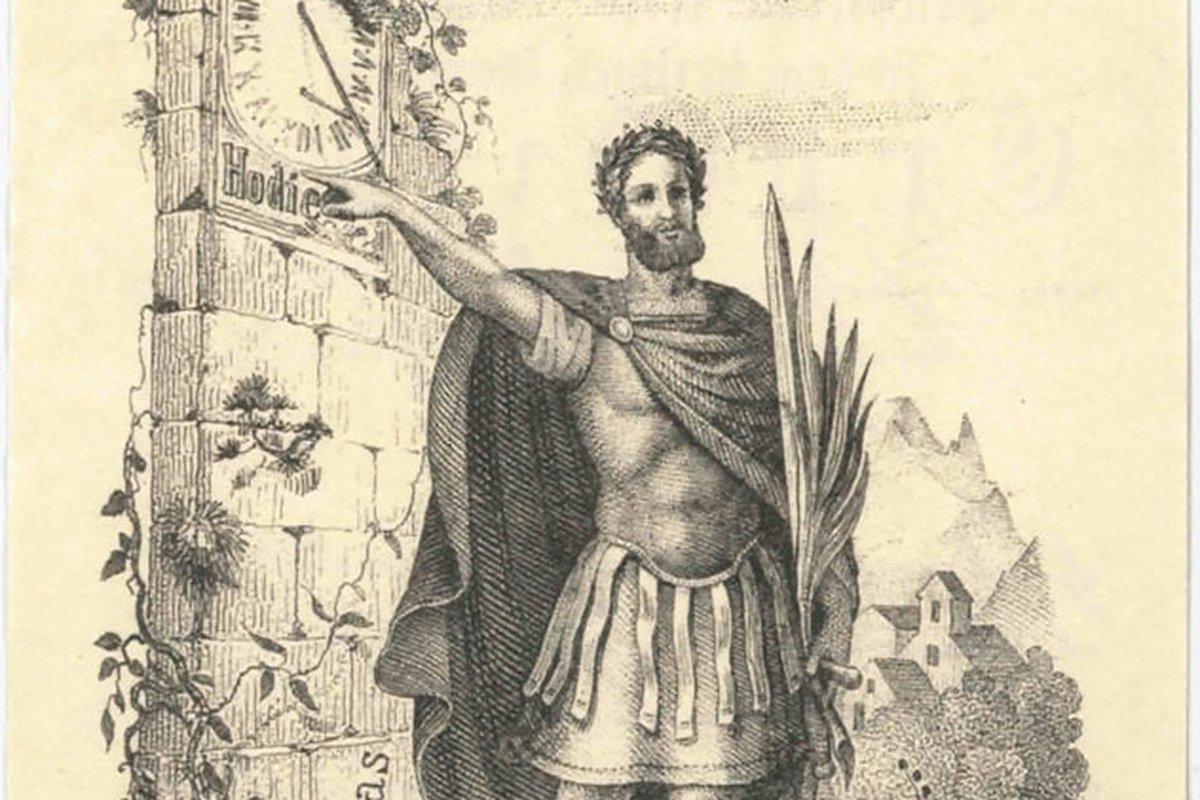
Unknown artist, 'Saint Expeditus,' 19th-century lithograph — public domain.
The soldier and the crow
The tradition that has circulated longest places Expeditus as a Roman soldier, possibly a centurion, serving with the Legio XII Fulminata at Melitene in Armenia, martyred around 303 AD during the persecution of Christians under the Emperor Diocletian, alongside a small group of companions. Later legend adds the detail that made him famous far beyond that original story: as Expeditus prepared to convert to Christianity, the devil appeared to him in the shape of a crow, croaking the Latin word "cras" — "tomorrow" — trying to talk him into delay. Expeditus is said to have stamped on the bird and declared he would become a Christian that very day, not tomorrow.
Whether or not any part of that scene happened, it explains almost everything about how Expeditus is venerated today. His name itself sounds like the Latin word for "prompt" or "unencumbered," and between the name and the crow story, he became the natural saint to invoke for urgent matters — pressing legal cases, quick resolutions, exam results, and, increasingly in modern devotion, simple procrastination.
The crate story — a good tale, not a verified one
A separate and more recent legend claims to explain where devotion to Expeditus actually came from: that sometime in the 18th or 19th century, a crate of unlabeled relics arrived at a convent, marked only with a word meaning "shipped" or "dispatched" — commonly given as the Italian "spedito" — which the nuns supposedly misread as the saint's own name and began venerating accordingly. It's a memorable story, and it circulates widely online and in popular devotional accounts. But it doesn't hold up well against the historical timeline: veneration of a martyr named Expeditus is attested in sources that predate the crate story by decades, if not longer, which means the legend is best understood as a colorful, unverified folk explanation rather than documented history. Readers should treat it with the same caution the rest of his biography requires.
A cross that says "today"
Whatever the truth of his origins, Expeditus's imagery has stayed remarkably consistent for well over a century. He's almost always shown as a Roman soldier in armor, holding a cross inscribed with the Latin word "Hodie" — "today" — a direct visual answer to the crow's whispered "cras," tomorrow. A palm branch, the standard symbol of martyrdom in Christian art, usually appears in his other hand, and the crow itself is frequently shown crushed underfoot or flying away in defeat. That single word on the cross does a lot of work: it compresses the entire legend, temptation to delay, refusal, and immediate action, into an image simple enough to print on a prayer card or carve into a small statue, which is likely a large part of why the devotion spread as widely and as fast as it did.
Feast day, and where devotion runs strongest
His feast is kept on April 19, and while it never became a major date on the universal Church calendar, it holds real weight in specific pockets of Catholic practice. New Orleans, in particular, developed an unusually strong local devotion to Expeditus, centered for generations at Our Lady of Guadalupe Church in the French Quarter, where a statue of the saint has drawn petitioners seeking quick help with urgent, often financial or legal, problems. Similar pockets of devotion took root in parts of Latin America, southern Italy, and the Philippines, frequently carried there through immigrant and missionary communities rather than through any centralized Church promotion — a devotion that grew from the ground up, saint's-name uncertainty and all.
A debated saint who is still venerated
Because the surviving evidence for Expeditus is so thin, some historians have gone further and suggested that "Expeditus" may not originally have referred to a specific person at all — that the word could have started as a military or liturgical term (soldiers "expediti" were light-armed troops ready to march at short notice) later misread as a proper name in a martyrology, the kind of list-based error that produced a handful of other uncertain saints in the Roman calendar. This is a real scholarly debate, not a settled conclusion, and it sits alongside — rather than replaces — the traditional soldier-and-crow story.
None of this uncertainty has slowed his popular devotion, particularly in Louisiana, parts of Latin America, and southern Europe, where he remains one of the most frequently invoked saints for urgent, time-sensitive prayers. Expeditus belongs, in that sense, to a small category of Catholic devotion where the strength of popular veneration has outpaced — and outlasted — the certainty of the historical record beneath it, much as it has for a handful of other early martyrs whose stories survive mainly through legend rather than documented fact.
Trivia
Who was Saint Expeditus supposed to have been?
Why is Saint Expeditus invoked against procrastination?
Is there a popular legend that Saint Expeditus's name came from a shipping crate?
Does the Catholic Church officially question whether Saint Expeditus existed?
You May Also Like

Related Reading