Saint Matthew the Apostle

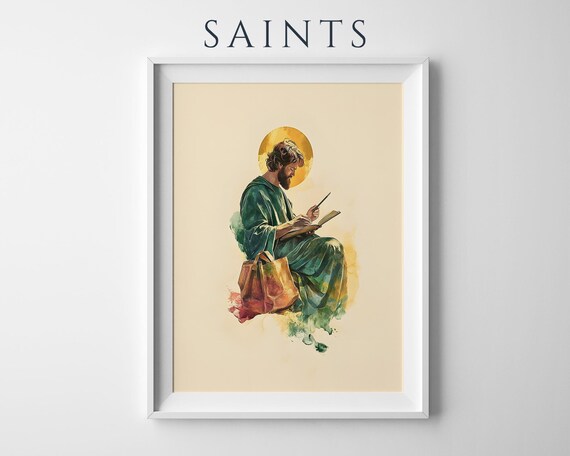
A job that made him an outsider among his own
Before he was an apostle, Matthew worked as a tax collector in Capernaum, gathering duties on behalf of Herod Antipas from farmers, merchants, and travelers passing through on the main trade road. It was lucrative work, and deeply resented — Jewish tax collectors were widely regarded as collaborators with Rome, frequently assumed (often accurately) to be pocketing more than they were owed. Choosing to associate with one, let alone recruit one, was not a neutral social move.
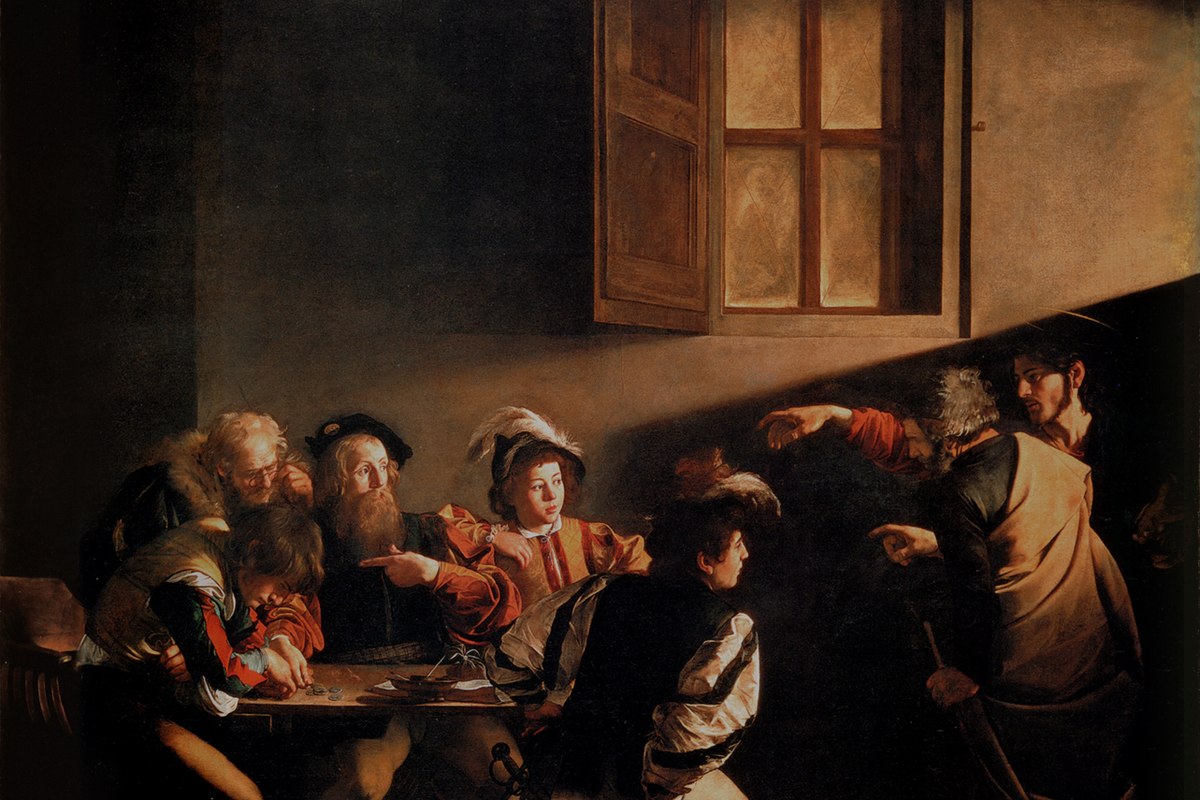
Caravaggio, "The Calling of Saint Matthew," 1599-1600 — public domain.
Two words, no negotiation
That's exactly what Jesus does. Matthew records his own calling with almost startling brevity: "As Jesus passed on from there, he saw a man named Matthew sitting at the customs post. He said to him, “Follow me.” And he got up and followed him." (Matthew 9:9, RSV-CE). There's no recorded hesitation, no bargaining, no explanation offered for why a man in the middle of his workday would simply stand up and leave it behind. The text doesn't dwell on his motives — only on the immediacy of his response.
A recruitment other observant Jews would have questioned
What makes the moment more pointed is what it would have signaled to onlookers. Rabbis and respected teachers were expected to keep their distance from tax collectors, not draw them into their inner circle. Jesus's choice to call Matthew — publicly, at his own booth — was less a quiet gesture and more a visible statement about who exactly he considered worth following him.
From a tax booth to the longest Gospel
Tradition holds that Matthew went on to write the Gospel that bears his name — the longest of the four, and one early Church writers associated with a Jewish Christian audience, with some accounts holding it was originally composed in Aramaic. Whatever the precise details of its authorship, the trajectory remains striking: a man whose profession made him an object of scorn became, in Christian memory, one of the four voices chosen to record the life of the man who called him.
The dinner that followed the calling
Matthew's own Gospel doesn't stop at his rising from the tax booth — it continues into a dinner scene that provoked its own controversy: Jesus eating at Matthew's house alongside "many tax collectors and sinners," which drew criticism from the Pharisees for keeping such company (Matthew 9:10-11). Jesus's recorded reply — that it is the sick, not the healthy, who need a physician — reframes the entire episode as a statement of purpose rather than a lapse in judgment. Luke's Gospel tells essentially the same calling story but names the tax collector Levi (Luke 5:27-32), and the traditional harmonization —followed by the Church since the earliest centuries—is that Levi and Matthew are the same man, with "Matthew" serving as either a second name or a new one taken up after his call, similar to how Simon became Peter.
A winged man among the four living creatures
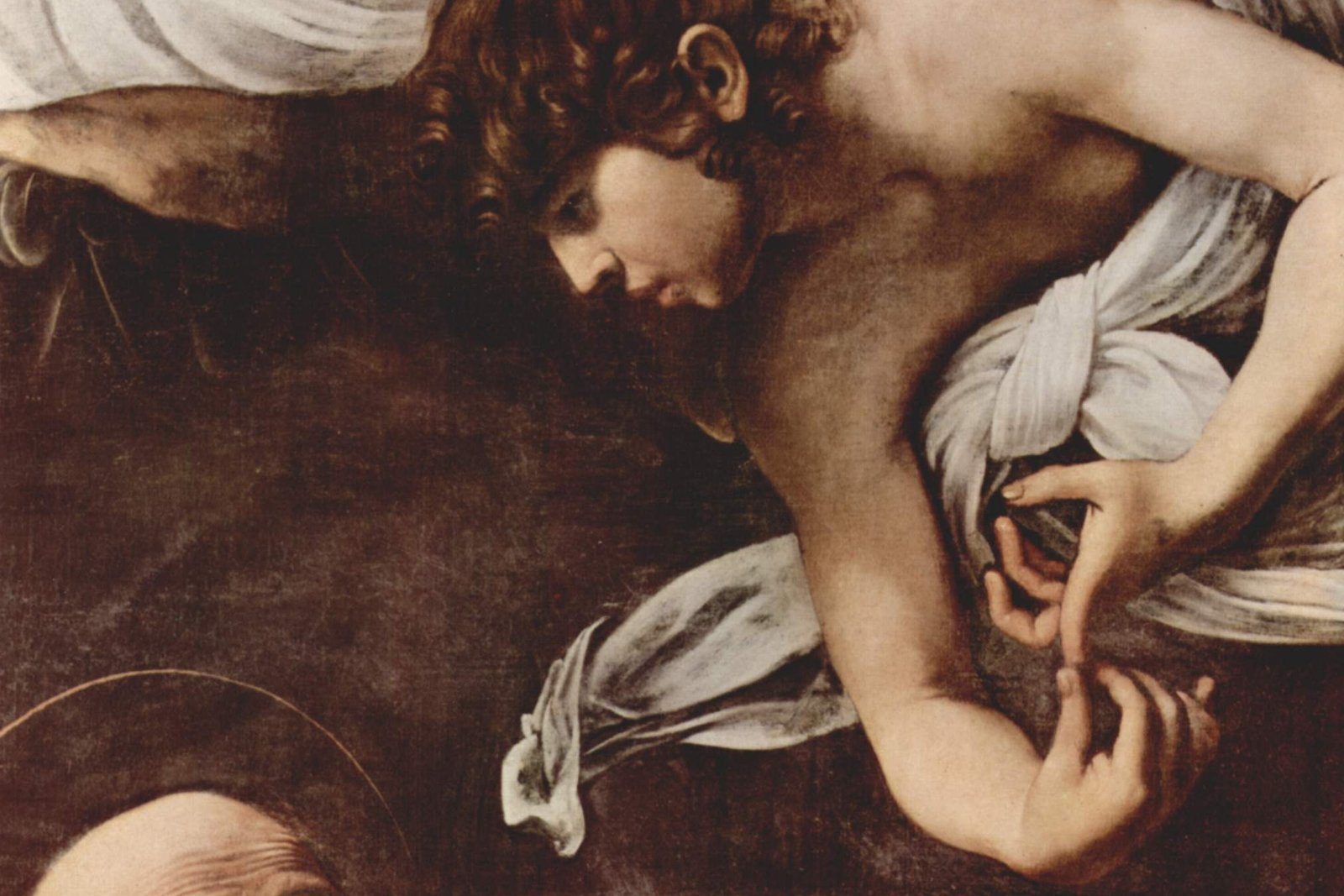
In Christian art and especially in the decoration of churches, each of the four Gospel writers is traditionally paired with one of the four living creatures described in the prophet Ezekiel's vision and echoed in the Book of Revelation: a man, a lion, an ox, and an eagle. Matthew's symbol is the winged man (sometimes rendered as an angel), a pairing traced back to early Christian commentators who linked it to his Gospel's opening genealogy, which roots Jesus's origins in human history and lineage before anything else. That symbol appears consistently across centuries of illuminated manuscripts, cathedral sculpture, and altar paintings, making Matthew one of the few apostles instantly identifiable by an attribute that has nothing to do with the manner of his death.
From Capernaum to a much later legend
Scripture says nothing about what became of Matthew after the Gospels end, and everything past that point belongs to later tradition rather than to any contemporary record. Various accounts, none of them uniform or verifiable, place his later ministry in regions as distant as Ethiopia, Persia, or Parthia, and hold that he died a martyr — though the details differ enough between sources that the Church treats the specifics as pious tradition, not settled history. What historical evidence does exist points instead to relics venerated since the medieval period in the crypt of Salerno Cathedral in southern Italy, brought there in the tenth century according to local tradition, and still the focus of an annual September feast in the city today.
Why Caravaggio's version endures
The hero image on this page, Caravaggio's "The Calling of Saint Matthew," is itself worth understanding as more than illustration: painted around 1600 for the Contarelli Chapel in Rome, it places Matthew in contemporary dress at a table of coin-counters, with a shaft of light and Christ's gesturing hand cutting through the darkness from the edge of the canvas. Art historians have long debated exactly which seated figure is Matthew — the man pointing at his own chest in apparent disbelief, or the youth at the end of the table absorbed in counting money — and that ambiguity is arguably the point: the painting captures the exact, disorienting instant before an ordinary man realizes he has just been chosen.
Trivia
What did Matthew do before he was called by Jesus?
What does the Bible say about his calling?
Why would Matthew's calling have scandalized people at the time?
What did Matthew go on to write?
What is Saint Matthew the patron saint of, and when is his feast day?
Related Reading