Saint Simeon Stylites

A shepherd boy drawn to extremes
Simeon was born around 388 in the village of Sisan, near the frontier between Syria and Cilicia, the son of a shepherd, and the traditional accounts of his conversion to religious life describe a moment of sudden, overwhelming conviction rather than a gradual vocation — reportedly triggered by hearing the Beatitudes read aloud and being struck, almost physically, by their demand. Whatever exactly happened, he abandoned his family's flocks and entered a nearby monastery as a teenager, and from the very start of his monastic life showed a pattern that would define everything that followed: an instinct to take every ascetic practice further than his community expected or, often, permitted.
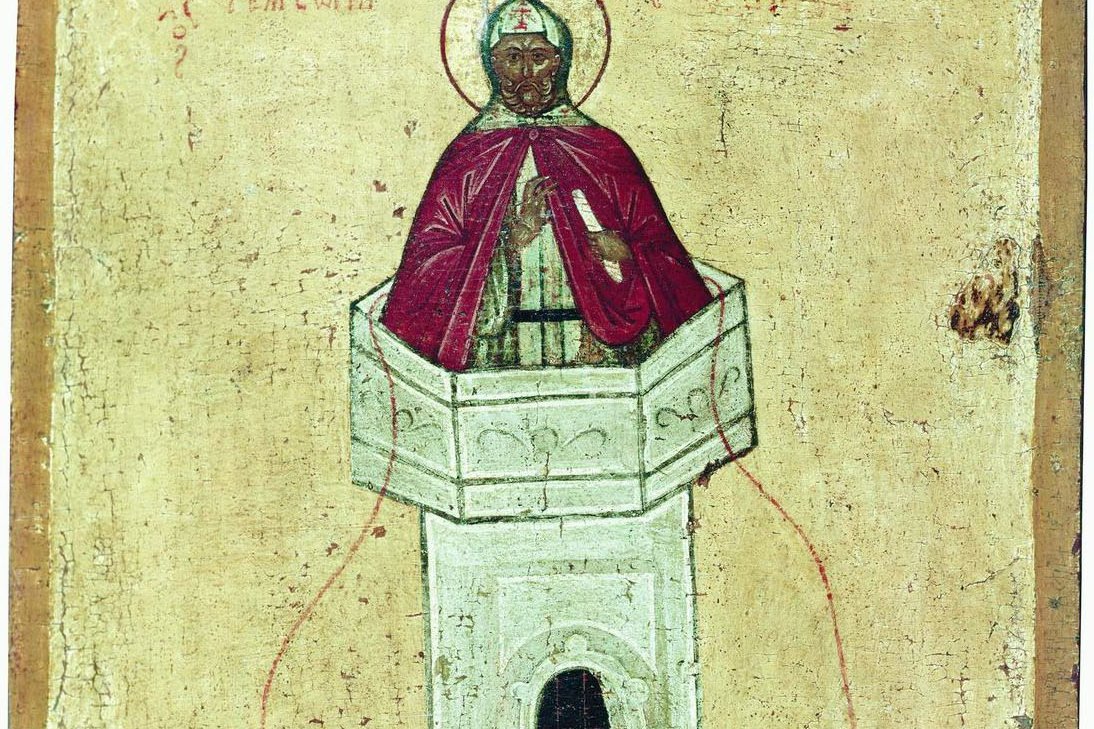
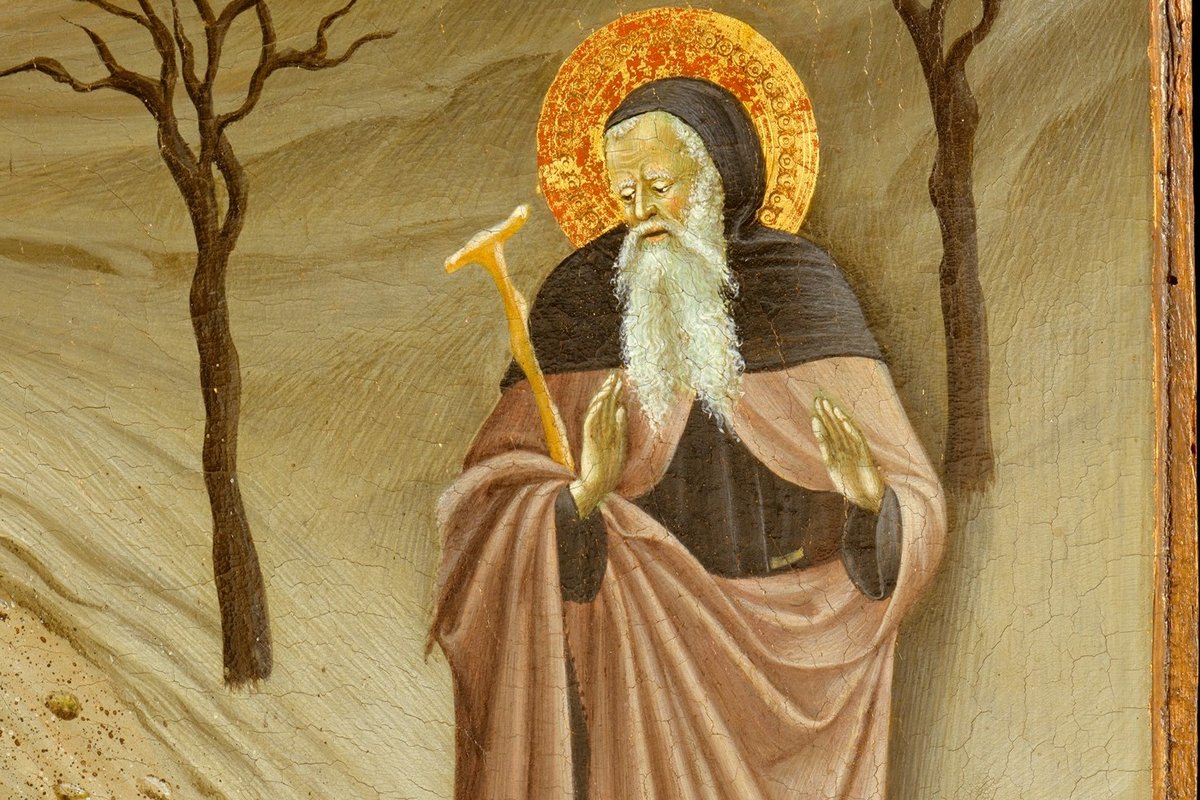
Anonymous, icon of Saint Simeon Stylites, 1465 — public domain.
Early biographers describe him wearing a rope of twisted palm fronds so tightly around his body that it cut into his skin and had to be cut out by fellow monks, along with fasting practices so severe that his own monastery eventually asked him to leave, worried that his self-mortification was becoming a source of scandal or an unsafe example for others rather than a model of disciplined restraint. Simeon did not treat this as a rebuke to soften his practice — he simply moved to increasingly remote and difficult settings, spending time in a hillside hut, then reportedly buried himself up to his neck in a pit for the duration of one Lent as an act of penance, apparently taking whatever obstacle his community placed in his path as confirmation he was on the right track.
The pillar as a solution to fame, not a spectacle
What actually drove Simeon onto a pillar, around the year 423, was not showmanship — it was, by the account of his own contemporaries, a practical response to a problem his earlier asceticism had created. His reputation for holiness had spread widely enough that crowds began arriving continuously at whatever remote spot he chose, seeking healing, blessings, or simply the chance to see him, and the resulting demands on his time made the uninterrupted prayer he was seeking essentially impossible. A pillar, positioned in open country near Aleppo, offered a way to remain physically present and available to visitors — he could still be seen, still preach, still bless the sick who came — while removing himself from direct physical contact and the constant crush of a ground-level crowd.
The arrangement, somewhat paradoxically, made him far more famous rather than less. Visitors traveled from across the Eastern Roman Empire and beyond to see the spectacle of a man living permanently atop a column, and accounts from the period describe emissaries arriving even from Persia and other regions well outside Roman territory, along with ordinary pilgrims seeking healing or simply a blessing shouted down from the platform above. Simeon adjusted, rather than abandoned, his original goal: he preached daily to the crowds gathered at the pillar's base, mediated disputes brought to him by people who apparently trusted his judgment more than that of ordinary courts, and is credited by later Church historians with converting significant numbers of pagan Bedouin who had come initially out of curiosity rather than faith.
Thirty-seven years, and a series of taller pillars
Simeon remained on his pillar, in one form or another, for roughly thirty-seven years until his death in 459 — an extraordinary span made more striking by the fact that he wasn't simply sitting still. He stood through the platform's narrow railing for long stretches of prayer, reportedly performing repeated prostrations that visitors below could count by watching his head dip below the railing and rise again, sometimes numbering in the hundreds within a single day. Over the decades the column itself grew taller, replaced several times, with the final version said to have reached around fifty feet — high enough that ordinary conversation with those below would have required real effort, which may itself have been part of the intent, preserving some distance even as his fame made total isolation impossible.
He ate sparingly, reportedly relying on food pilgrims would send up on a rope or a ladder, and endured the region's harsh seasonal extremes — brutal summer heat and cold winter winds — without shelter beyond whatever minimal structure the platform provided. Church historians of the period, including Theodoret of Cyrrhus, who is believed to have known Simeon personally, wrote detailed contemporary accounts of his life on the pillar, which is part of why Simeon's asceticism is unusually well documented compared to many earlier desert ascetics whose lives survive mainly through later, more legendary retellings.
A tradition he founded without quite meaning to
Simeon's pillar-dwelling was not initially conceived as the founding act of a new form of monastic life, but that is effectively what it became. Within a generation, other ascetics across Syria and the wider Eastern Mediterranean had begun adopting the same practice, giving rise to a recognized category of holy men — the stylites — that persisted for centuries, most notably in Simeon Stylites the Younger, a 6th-century ascetic who spent even longer on his own column near Antioch. The practice never spread meaningfully into Western Christianity, remaining a distinctly Eastern phenomenon, but within Syrian and Byzantine monastic memory Simeon's pillar became the fixed reference point against which every later stylite's ascetic achievement was measured.
Simeon's feast is kept on January 5 in the Western calendar and January 1 in some Eastern calendars, and his story continues to function, nearly sixteen centuries later, as the standard illustration of just how far Christian asceticism could be taken — not as an eccentric footnote, but as the deliberate, sustained practice of a man who genuinely believed that the more distance he put between himself and ordinary comfort, the closer he moved toward the God he was trying to reach.
Trivia
Who was Saint Simeon Stylites?
How tall was Simeon's pillar, and did it stay the same height?
Why did Simeon choose to live on a pillar instead of in a monastery?
Did living on a pillar actually give Simeon the isolation he wanted?
Is 'stylite' asceticism still practiced today?
You May Also Like
Related Reading