The Cherubim on the Ark of the Covenant

A gold box built to exact specifications
The instructions in Exodus 25 are strikingly precise for what is, at its core, a wooden chest: acacia wood, "two and a half cubits long, one and a half cubits wide, and one and a half cubits high," plated inside and out with pure gold, fitted with gold rings and carrying poles that were never to be removed from the ark once inserted (Exodus 25:10-15, NABRE). Whatever else the Ark of the Covenant was meant to be, it was built to be handled — carried by the priests, moved with the people, never treated as a fixed monument bolted to one spot.
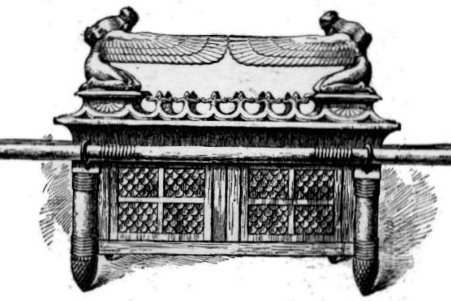
James Tissot, The Ark of the Covenant (c. 1896), public domain via Wikimedia Commons
Two angels, facing each other
It's the very next instruction that turns a portable chest into something else entirely. God tells Moses to make a cover of pure gold for the ark, and on that cover, two cherubim "of beaten gold," one at each end, formed from the same single piece of metal as the cover itself (Exodus 25:17-19, NABRE). Their posture is specified with the same precision as the box below them: wings "spread out above, sheltering the cover," faces turned toward each other and downward, "toward the cover" (Exodus 25:20, NABRE). This isn't ornamental flourish tacked onto a finished object — the cherubim and the cover they crown were conceived, and cast, as a single piece.
The space between the wings
What God says next is the reason this detail matters at all: "There I will meet you and there, from above the cover, between the two cherubim on the ark of the covenant, I will tell you all that I command you regarding the Israelites" (Exodus 25:22, NABRE). Of every location available to an infinite God, Exodus describes him choosing a specific, measurable point — the narrow gap between two angels' wings, on top of a box built to human dimensions — as the place from which he would speak. The cherubim aren't guardians stationed to keep something out; their wings define and shelter the very space where God's word to Israel was to be given.
A throne, not a landing pad
Later books of the Old Testament describe the ark, and by extension the cherubim on it, in language of kingship rather than simple sacred furniture. When Israel's elders send for the ark before a battle against the Philistines, Scripture identifies the God connected to it as the one "enthroned upon the cherubim" (1 Samuel 4:4, NABRE) — the wings function as a throne, with the empty space above the cover understood as where God's own presence rested, even though no image of God himself was ever made or permitted. The cherubim mark the seat; they are never made to represent the one seated on it.
Cherubim beyond the Ark
The pair on the mercy seat weren't Scripture's only cherubim, and setting them alongside the others sharpens what makes them distinct. After Adam and Eve are driven from Eden, God stations a cherub — in some translations, plural cherubim — with a flaming sword "to guard the way to the tree of life" (Genesis 3:24), a much more familiar guardian role. Centuries later, when Solomon builds the Jerusalem Temple to house the ark permanently, he commissions two colossal cherubim of olive wood, each ten cubits tall, their outstretched wings spanning the full width of the inner sanctuary — one wing of each figure touching the wall, the other touching its counterpart's wing at the center, directly over the ark (1 Kings 6:23-28). The Eden cherub keeps something out; the Temple cherubim, like the small gold pair on the ark's cover, keep watch over the place where God chose to be present.
Not what popular imagination pictures
The word "cherub" today often calls to mind a plump, harmless infant face from Renaissance art — a tradition with real roots in later Christian iconography, but a long way from what Exodus actually describes. The cherubim of the Ark are winged, faceless-in-the-text, gold-cast figures defined entirely by function: wings that shelter, faces that turn toward the sacred space between them, a posture of permanent attention rather than decoration. Whatever they looked like in full, Exodus is far more interested in what they guard and frame than in giving readers a portrait to visualize.
An object without a known ending
The Ark, cherubim included, rested in the Holy of Holies of Solomon's Temple for centuries, at the heart of Israel's worship. Scripture records no account of what happened to it after the Babylonian army destroyed Jerusalem's Temple in 587 BC — it simply disappears from the biblical narrative, and no confirmed trace of the original object has ever surfaced despite centuries of searching and speculation, some of it far more legendary than historical. What Exodus leaves behind instead is the image itself: two golden angels, wings spread toward one another, marking out — more clearly than almost anything else in the Old Testament — a single, exact place where heaven was said to meet earth.
Trivia
What exactly does Exodus say the cherubim on the Ark looked like?
What was the cover between the two cherubim actually called?
Did the Israelites believe God actually lived between the cherubim?
Were cherubim only ever gold statues on the Ark, or did they appear elsewhere?
What happened to the cherubim and the Ark itself?
Related Reading