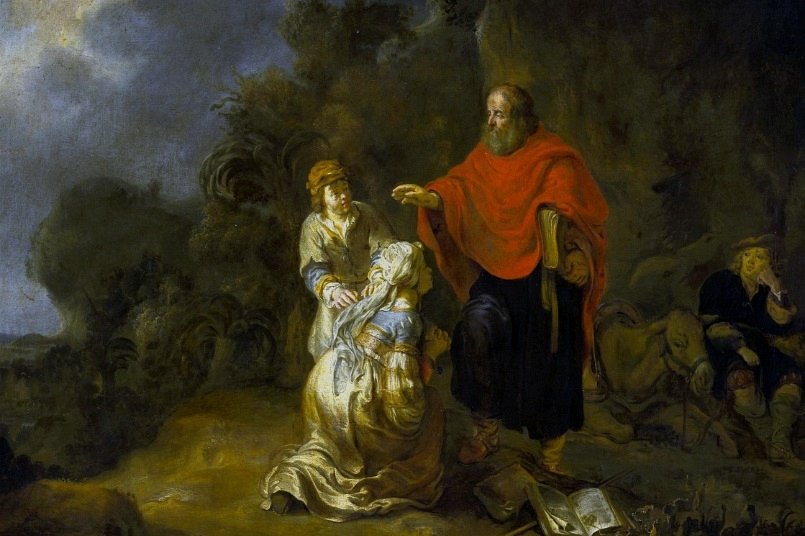
Elisha Raises the Shunammite Woman's Son

Hospitality Offered Without Being Asked
The story begins with an act of quiet, sustained generosity rather than any dramatic event. Elisha, the prophet who had succeeded Elijah, regularly passed through the town of Shunem, and a woman there — described in 2 Kings 4:8 only as "a woman of influence," without further detail about her name or family background — began inviting him to dine whenever he came by. What started as occasional hospitality became a settled arrangement of her own devising: she proposed to her husband that they set aside "a little room on the roof and furnish it for him with a bed, table, chair, and lamp, so that when he comes to us he can stay there" (4:10).
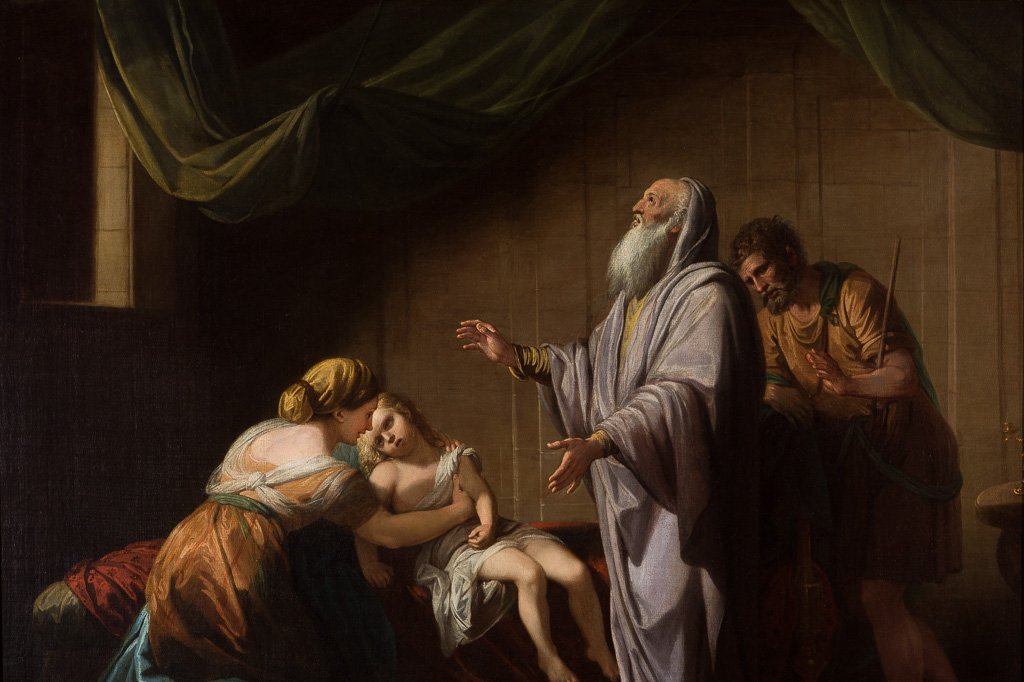
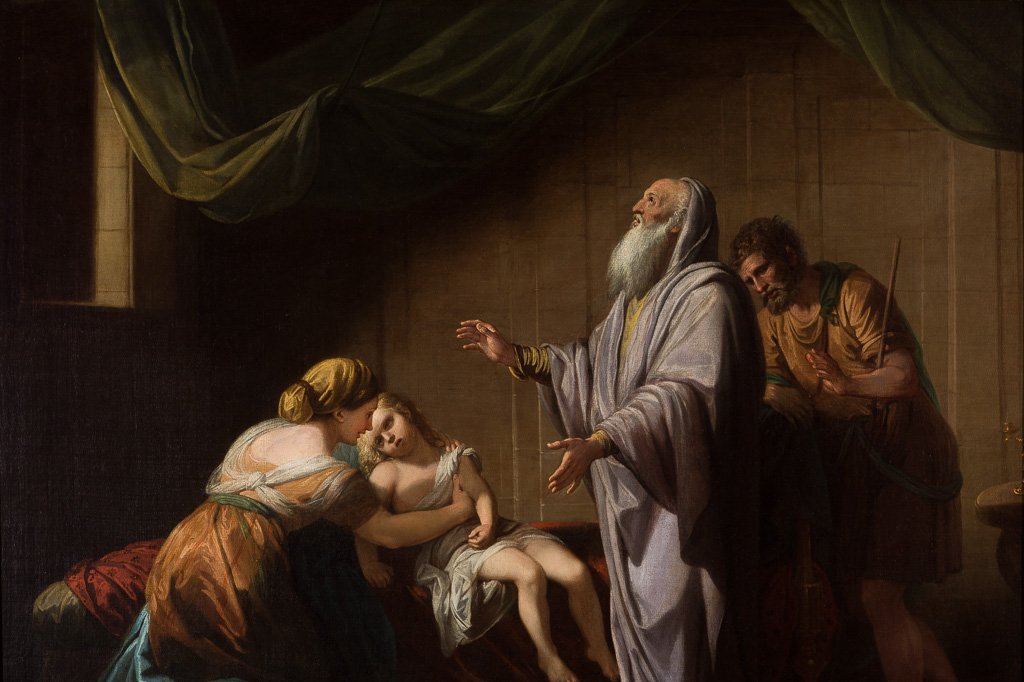
Benjamin West, Elisha Raising the Shunammite's Son (1765) - Wikimedia Commons, public domain
This detail matters for understanding what follows. The woman's kindness toward Elisha was not transactional or motivated by any expectation of reward — she recognized him simply as "a holy man of God" (4:9) worth supporting in a practical, ongoing way, well before any personal benefit to herself entered the picture.
A Gift She Never Requested
Wanting to repay her generosity, Elisha instructed his servant Gehazi to ask what might be done for her — perhaps a good word with the king or the local military commander. Her answer reveals a woman who needed no outside intervention or favor: "I live among my own people" (4:13), a simple statement of self-sufficient contentment. It is Gehazi, not the woman herself, who identifies what she actually lacks: "Yet she has no son, and her husband is old" (4:14).
Elisha's response is direct and startling in its specificity: "About this time next year, you will be holding a son" (4:16). The woman's reaction is not eager acceptance but a kind of protective caution, as though she has learned not to hope for what seems impossible: "My lord, you man of God, do not deceive your servant" (4:16). The text confirms the promise was kept exactly as stated: "the woman conceived and bore a son at that same time the following year, as Elisha had promised her" (4:17).
Sudden Loss in the Harvest Field
The story then jumps forward, without extensive detail, to a day when the boy — old enough to go out to the fields where his father was working with the harvesters — suddenly collapsed. "My head, my head!" he cried out to his father, who had him carried to his mother (4:19). She held him on her lap until midday, when he died in her arms.
What she does next reveals a woman acting with remarkable composure and clarity under devastating circumstances. Rather than sending for help immediately or telling her husband what had happened, "she went up and laid him on the bed of the man of God, closed the door on him, and left" (4:21). She then asked her husband for a donkey and a servant so she could ride quickly to Elisha, offering him no explanation beyond, "Everything is fine" (4:23) — a striking, deliberately vague answer that suggests she had already decided her course of action and was not seeking permission or discussion, only speed.
Reaching the Prophet
She rode directly to Mount Carmel, where Elisha was staying, and when Gehazi went out to meet her and ask if all was well, she gave him the same brief answer she had given her husband — "Everything is fine" (4:26) — before continuing past him straight to Elisha himself. There, "she took hold of his feet" (4:27), a gesture of urgent supplication, and Gehazi moved to push her away before Elisha stopped him, sensing something was deeply wrong even before she spoke: "the Lord has hidden it from me and not told me" (4:27).
Her words to Elisha carry an edge of something close to reproach, recalling her earlier hesitation to believe his promise in the first place: "Did I ask my lord for a son? Did I not tell you not to deceive me?" (4:28) — a question that reads almost as an accusation that the gift she never sought had now been taken from her in the cruelest possible way.
The Raising
Elisha's first response was to send Gehazi ahead with his own staff, instructing him to lay it on the boy's face — but this produced no result, and Gehazi reported back plainly, "The child did not wake up" (4:31). Elisha himself then went to the house, and finding the boy dead on his own bed exactly where the mother had left him, "went in, closed the door on them both, and prayed to the Lord" (4:33).
What follows is described with unusual physical detail for a biblical miracle account: "he lay upon the child on the bed, placing his mouth upon the child's mouth, his eyes upon the eyes, and his hands upon the hands. As Elisha stretched himself over the child, the boy's flesh became warm" (4:34). After pacing the room and repeating the action a second time, "the boy sneezed seven times and opened his eyes" (4:35). Elisha then summoned the mother directly: "Call the Shunammite," and when she came, he said simply, "Take your son" (4:36). "She came in and fell at his feet in homage; then she took her son and left" (4:37).
A Story of Ordinary Faithfulness Met With Extraordinary Mercy
What distinguishes this episode from many other miracle accounts in the books of Kings is its grounding in an ongoing, personal relationship built on unremarkable, sustained kindness rather than a single dramatic encounter. The Shunammite woman is never described performing any extraordinary act of faith before receiving Elisha's promise of a son — she is simply a generous, practical woman who noticed a need and met it, repeatedly, without expectation of return. Her later composure in the face of her son's death, riding directly to the one person she trusted to help rather than succumbing to despair or delay, reflects the same steady, purposeful character established earlier in the story.
The episode also reinforces a pattern found elsewhere in the ministries of both Elijah and Elisha — the restoration of a child to a mother who had given the prophet hospitality, echoing the earlier account of Elijah and the widow of Zarephath. Read together, these stories present God's mercy working through ordinary human relationships of care and trust, rather than through dramatic public displays alone.
Readers interested in more of Elisha's ministry may also enjoy Elisha's Miracles for a broader survey of his prophetic career, and Elijah and the Widow of Zarephath for the earlier, closely parallel account involving Elisha's own prophetic predecessor.
Trivia
Who was the Shunammite woman, and how did she meet Elisha?
What did Elisha offer the woman in return for her hospitality, and how did she respond?
What happened to the son years later?
How did Elisha restore the boy to life?
Does the Shunammite woman appear again elsewhere in the Bible?
Related Reading