Ezekiel's Vision of the Valley of Dry Bones

A prophet set down among the dead
Ezekiel himself was no stranger to displacement. A priest by training, he was among the first wave of Judeans deported to Babylon roughly a decade before Jerusalem's final fall, and he received his prophetic call while already living among the exiles beside the Chebar canal — meaning that by the time he saw the valley of dry bones, he had already spent years ministering to a community that had lost everything familiar and was struggling to imagine what, if anything, came next.
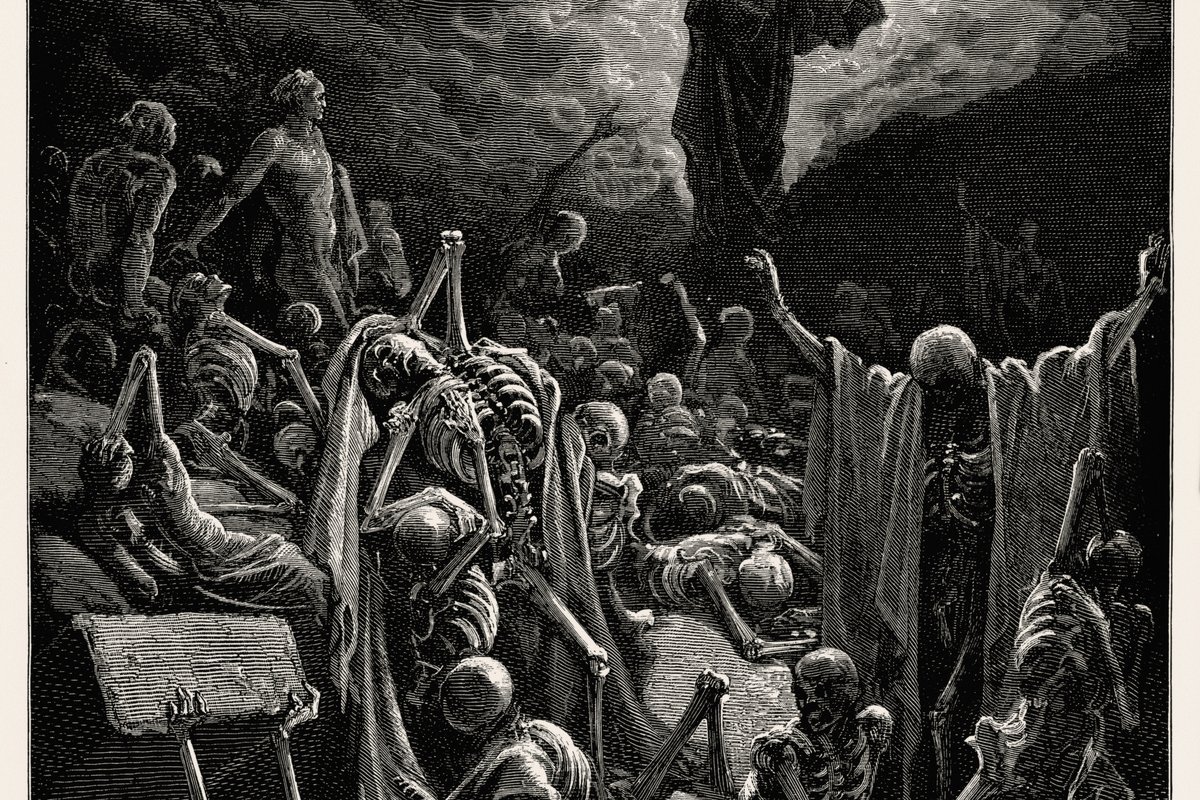
Gustave Doré, "The Vision of the Valley of Dry Bones," 1866, from the Doré Bible — public domain.
Ezekiel's ministry unfolds among the Israelite exiles carried off to Babylon after Jerusalem's fall in the early 6th century BC — a community that had lost its city, its Temple, and, as far as many of them could tell, any reasonable hope of a future. Into that despair comes one of the strangest and most physical visions in the entire prophetic tradition. Ezekiel describes being carried by the Spirit of the Lord and set down in the middle of a valley filled with human bones, scattered and completely dried out — not recent casualties, but the long-dead, bones that had clearly been lying there a very long time. It is one of a handful of dramatic, almost cinematic visions that mark Ezekiel's book as different in style from most other prophetic writing, alongside his earlier vision of a wheel-within-a-wheel chariot-throne and his closing vision of a rebuilt Temple.
God asks him a question that sounds, on its face, almost cruel: can these bones live again? Ezekiel doesn't claim to know. His answer places the possibility entirely in God's hands, and God responds by instructing him to prophesy directly to the bones themselves — to speak God's word over what looks like the most final, irreversible kind of death imaginable.
Bones, sinews, breath
What follows happens in stages, almost like a reversal of decay played backward. As Ezekiel prophesies, the bones begin rattling and coming together, joint to joint. Sinews and flesh and skin form over them, until what had been a valley of scattered bones becomes a field of full bodies — bodies still lying motionless, without breath, without life. Only when Ezekiel prophesies a second time, calling on breath to enter them from the four winds, do the bodies rise up and stand — described as an immense army, restored to full life in front of the prophet's eyes.
It's a vision built for maximum contrast: nothing in the ancient world looked more permanently, irreversibly dead than a valley of sun-bleached bones, and nothing in the vision leaves any doubt that the restoration comes from God's power alone, not from any capacity the bones themselves retained. Ezekiel is given the role of prophesying twice — once to summon the physical rebuilding of the bodies, and a second time to summon the breath that makes them truly alive — and that two-stage structure matters theologically: a body reassembled but not yet breathing is still, in the vision's own terms, a corpse. Life is something added from outside, not a property the bones ever held on their own, which is exactly the point the vision is making about Israel's own hope of restoration.
What the vision meant, in plain terms
Scripture doesn't leave the meaning to guesswork. Within the same chapter, God explains the vision directly to Ezekiel: the bones represent the whole house of Israel, a people who had been saying openly that their hope was lost and they were as good as cut off. The vision answers that despair point for point — God promises to open their graves, bring them back to the land of Israel, and put his own spirit within them, restoring them as a living, unified nation. For an exiled community that had watched its capital burn and its Temple destroyed, this wasn't an abstract theological argument. It was a direct promise that national and spiritual death was not the end of the story.
The same chapter goes on to a second, related image that's less famous but reinforces the point: God tells Ezekiel to take two sticks, write the names of Israel's divided northern and southern kingdoms on them, and join them together in his hand as a sign that the fractured nation will be reunited under one king. Coming immediately after the vision of the bones, this reunification sign makes clear that the restoration being promised is not only about individual survival but about a whole people, long divided and scattered, being brought back together as one.
A vision that outgrew its first audience
Ezekiel's vision was written for exiles in Babylon, but its imagery proved too powerful to stay confined to that one moment in Israel's history. Jewish tradition has long read the valley of dry bones as one of Scripture's clearest anticipations of a future bodily resurrection, and Christian readers, building on the same passage, have found in it an Old Testament foreshadowing of resurrection more broadly — a theme that runs through the whole of Christian hope from Ezekiel's contemporary Isaiah's vision of the heavenly throne through to the New Testament's account of the risen Christ. The passage is read liturgically in some Christian traditions during the Easter season and at funeral rites, precisely because of that resurrection resonance — a reading chosen deliberately for moments when a community needs to hear, again, that God can bring life out of what looks entirely finished.
The vision has also left a lasting mark on religious art, well beyond the well-known Gustave Doré engraving pictured at the top of this article. Medieval and Renaissance illuminators returned to the scene repeatedly, usually choosing to show the moment of transition itself — bones half-covered in flesh, some figures already standing while others remain scattered on the ground — because that in-between moment captures the vision's central drama better than either the beginning or the end alone. Centuries later, the same image resurfaced far from its Babylonian origin, reworked into the African American spiritual "Dem Bones" — proof of how thoroughly this single, strange vision has worked its way into the wider religious imagination, well outside the boundaries of formal theology.
Hope built for the hopeless
What keeps the vision alive across so many centuries isn't its strangeness, though it is genuinely strange. It's the honesty of the question at its center — can these bones live? — asked of something that looked, by every ordinary measure, completely and finally dead. Ezekiel's answer, worked out in front of him bone by bone, sinew by sinew, breath by breath, remains one of Scripture's most direct answers to exactly that kind of despair.
Trivia
Where does the vision of the valley of dry bones appear in the Bible?
What does God ask Ezekiel when he sees the bones?
What happens to the bones in the vision?
What did the vision mean to the people Ezekiel was speaking to?
Has this vision influenced later Christian and Jewish belief?
Related Reading