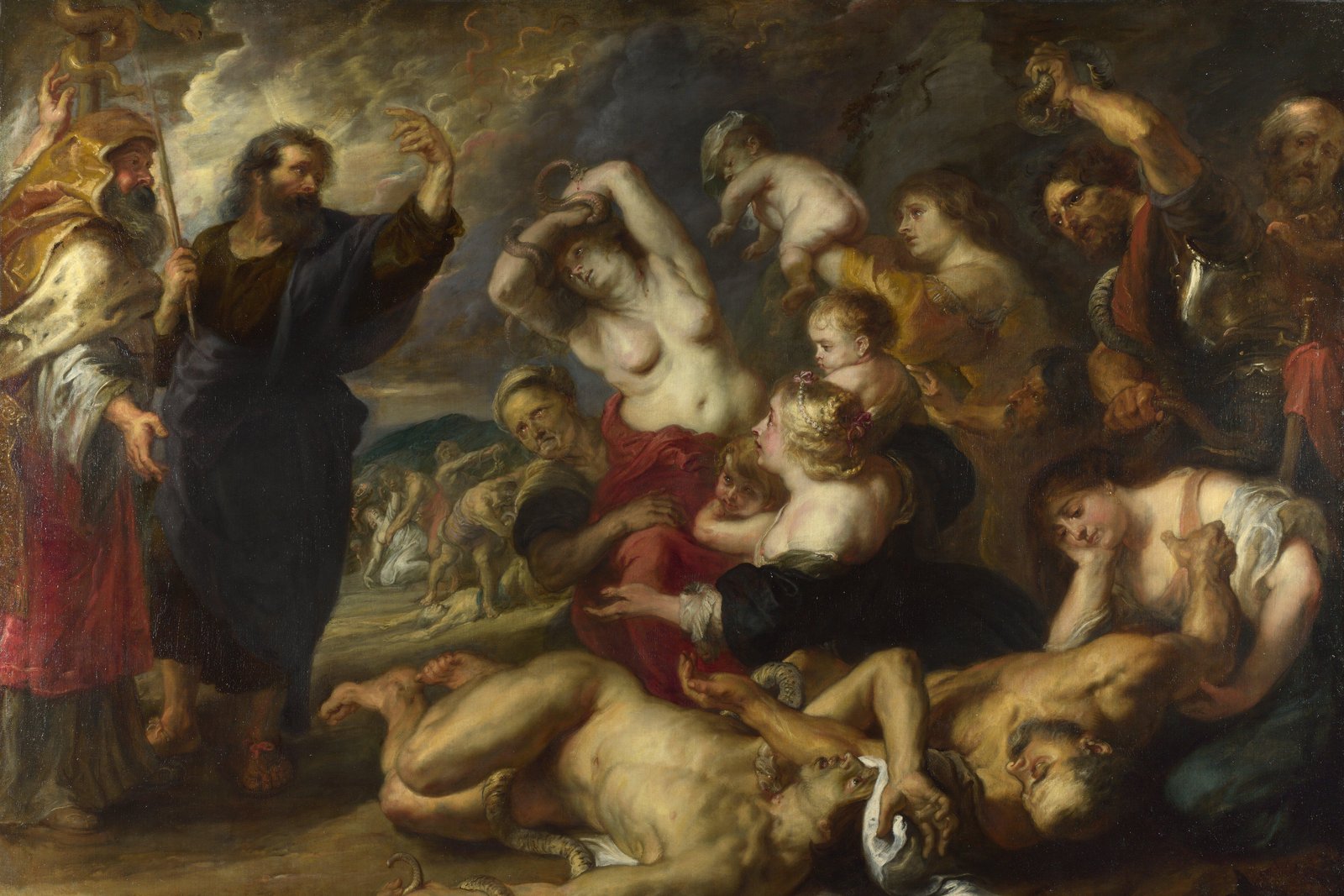
Naaman Healed of Leprosy

A Great Man With an Incurable Problem
Naaman held one of the highest positions in the Syrian kingdom of Aram — commander of the army, "a great man in high favor with his master... a valiant warrior" (2 Kings 5:1). But he had leprosy, a condition no rank could fix. The path to his cure came from the least powerful person in his household: a young Israelite girl, taken captive in a Syrian raid and now serving Naaman's wife, who mentioned that a prophet in Samaria could heal him.
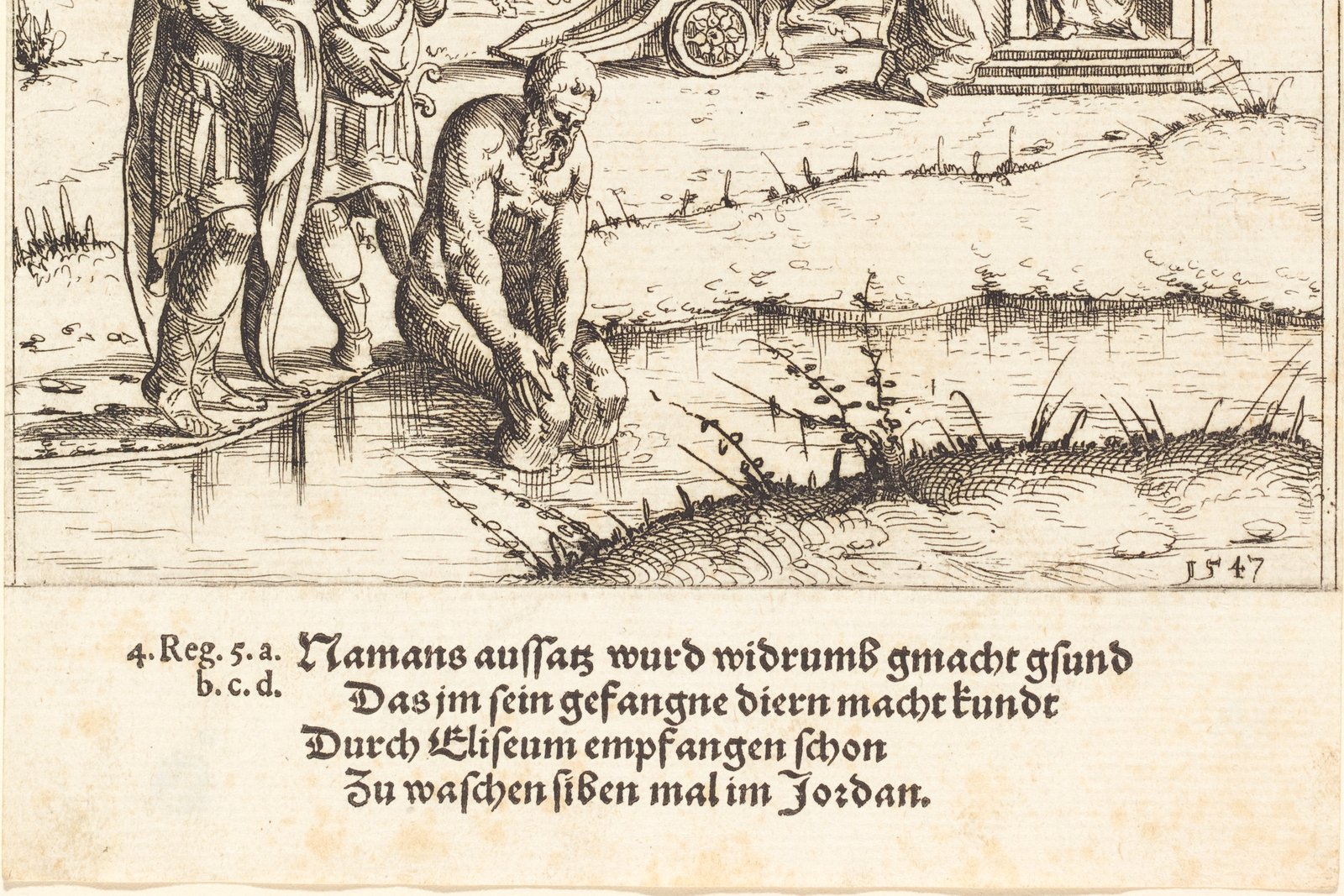
Augustin Hirschvogel, Naaman is Cured of Leprosy, 1547, National Gallery of Art — public domain.
Naaman took the suggestion seriously enough to travel to Israel with a royal letter and an enormous gift — ten talents of silver, six thousand shekels of gold, and ten sets of garments — arriving at the prophet Elisha's house with chariots and horses, the full display of a commander's rank.
An Insulting Simplicity
Elisha did not even come out to greet him. He sent a messenger with instructions stripped of all ceremony: "Go and wash seven times in the Jordan, and your flesh will heal, and you will be clean" (5:10). Naaman's reaction is fury. He had expected drama — a prophet standing over him, invoking God's name, waving a hand over the diseased skin, something matching the seriousness of his condition and status. Instead he got an errand a child could carry out, at a river he considered inferior to the ones back home: "Are not the rivers of Damascus, the Abana and the Pharpar, better than all the waters of Israel? Could I not wash in them and be cleansed?" (5:12). He turned and left in anger, prepared to go home uncured rather than accept an instruction this plain.
Servants Talk Sense Into Him
It is, again, people without rank who save him — this time his own servants, who catch up to him and reason gently but pointedly: "My father, if the prophet told you to do something extraordinary, would you not do it? All the more since he told you, 'Wash, and be clean'" (5:13). The logic lands. If Naaman would have obeyed an elaborate, difficult command without hesitation, why refuse an easy one simply because it wounds his pride?
Naaman goes down to the Jordan and washes seven times, exactly as instructed. "His flesh became again like the flesh of a little child, and he was clean" (5:14). He returns to Elisha, this time humbled, declaring, "Now I know that there is no God in all the earth, except in Israel" (5:15), and offers his gift again — which Elisha, notably, refuses to accept, making clear the healing was never for sale.
Gehazi's Greed Undoes Elisha's Refusal
The story doesn't end with Naaman's grateful departure. Elisha's servant Gehazi, watching his master turn down a fortune in silver and garments, "thought to himself: 'My master was too easy on this Aramean Naaman, not accepting what he brought. As the Lord lives, I will run after him and get something out of him'" (2 Kings 5:20). Gehazi catches up to Naaman's caravan, invents a story about needing supplies for visiting prophets, and comes away with two talents of silver and two changes of clothing — exactly the kind of payment Elisha had refused on principle only hours earlier.
When Gehazi returns and lies about where he has been, Elisha already knows. "Was I not present in spirit when someone got down from his chariot to wait for you? Is this a time to take money or to take garments, olive orchards or vineyards, sheep or cattle, male or female servants?" (5:26). The judgment that follows is severe and immediate: "The leprosy of Naaman shall cling to you and your descendants forever." And Gehazi went out, a leper with skin like snow" (5:27). The disease Naaman was healed of through humble obedience transfers, almost as a direct exchange, onto the servant whose greed corrupted the meaning of that healing.
This coda sharpens the story's central contrast. Naaman, an outsider with every reason for pride, humbles himself and is cleansed; Gehazi, an insider who has watched prophetic power up close his entire career, grasps for profit and is struck with the very affliction he witnessed being cured. Read together, the two halves of the chapter make the same point from opposite directions: it is humility, not status, that determines who receives mercy, and greed, not distance from God, that forfeits it.
Catholic Reading: Obedience Over Spectacle
The story is structured almost entirely around the theme of humility versus expectation. At every turn, the character with less social standing sees more clearly than the one with more: a captive servant girl points the way to healing; ordinary soldiers talk their commander out of his own pride. Naaman's cure comes not from an act of power impressive enough to match his rank, but from a plain, almost embarrassingly simple act of obedience he very nearly refused to perform.
Jesus draws on this story directly in his sermon at Nazareth, pairing it with the widow of Zarephath as evidence that God's mercy in the Old Testament already reached well beyond Israel's own people: "there were many lepers in Israel... yet not one of them was cleansed, but only Naaman the Syrian" (Luke 4:27). Catholic tradition has long read Naaman's healing, together with his baptism-like sevenfold washing in the Jordan, as an Old Testament foreshadowing of the sacrament of Baptism itself — cleansing that comes not through elaborate human effort but through simple, obedient submission to a means God himself designates, however unimpressive it may look from the outside.
Related reading: see Elijah and the Widow of Zarephath for the companion story Jesus cites alongside this one, and The Baptism of Jesus for the fuller theology of water and cleansing this story anticipates.
Trivia
Who was Naaman and what was his condition?
What did Elisha instruct Naaman to do?
Why did Naaman almost refuse to obey?
What convinced him to go through with it?
Did Jesus reference this healing?
Related Reading